 A Ruminating on Remedies reader made themselves known as a dentist who uses homeopathy. I asked if she would be so kind as to write a few words about how homeopathy works in her practice. (I highlighted the remedies mentioned, but other than that, here is her original email.) I started my career as a dentist in the army. I had only ever planned to do a few years in the army and then own a practice eventually. Whilst in the army a couple of my patients were using homeopathy. One of them attended with a swollen face because of an infection around his wisdom tooth. I carried out my standard practice of prescribing Metronidazole antibiotic and chlorhexidine mouthwash then to see him a few days later. He attended for his review stating that he didn't want to take the antibiotics and had instead used homeopathic gunpowder. As his face was still pretty swollen though a lot less red and he was out of pain I was very skeptical.
I was nearing the end of my army career and there was an offer of funding courses to help me reintegrate back into normal society. I thought about the gunpowder, still skeptical but realising that the use of complementary therapies and homeopathy were popular in the wider community and that maybe I should know something about health choices people were making. A dentist friend told me she had just done a course on dental homeopathy so I signed up. Within weeks I was using remedies which were working. The first one being for Acute Necrotising Ulcerative Gingivitis (Trench mouth) which is a horrible infection of the gums with destruction of the tissues, lots of green pus and a very distinctive smell of bacteria and rotting flesh. This is very common in the 18 year old trainees that I was used to looking after and I normally greeted them as they entered the practice with a prescription for Metronidazole and sent straight out again to see the pharmacist. One young soldier turned up with this condition on a Friday so the likeliness of him taking Metronidazole and avoiding alcohol for the weekend was slim. I gave him Merc Sol 30C to take over the weekend then to see him again on the Tuesday. His ulcers had healed almost completely and he had no halitosis. Wow this worked!!! I continued to study homeopathy wanting to know more (and have never stopped learning), bought a practice with my husband in Oxfordshire and now use homeopathy and other complementary therapies alongside my dentistry. Most of the time I use simple prescriptions for acute conditions such as Traumeel for taking teeth out or hygiene. Other times I can use homeopathy to support deeper problems and sometimes even improve the experience of conditions that conventional medicine struggles to help with such as burning mouth syndrome or facial pain. These conditions often cannot be cured but homeopathy can at least help make my patients comfortable even if it is just from being taken seriously. Wishing you all the best Samantha -- Dr Samantha Jugdev BSc(Hons), BDS(Brist), PGCME, FFHom(Dent) www.thirtythreedental.co.uk If you are in England and looking for a homeopathic-friendly dentist, this sounds like a good place to start! Thank you, Samantha! Julia Coyte, CHom Classically Practical homeopath #wellnessawaits
0 Comments
 I suppose I should be more specific… some dentists are on it!
A few years ago, I was having a pretty good-sized dental procedure and I was a little worked up about it. My dentist at the time (she sold her practice😩) offered Reiki* during the procedure. I had never experienced Reiki before, but I went for it. I have to say that it was nothing short of amazing. I returned home and my husband thought I had been drugged in some way… that’s how relaxed and unbothered I was from this procedure with the adjunct of Reiki. Fast forward to this year and my husband needed a couple of big dental procedures. The first dentist, a couple of months ago, included Arnica in his after-care instructions (as well as some good, sound nutrition advice). This week, another procedure (and a different dentist). I picked up the box of the mouth rinse to see what horrors he had been given and… the active ingredients were all homeopathic! 🎉 Turns out this company** makes a few dental products and they all appear to be homeopathic… and, all made in the USA, too! So, what’s in this oral rinse? I have never heard of the first remedy listed: Azadirachta indica, but, a quick look in my Radar Opus software tells us it is Margosa Bark, or, Neem. I know Neem for its valuableness in dealing with bug bites but apperently it’s good for teeth, too. The twigs can even be chewed on to improve dental hygiene. Homeopathically, Azadirachta indica would be indicated when there is a bitter or putrid taste in the mouth, a burning tongue and salty saliva. I am starting to see how this could be very helpful following big dental procedures. I have written about the benefits of Calendula and dentistry previously (see: The Eiffel Tower in My Mouth; A Calendula Quickie… for inner bites (and bites!); Brace Face.) Calendula and wound healing go hand in hand. Echinacea purpurea is often included in tooth and gum tonics due to its antimicrobial properties. It has a “well merited reputation” for suppurative conditions and helps with pain (Dewey 2003). Plantago major has been used in its herbal form for pretty much ever. The Herbal of Dodoens from 1558 suggests the juice of the leaves or roots of Plantago for toothache and bleeding gums. (That’s a pretty long documented history of use!) Dr. Robin Murphy lists it in his repertory for toothaches, sensitive teeth and for dry sockets. I am so excited to see these marvelous homeopathic remedies moving into the mainstream. None of the dentists mentioned are “holistic” or alternative practitioners. All these patients are being introduced to homeopathy without even knowing it. I just hope that some (all!) of them take a peek at the ingredient list (or, even the little “homeopathic” word printed on the top of the packaging) and make the connection and have their curiosity stirred up a little bit. 🤞 I can’t wait until the day that homeopathy comes into its own. It’s going to be so exciting!! Thank you to those mainstream dentists out there doing the early leg work of sharing homeopathy! Julia Coyte, CHom Classically Practical homeopath #wellnessawaits * “Reiki is a Japanese technique for stress reduction and relaxation that also promotes healing.… The word Reiki is made of two Japanese words — Rei which means ‘God’s Wisdom or the Higher Power’ and Ki which is ‘life force energy.’… A treatment feels like a wonderful glowing radiance that flows through and around you.” Something wonderful was clearly flowing through me after that treatment! ** I have no affiliation with this company. Reference list Dewey, W. A., 2003. Practical Homoeopathic Therapeutics. accessed through Radar Opus software. B Jain Pub Pvt Limited. Murphy, R., n.d. Homeopathic Remedy Guide. accessed through Radar Opus. 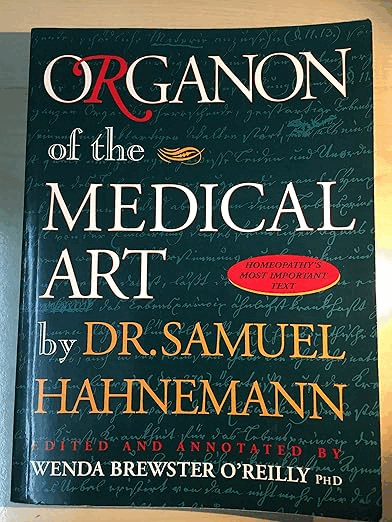 270 years ago tomorrow, Samuel Hahnemann was born. I, for one, am very thankful that he was born on April 10th, 1755. Without Dr. Hahnemann, homeopathy as we know it, just wouldn’t be. I will skip over his early years (there is plenty of information on line about him: here, here and here and here and here to get you started) and pick up in 1784, where he is 29 years old, an on again/off again allopathic physician and not a fan of bloodletting. He begins “attacking the medical practices of his time…attracting notoriety, ridicule and rejection by his colleagues” (De Schepper 2001). However, he had nothing else yet to offer in ways of healing. As an author, a chemist and as he was more than proficient in Latin and Greek, he would translate earlier works for payment. It was during one of these translations (Cullen’s Materia Medica) where he had an aha moment in regard Cinchona bark (a.k.a. China officianalis). It was with this substance he began to experiment on himself and found China could create “the same symptoms it would cure in the sick person” leading to the foundation of homeopathy: Similia Similibus Curentur or, Like is Cured by Like. Like cures like = a substance that can produce symptoms in a healthy individual can also relieve similar symptoms in someone with a disease. Not surprisingly, the current medical establishment of the time did not much care for his newfangled ideas. Fast forward to 1810 when Dr. Hahnemann published his first edition of Organon of the Healing Art. Following both ostracisms as well as some public successes (treating typhus, and scarlet fever, and cholera, to name just a few), Dr. Hahnemann continued to write and to “prove” remedies and to hone his craft. It is this Organon where I want to focus my thoughts today. To my knowledge, all students of classical homeopathy are required to read this fascinating treatise. The final edition, the 6th, (the most frequently taught), is the “most complete and best method,” and was published after his death in 1843. Organon, from Greek, “an instrument of thought, especially a means of reasoning or a system of logic” (Soanes and Angus Stevenson 2006). Step by step, aphorism* by aphorism, Dr. Hahnemann walks us through his remarkable system of medicine. A how-to manual of homeopathy, really. (*An aphorism (denoted by §), OED tells us, is “a pithy observation which contains a general truth.”) Before we get to the good stuff in the book, the aphorisms, we learn about previous methods of medicine, as well as Dr. Hahnemann’s views on disease: where they come from and what they are and why the “old school” or the “allopathic” method is flawed in its way of thinking. He then begins with Part 1, the Principles of Cure, including his first 71 aphorisms. With that, I have pulled out a few of my favorite aphorisms and plugged them in among the overview of the Organon. (I have many more than 12 favorites, but here are the most generally relevant to non-homeopaths of my favorites:) § 1 The physician’s highest and only calling is to make the sick healthy, to cure, as it is called. § 2 The highest ideal of cure is the rapid, gentle and permanent restoration of health… § 9 In health, the life force keeps all parts of the organism in harmony. § 11 In disease, the life force is first dynamically mistuned and then manifests its mistunement through symptoms. § 12 The manifestations of a disease reveal the whole disease, and their disappearance indicates complete recovery. § 18 The totality of symptoms and circumstances in each individual case of disease must be the sole indicator in choosing a remedy. § 21 A medicine’s power to cure is revealed in the symptoms it engenders in healthy people. These symptoms reveal the medicine’s particular disease-engendering power which is the same as its disease-curing power. Part II. Understanding Diseases §72-81 Dr. Hahnemann defines acute and chronic diseases in aphorisms 72-81. Part III. Taking the Case §82-104 § 82 Careful investigation of the case is needed for individualized treatment of disease. Part IV. Acquiring a Knowledge of Medicines §105-145 § 127 Provers must be both male and female. (I have to say that I love that he figured out that men and women respond differently to remedies and medicines and other substances sooooo long ago!) Part V. Homeopathic Treatment of Diseases §146-203 § 148 Natural diseases are dynamically engendered by potencies that mistune the life force. Medicines cure by dynamically overtuning the life force with a similar but stronger artificial disease. § 153 Strange, rare and peculiar symptoms are the most important in the search for a homeopathic remedy. Part VI. The Chronic Miasms §204-209 Dr. Hahnemann describes the chronic miasms in aphorisms 204-209. Part VII. Mental and Emotional Diseases §210-230 20 aphorisms describing mental and emotional diseases. (Spoiler alert: they are treated the same way as other diseases (§214)). Part VIII. Intermittent Diseases §231-244 13 aphorisms discussing how to treat diseases that recur at definite and indefinite intervals. Part IX. Case Management §245-263 § 261. The best regimen for chronic disease includes innocent diversions, exercise in the fresh air and a good diet, in addition to removing obstacles to cure. (He was so on it and so ahead of his time!) Part X. Preparation of Medicines §264-271 8 aphorisms to ensure the quality of the remedies. Part XI. Administration of Medicines §272-285 This is where the classical homeopaths and the practical/clinical homeopaths split in terms of the Organon: §273 Administer only one single, simple medicine at a time and §274 Do not use complex means when simple ones will suffice; The actions of two or more medicines given together have not been determined… (You can see some of my further thoughts on this matter here.) Part XII. Other Therapeutic Approaches §286-291 Here he talks about magnets, electricity and galvanism (therapeutic use of electric currents), Mesmerism (hypnotism) and warm and cold baths. He was a pretty clever fellow. Julia Coyte, CHom Classically Practical homeopath #wellnessawaits REFERENCES
De Schepper, L., 2001. Hahnemann Revisited. Santa Fe, NM: Full of Life Publications. Lifeforce Homeopathy, 2025. Dr. Samuel Hahneman, MD, Founder of Homeopathy. Life Force Homeopathy Clinic Hahnemann, S., 2001. Organon of the medical art. Palo Alto, Ca: Birdcage Books. Homeopathy UK, 2022. Samuel Hahnemann & the beginnings of homeopathy [online]. MEDICOSAGE, 2021. BIOGRAPHY OF DR. HAHNEMANN - Organon Of Medicine & Philosophy [online]. Medicosage. Patil, B. K. and Gandhi, M. A., 2024. The Life and Legacy of Samuel Hahnemann: Founder of Homoeopathy and His Medical Philosophy. Cureus [online]. Soanes, C. and Angus Stevenson, 2006. Oxford dictionary of English. Accessed through Oxford Dictionary of English, 2nd edition software. Oxford ; New York: Oxford University Press. The Editors of Encyclopaedia Britannica, 2019. Samuel Hahnemann | German physician | Britannica. Encyclopædia Britannica [online]. De Schepper, L., 2001. Hahnemann Revisited. Santa Fe, NM: Full of Life Publications. Hahnemann, S., 2001. Organon of the medical art. Palo Alto, Ca: Birdcage Books. Edited and annotated by WENDA BREWSTER O’REILLY, PH.D. (“The sixth edition of Dr. Samuel Hahnemann’s work of genius based on a translation by Steven Decker”) Soanes, C. and Angus Stevenson, 2006. Oxford dictionary of English. Accessed through Oxford Dictionary of English, 2nd edition software. Oxford ; New York: Oxford University Press. |
Julia Coyte, CHomI am passionate about homeopathy and I love sharing this passion. Having a working knowledge of homeopathy shouldn't be kept a secret. If people have the ability to help themselves, their children and their friends when they have minor ailments, life just gets better for everyone. That is the purpose behind Ruminating on Remedies. Archives
October 2026
Categories
All
|
 RSS Feed