 OHM is an excellent homeopathic pharmacy located in Texas. They make a nice little kit aimed at pain management. Unfortunately, OHM doesn’t sell to the general public; but, that doesn’t stop you from creating your own little kit based on their suggested remedies.
Let’s see why these 11 remedies are included in this select little kit and why you may want to consider having some handy. Note: this is a quick list to get you started — it is far from complete. Aconite 200c
Arnica 30 & 200
Bryonia 30c
Calc phos 6c
Calendula 30c
Chamomila 30c
Hypericum 30c
Phosphorus 30c
Rhus tox 30c
Ruta 30c
Symphytum 30c
This kit suggests using the appropriate remedy every 15 minutes in acute situations. Reduce frequency repetition upon improvement. I have a number of longer homeopathic pain remedy articles still in the works. Sit tight! Julia Coyte, CHom Classically Practical homeopath #wellnessawaits
0 Comments
I misjudged how much time I actually have had in the last couple of weeks, so here's a little pain teaser to tide you over…
With that, here is a very quick rundown of go-to pain remedies as suggested in the latest arrival to my bookshelf… Weiner’s Pain Management: A Practical Guide for Clinicians (Boswell and Cole 2007). I purchased this hefty tome (coming in over 1600 pages) to learn better how mainstream medicine approaches treating pain: diagnostic criteria, pathophysiology and methods of treatment; associated factors; causations, etc. I was, needless to say, very happy to see a chapter on Homeopathy! Dana Ullman is a co-author of this section with a short overview of homeopathy (remember, this book is aimed at mainstream physicians), followed by brief entries on common painful conditions, each accompanied by relevant research for the homeopathic remedies. Then, they have a short list of “Commonly Used Homeopathic Medicines for Painful Conditions”:
Sit tight for the longer, more in-depth pain articles which are currently in the works. I am not going to get them all posted before the end of the year - my apologies for that. Wishing you a pleasant and pain free end of 2025! Julia Coyte, CHom Classically Practical homeopath #wellnessawaits Boswell, M. V. and Cole, B. E., eds. 2007. Weiner’s pain management : a practical guide for clinicians. New York: Informa Healthcare.  Do you ever watch a movie or read a book and think, that character needs XXX remedy? I do! I love reading novels. It is without question one of my favorite things to do. I just finished an enjoyable book, My Friends: A Novel by Fredrick Backman. (He wrote another book I liked: A Man Called Ove. In my opinion, read the book, skip the movie.) One line from My Friends keeps playing in my head: “Getting stabbed with a knife is a trauma for the whole body, his leg was probably the part that healed quickest, it was other parts of Ted that were limping” (p 430). This quote so beautifully relates to homeopathy. One thing happens and we generally think only of the tip of the iceberg effects. We assume (incorrectly) that, as in this case, a stab wound affects only the leg, right where it happened. But that is so not true. That wound reverberates throughout the entire system: mind, body and soul… and may linger long after the actual wound is “healed.” I have listened to a lot of lectures* by Dr. Robin Murphy. (I highly recommend doing so yourself if you have anything more than a passing interest in homeopathy.) I was reminded the other day of Dr. Murphy’s thoughts on first aid prescribing while reading a blog post from Lisa Strbac, talking about Ian Watson quoting the great late Robin Murphy from “What Heals Podcast”: The highest form of homeopathy is first aid prescribing. You homeopaths… you think it’s all this fancy miasm stuff and chronic stuff and constitutional? It’s not its first aid [sic]. Almost every chronic case, if you take it back, where did it start? It started as a shock, with a grief, an accident, with a medical procedure that went wrong. It started as a first aid situation and if that had been properly treated in the moment, someone had a home ready kit and they know what to do, this whole chain of health problems would never have needed to happen. Today, I’m going to have a little fun and see how we can address “Ted’s” stab wound. (For this exercise, I will be focusing only on highly indicated remedies for this type of wound, though, in real life, I would look at all possible remedies. It’s important to note that there is also crossover between these remedies and symptoms. For instance, “anger” is a 4 for Staphysagria and a 2 for Ledum and Apis - therefore the rubric only shows up in my list under Staphysagria.) Homeopathically, there are a few big remedies to consider. Note: these would be the same remedies which would be useful in the moment, at the time of the stab wound. I have the added benefit of a little insight into Ted after reading this book and will supply relevant quotes when available. (If a symptom shows up in multiple remedies, I will only put the quote in the first instance, unless there are multiple quotes which fit the bill.) Other symptoms I will include simply from the general sense of the character from the book. It’s a little like taking a homeopathic case! Of course, there is so much more to this than I am writing here. People, even fictional characters, are highly nuanced. I have over-simplified this entire process tremendously… but I had fun doing it! We’re not entirely certain when this stabbing occurred, except we know he was an adult. Did Ted’s history play a part in the ramifications? Probably. All the background of a person will then lead to how a person reacts when such a trauma occurs… miasms, genetics, epi-genetics, environment, experience… it’s all in there in each of us. Looking up “stab” in Dr. Murphy’s Meta Repertory (found in Similia software**), five remedies show up as highly indicated (but I only included 4 of them): Apis, Calendula, Hypericum and Ledum. Those familiar with homeopathic remedies might be saying, “But what about Staphysagria?” Good question. keep reading to find out what I learned about this. For this exercise, I focused primarily on the big 3 or 4 point symptoms in MIND and GENERAL and a quick scan through other highly indicated rubrics from things I remembered from the book. In alphabetical order: APIS From Murphy’s Materia Medica, causations (among others): Grief. Fright. Rage. MIND:
CALENDULA is another good remedy for wounds, but unfortunately, it has not been proven very well (in the traditional sense) but let’s see what we can find. Because of the dearth of level 3/4 rubrics, I opened this MIND search up to levels 1 & 2, as well. (Colin Griffith does have more information on Calendula in his “New Materia Medica Vol. 3,” but that’s a whole other topic which I will (happily!) get to one day soon.) From Murphy’s causations: Cuts. Punctures. Stabs. Surgery. Wounds. MIND:
Interestingly, those who may benefit from Calendula may be ameliorated by walking. HYPERICUM From Murphy’s materia medica: “It is called for in nervous depression following wounds, effects of shock and fright… Pain in old scars.” From Murphy’s causations (among others): ill effects of fright… punctures, lacerations… wounds, stab wounds Note: Hypericum has only one 3/4 level rubric under the MIND section in Murphy, so I added lower level rubrics for this one, too. MIND:
LEDUM From Murphy’s materia medica: “Ledum is for punctured wounds, produced by sharp-pointed instruments or bites, particularly if the wounded parts are cold, this is the remedy… Causations: ill effects punctured wounds, recent or chronic injuries.” MIND:
STAPHYSAGRIA
Has a reputation for “clean” wounds, not jagged, just as a knife would create. Dr. N.M. Choudury, senior professor of Materia Medica at Bengal Allen Homeopathic Medical College and Hospital in Kolkota, says: “We use it both internally and externally for injuries caused by sharp cutting instruments such as knife, glass, etc.” Why it’s not this clear in the repertories, I have no idea. I asked Viva (homeopathic) AI*** why Staphysagria doesn’t show up in the “stab wounds” rubric and it says, “Staphysagria is more commonly associated with emotional trauma and conditions resulting from surgical procedures rather than purely physical injuries like stab wounds. While Staphysagria can be useful for wounds, it is particularly indicated when there is a history of emotional trauma (which Ted has in spades) or when the injury is associated with feelings of anger, resentment, or violation.) To find appropriate rubrics for Staphysagria and knife wounds, one needs to search a little differently for that:
From Murphy’s materia medica: “Surgery. Lacerated tissues.” Causations: “Ill effects of anger and insults, anger suppressed or reserved. Humiliation.” MIND:
Julia Coyte, CHom Classically Practical homeopath #wellnessawaits * It looks like the Lotus Health Institute† may be moving some of their goodies around — I see a podcast and putting his lectures up for online listening. ** Similia has been kind enough to open up the full use of their software for me to play around with in exchange for any feedback I may have for them. Other than that, I have no affiliation with this company, either. *** Staphysagria info from Viva ai† cites the following: “These sources collectively contribute to the understanding of how remedies are classified and used in homeopathy, including the rationale behind the presence or absence of specific remedies in particular rubrics.” The sources cited are: Hahnemann’s Organon of Medicine; Materia Medica Pura; Andrew Lockie’s The Complete Homeopathy Handbook; Boericke’s Homeopathic Materia Medica; Clinical experience; Homeopathic repertories such as Synthesis or Kent’s Repertory “categorize remedies based on symptoms and modalities, providing insight into why certain remedies appear in specific rubrics while others do not.” † I have no affiliation with this or any other company.  “Wellness Box” image created by AI, with my help. Everything else was done by lil’ old me. Do you have a homeopathy kit yet?
If not, why not? It doesn’t take anything fancy. Any old box or bag will do. You could purchase a kit, ready to go. (See here and here for some ideas.) Or, you could make your own kit by purchasing remedies as you need them. Start with one. Add another couple and put a rubber band around them to keep them together. Add a few more and put them in a little ziplock bag. Add a few more and put them in a shoebox. Once you have them, you are then good to go. As long as you keep them safe and together, then you have your kit. I could give you a list of suggested remedies. Would that help? (Almost all of these Ruminating on Remedies articles are written with common, easily sourced remedies in mind. Read through and find a few remedies that might serve you and your family well. It’s actually one of the hardest things to do — narrowing down to just 10, but here goes! Top 10 — in no particular order: 1. Arnica
Two people have independently spoken to me about their homeopathic kits in the last two weeks. The first one purchased a Narayani kit and there is no other way to say it — she is over the moon with it. (She didn’t purchase the little one mentioned in the link above, she went for the whole kit and kaboodle!) The second person, just this morning told me how much she loved her little kit of 50 remedies. She said she wants to carry it around with her everywhere. The other day her son was feeling a little off — Nux took care of that. She slammed her finger tip in a drawer and Arnica and Hypericum took care of that. Done. Easy. Return the remedies to where they belong and your kit is once more ready to go for the next thing that comes along. What are you waiting for?!? Julia Coyte, CHom Classically Practical homeopath #wellnessawaits  You can't see them in the photo, but trust me… they're there! So there I was, basking in the purity of the White Sands. The day before was unbearably hot… all… day… long. I mean seriously hot. In fact, we were supposed to visit White Sands yesterday afternoon but the thought of said dunes in that heat was too much. We opted for an early morning visit the next day instead. Excellent choice! The sand, (well, the gypsum,) felt amazingly cool as we climbed the first dune. I left the rest of the hiking of the dunes to the more intrepid among us and I wallowed in the marvel that is this amazing place. I was lying on my back, hat over my face, loving every second of this and contemplating making a sand angel cuz it felt like the appropriate thing to do. My arms were stretched out to either side, just about ready to go and, “Ow!” I frantically brushed at my arm and as I looked to see what got me, a little red head was still attached to my bicep. How could something so awful be hanging out in such a pure and marvelous landscape? To be fair, shortly after arriving on the top of the dune, I looked down and saw a red ant. Then I saw many more red ants. I knew they were there and I should have paid heed. Alas. Live and learn. Back to the red menace… I leapt up and got down the dune incredibly quickly. (Bounding down the dune was so much fun — if you go, forget the sled! They sell you a sled at the ranger station and then they buy it back from you for less than you paid. Sometimes you can find a perfectly good sled in the garbage, FYI.) I dug out my kit of 100 miniature vials of homeopathic remedies that always travels with me and immediately went for the Apis. I did a couple doses of Apis but the thing was still incredibly painful. I then switched to Ledum. Still really not any improvement. Then, I looked at the bite and saw a large welt developing, coupled with the intensely painful itching… Staphysagria. That one brought some relief, both to my arm and to my mood. I then alternated between Staphysagria and Apis every few hours for the rest of the day. This was on a Sunday. By Tuesday, it felt like it was getting worse. It was hot. It was itchy. It hurt. It felt like it was getting much bigger. Infection setting in? I moved to Hyper/Ars: Hypericum mixed with Arsenicum album. This, too, was helpful. It contained the spread and it shrunk in size just a little bit, but then it began to spread again. I tried a little Plantain ointment. That certainly didn’t hurt, but it wasn’t the answer. By Wednesday morning, I had decided to try a completely different route and I dug out my little canister of PRID Drawing Salve*. PRID Drawing Salve has been around for over 50 years, and, as the package says, it is a “pain relief & irritant drawing salve” for splinters, thorns, ingrown hairs, insect bites, boils, minor cuts and scrapes. My one little bite was pretty big by now so I dabbed the sticky brown stuff on my arm and had to use 2 bandages to keep it from getting on everything. What’s in it? As I mentioned above, this stuff is sticky. Among its ingredients: beeswax and wood rosin (the internet tells me this is a natural resin from the sap of pine trees.) Homeopathically speaking, PRID contains low X potencies of Arnica, Calendula, Echinacea, Hepar sulph, Ichthammol, Silicea and Sulphur -- all excellent choices for infection. I have written previously about Arnica, Calendula, Echinacea, Hepar sulph, Silicea and Sulphur. (You can search for articles on these remedies on Ruminating on Remedies.) While digging a little deeper into Echinacea, I have learned some interesting things from herbalist Matthew Wood (I highly recommend picking up Wood's Earthwise Herbal books). (Note: I accessed this through Radar Opus software and I don't see which of his many books correlates to this title.) The Indians of the Great Plains used the western purple coneflower, Echinacea, "to treat snake bites, insect bites, septicemia and various kinds of poisonings" (Wood). Dr. Robin Murphy notes that homeopathic Echinacea is a great remedy "when boils progress to the stage where they appear about to point then stop and do not suppurate. Echinacea helps in carbuncles with similar symptoms, a bluish-red color and intense pain" (Murphy n.d.). (I have to say, this sounds a little like where it felt my ant bite was going.) Ichthammol (or, Ichthyolum), however, is a new remedy for me. Dr. Robin Murphy tells us this is an “unproved” remedy**, (made from shale oil), which comes to us from old-school therapeutics as an external application which has been used for psoriasis, eczematous dermatitis, leg ulcers, seborrheic dermatitis and furuncles (Boyd 2010). Like Echinacea, Ichthammol is said to be a powerful anti-septic. When I removed those first 2 bandages a couple hours later, the swelling and redness had shrunk considerably. I did feel the need to apply the PRID two more times and then that was the end of that. I am now a day shy of 2 weeks from the day of this bite and I have no pain, but I do have a residual reddish mark. The other day I could see and feel 4 little white bumps so I think I suffered more than 1 nibble. The downside of using a combination remedy is that it is impossible to know which remedy worked. Having said that, who cares? I am interested in positive results -- it really doesn't matter to me how I get there. Might it be more elegant to take a single dose of the appropriate homeopathic remedy. Sure! In this case, might the drawing part of this salve have played a role? Could be. Julia Coyte, CHom Classically Practical homeopath #wellnessawaits * I have no affiliation with this company or this person (or, any other, actually). ** Ichthammol is listed in Bradford’s Index of Homeopathic Provings (1898), so 🤷♀️. References:
Boyd, A. S., 2010. Ichthammol revisited. International Journal of Dermatology [online], 49 (7), 757–760. Murphy, R., n.d. Homeopathic Remedy Guide. accessed through Radar Opus software. National Park Service, 2022. White Sands National Park (U.S. National Park Service) [online]. www.nps.gov.  So I was just driving home from the grocery store and a song came on that I like to whistle along. I couldn’t whistle. I mean, at all. It was weird. I then tried to sing along instead and my voice was all gravelly. I was having a very challenging musical moment!
I called my son, who is a whistling aficionado and asked if his whistler ever just stops working. His response: “You gotta lick the lips, dude.” I had licked my lips already. It wouldn’t work. At all. I told him it was like my lower lip and/or jaw was stuck. It was kind of uncomfortable, actually. I got home, put away the groceries and thought that my lower lip and chin felt like I had had dental work - like numbing that was wearing off. So, I tried some Hypericum. Nothing. Then I sat down at my computer and I saw the new flavor of kombucha that I was drinking. One of the ingredients is yuzu. I’ve never knowingly had yuzu before so I looked it up. Stylecraze.com (no idea what it is, but it was one of the first things that popped up) tells me that it’s rare, but that yuzu may cause allergic reactions and other symptoms like… (first thing listed) itchy lips, tongue and throat. That changed my choice of remedy. I went to the kitchen and grabbed my handy dandy tube of Apis that sits ready on the counter for any allergic reactions to bees (which has been known to happen in my house). It has been about 10 minutes. I’m drinking lots of water. The tingling is disappearing. My whistler is returning. Phew! Who knew?!? Julia Coyte, CHom Classically Practical homeopath #wellnessawaits 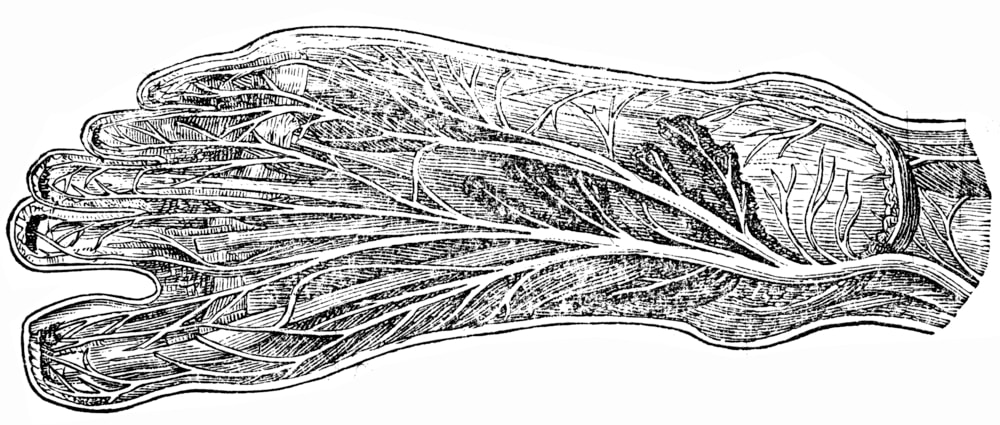 “'Nerves of the foot” an illustration from the encyclopedia publishers Education, St. Petersburg, Russian Empire 1896." I used to love riding horses. Sometimes I think about maybe doing it again one day, but I haven’t done anything about that. (I think I’m OK with that. I think. We’ll see. I digress…)
Once upon a time I was out for a little horse ride on a dirt road. My husband showed up in the car with his sister and her young children. One of them loved loved loved horses and jumped out of the [stopped] car and ran up to pet the horse in her bare feet. The horse stomped on her little foot! Needless to say, the tears came and they hopped (literally) right back in the car and headed to urgent care for an X-ray. Fast forward to this week and a homeopath friend texted… wondering if I had any remedy suggestions to add for her niece who just had her foot stepped on badly by a horse. They were already on the Arnica and Aconite and the other usual trauma remedies but she wanted to make sure she wasn’t overlooking some potentially useful remedy. (See "Remedies to consider following a major accident" for more ideas.) I immediately thought of Hypericum perforatum. Back in the early days of learning homeopathy, I was taught Hypericum is one of the first remedies to consider for a crushing injury and I figured a horse stomp to the foot has to qualify for that description. The average weight of an adult horse is between 900 to 2,200 pounds (Johnston 2023) and when they decide to stomp, that has to be some serious weight/pressure in a concentrated area. In particular, Hypericum is noted (bold and underlined) for crushed nail injuries. Why? Because there are a lot of nerves in the tips of fingers and toes. You see, Hypericum is known as “the Arnica of the nerves” meaning it's the go-to remedy for any injuries of nerve-rich areas. In addition to all those 26 bones in the foot, there are a lot of nerve endings in the feet, in general, not just in the tips of the toes. A quick look at the internet tells me there are many thousands of nerve endings in the feet. That makes sense… how many people do you know who don’t have ticklish feet? All these foot nerves play an important role in sending information to the brain about the world around us — assisting us in balance and controlling the muscles in the feet and detecting hot and cold, to name just a few. Sore feet can radiate up your legs and into your back and up to your neck. Or, conversely, foot pain can be caused higher up and radiate down and end up in the feet. (The all too painful sciatic nerve goes all the way from your buttocks down through the back of your thigh and into your foot. Sometimes this sciatic pain can be confused with plantar fasciitis.) Where else other than a foot stomp might Hypericum be useful?
What is it with homeopaths and their nieces getting their feet stomped on by horses? 🧐 I’m happy to report that neither horse stomp resulted in any broken bones. I wish I had known about Hypericum for my young niece all those years ago. Alas. Julia Coyte, CHom Classically Practical homeopath #wellnessawaits  Tis the Season for… Burns?! Yes. You catch that holiday spirit and suddenly you’re a baking fool and… that’s the way that went. Are you frantically baking these days? I’m not. I want to be, but traveling was on the front burner this week. (Sorry, couldn’t resist the bad joke.) And, since we have no big at-home festivities planned, I decided to be honest with myself and acknowledge that if I were to start baking now, I would only just eat them all myself. Alas. All my cookie recipes will have to wait til next year. OK, maybe I’ll have to make just one*. Baking. Cooking. Roasting. Heck, even a quick little zap from some old Christmas lights or stomping on an ember that shot out of the fireplace. Hazards of the festive season, I guess. If you are interested in a good fire glove, these have been a really impressive addition to our fireplace.** Juggling all the pots on the stove while fishing the baked goods out of the oven and, boom, there it is… A nasty burn, generally on the hands or wrists in my experience. I’m talking about little burns today. If you get a big, deep burn, be sure to pay a visit to your nearest emergency room. For previous blogs on burns, see: Kitchen Quickie: Burns and Summer Fun 1. According to The Survival Medicine Handbook (Alton and Alton 2016), first degree burns will appear red, warm and dry and be painful to the touch. The conventional treatment is to simply relieve the discomfort. (Second degree burns are moist with blisters and will cause swelling.) So, in addition to the conventional application of a cool cloth, here are a few homeopathic remedies which may help, especially if the remedy is incorporated into the cool cloth. Homeopathic remedies that come to mind for 1st degree burns… For all of these suggestions, repeat the remedy whenever the pain returns. Urtica urens for stinging, burning pains. Burns with itching. Calendula for burns that hurt more than they "should." Richard Hughes, a homeopath from the late 1800s, refers to Calendula as a remedy for "breaches of surface" -- an apt description for a superficial burn. Calendula cream can be applied directly on the minor burn, or, around the edges of the burn if it's too tender. For an interesting study on Calendula and burns, click here. Causticum for burns with a sensation of rawness. Causticum is a good one to turn to if the other well chosen remedies aren’t quite doing the job, or, the burn is slow to heal. It is also useful to help heal up old burn wounds and scars. Hypericum would be especially useful in cases of burns to nerve rich areas like the fingertips. May have a tingling or numb feeling. Cantharis is an excellent choice for really painful burns -- a cutting, smarting pain. Cantharis is said to help prevent blistering from burns. All of these remedies can also be applied topically, as well as taken internally. First Aid with Homeopathy (Ratera 2016) says to dissolve a couple pellets (whatever your tube recommends as a dose) in some saline (e.g. 2 pellets in 200 ml of saline) and to always keep the dressing moist. Another option is to put a few pellets of your chosen remedy into a fresh bottle of clean water. As the pain returns, take a spoonful of the water in your mouth as well as applying some gauze soaked in that remedy water directly to the affected area. How about when you just can’t wait another moment for one of those cookies and you pop it into your mouth before it’s cooled? A dose of Cantharis, Calendula or Causticum would be where I would start. If you decide to try your hand at a figgy pudding and suffer a burn from hot steam, in addition to the remedies listed above, Apis or Kali bich might be useful. If the hot toddy spills on you (or, more likely, the boiling water for the potatoes spills on you) resulting in a superficial burn, Dr. Ratera recommends Causticum. Wishing you and yours a very Merry (and burn free!) Christmas! Julia Coyte, CHom Classically Practical homeopath #wellnessawaits * The cookies I have just now decided to make this year are Brown Sugar and Nutmeg Snaps, a recipe I found in Bon Appetit way back in 1994. (Note: the dough needs to chill for 1 hour.) 1-1/4 cups packed light brown sugar 1/2 cup unsalted butter 1 large egg 1-3/4 cups all purpose flour (Jules gluten free flour** is a terrific substitute) 1 tsp ground nutmeg 1 tsp baking soda 1/2 teaspoon salt Sugar -- Using an electric mixer, beat brown sugar and butter in bowl until fluffy. Mix in egg. Add flour, nutmeg, baking soda and salt; beat until well blended. Chill for 1 hour. Preheat oven to 350. Butter 3 heavy large baking sheets. Roll dough into 1” balls. Roll ball in sugar, coating completely. Arrange on prepared baking sheets, spacing balls 2” apart. Using the bottom of a glass, flatten the cookies to 1-3/4” rounds. Bake until cookies are golden, about 13 minutes. Be careful getting them out of the oven! Cool on baking sheets. (Can be made 1 week ahead. Store in airtight containers.) ** I have no affiliation with this company, I just like their products. Reference list
Alton, J. and Alton, A., 2016. The survival medicine handbook : the essential guide for when help is not on the way. United States: Doom And Bloom. K. Chandran, P. and Kuttan, R., 2008. Effect of Calendula officinalis Flower Extract on Acute Phase Proteins, Antioxidant Defense Mechanism and Granuloma Formation During Thermal Burns. Journal of Clinical Biochemistry and Nutrition [online], 43 (2), 58–64. Ratera, Dr. M. M., 2016. First Aid with Homeopathy. Germany: Narayana Verlag.  Is it just me or is everybody noticing the incredible number of new knees being handed out? I know 89 year olds getting new knees and I know people in their early 50s getting new knees. New knees are everywhere!
Don’t get me wrong — a new knee is an amazing feat. I know people with one new knee and I know people with two new knees. Everybody is pretty darned happy with their new knees, no matter how many they have received! They are not quite like what was portrayed in The Six Million Dollar Man and The Bionic Woman, but I’m told from those who have had the procedure that it is life changing stuff. I recently suggested a homeopathic combination remedy for somebody who is waiting for their new knee. She has about 2-1/2 months to wait for her surgery and she is in some significant pain. She’s pretty skeptical of homeopathy and, to be honest, I wasn’t sure she was going to try the remedy. She agreed to try it. I suggested taking it twice a day. I also mentioned that sometimes some sort of relief can be felt pretty darned quickly. I guarantee she had zero expectations of receiving any sort of benefit. She took her first dose of the remedy and she headed home. Shortly thereafter, I texted her because I forgot to tell her how to get the remedies out of the self-dispensing tube*. Well, she responded that her stiffness had gone down substantially and that she was actually freaking out a little bit. I wasn’t surprised, but she was! (This was less than an hour after putting the remedy in her mouth.) What did I give her? I gave her a combination of Hypericum, Rhus tox and Symphytum. If you are on track for a new knee, I’m not suggesting this combination remedy will halt that process, but I am suggesting your discomfort may be lessened while you wait. And, who knows, if you start homeopathy early enough in the process, perhaps a new knee can be avoided, or, at the very least, postponed. Homeopathy is indeed the bee’s knees, as far as I’m concerned! Julia Coyte, CHom Classically Practical homeopath #wellnessawaits * These tubes can be very frustrating. The first time I tried it, I actually ended up using something sharp to widen "the stupid little hole” while I was cursing the entire experience. I guess I was in too much pain to read the instructions on the tube. To save you the annoyance, here is the trick: With the lid on the tube, turn the tube upside down and twist the lid. The pellets will fall into the lid. When the desired number of pellets have dropped, remove the lid and pour the pellets directly into your mouth from the lid. Voila! Remember, the homeopathic medicine is applied on the outside of the pellet, therefore it is best not to handle them -- the remedy acts best when it is allowed to dissolve directly into the mucosal lining under the tongue. From Boiron: "Can I touch homeopathic pellets or tablets with my fingers or hands? We do not recommend touching the pellets and tablets with your fingers or hands. Introducing any moisture to the pellets or tablets will begin the dispensing of the medicine, and any oils on your skin may coat them and hinder absorption once the medicine is in your mouth."  I was listening to a Russel Brand podcast the other day where he was talking to the man who began VivoBarefoot* shoe company -- shoes that changed my world. I used to love my pointy-toe cowboy boots and my high heels and for a minute there I had some kickin' little, pointy toe boots made from army green cloth -- they didn't last long, but I loved them! Somewhere along the line, a body worker suggested my footwear may be playing a part in my hip/spine aches. So, me being me, always looking for ways to improve my condition, I put my binding and lifting (but cute!) shoes on the shelf and moved to a shoe with a negative or zero-drop heel and a wide toe box. Lo and behold, it helped! A lot. I'm never going back. It wasn’t over night, that’s for sure. It took quite a while to build up those long under-used muscles. When I first began, the ache in my feet, going all the way up the leg was definitely a thing. (If you are going to give this a try, be sure to go slowly — wearing the barefoot shoe for short periods of time and building up to a full day.) The only problem, though, was that the bulk of these shoes were not cute. I would look down at my feet and think, “I’m wearing clown shoes.” But, I stuck with my unfashionable shoes and my toes can now move around like never before — the way they are supposed to. (Note: overall, comfy shoes are much better looking now than when I began this process.) There are zero-drop shoes and there are minimalist shoes (like the Vivo Barefoot I mentioned earlier, as well as what I call my “frog feet” shoes — Vibram Five Fingers* — which they now do a nice job of disguising, but when I first started wearing them they were really goofy looking). The point of minimalist shoes is to allow your feet to use all those muscles that become under-utilized when wearing modern comfy, squishy shoes. There are a lot of muscles in your feet and all those muscles connect to all those other muscles and ligaments and tendons and joints going all the way up the chain -- you know, the foot bone is connected to the ankle bone…. (For a little look at what’s going on down there: (Card and Bordoni 2020). As we have all experienced, when your feet hurt, everything hurts. I have written a little bit about plantar fasciitis and heel spurs here. Without going into specific foot problems, a place to start for sore feet would be my go-to combination for all things joints/muscles: Arnica/Ruta/Rhus. See here and here. Why Arnica, Ruta and Rhus? Arnica is the first remedy to think about for trauma/injury. Excellent for bruising and muscle pain, in general. Ruta is good for connective tissues -- tendons and ligaments as well as stiffness. Rhus tox is a go-to for joint issues and is highly indicated in the following specific feet issues:
If you want to get a little more specific, rather than taking a combo remedy, try one of these remedies on for size… Foot pain that extends upward: Ledum palustre As if sprained: Arnica or Rhus tox Toenail injuries: Arnica or Hypericum Cramps: Mag-phos or Calc carb Pain while sitting (the pain lessens during continued movement) & feels better in warmth: Rhus tox Pain while standing: Ruta Sole pain: Causticum Shooting pain or tearing pain: Kali-carb Take a step in the right direction and try some homeopathy and see if you can get a little relief for those sore tootsies. Julia Coyte, CHom Classically Practical homeopath #wellnessawaits * I have no affiliation with any of these companies. I just like their products. Reference list
Card, R. K. and Bordoni, B., 2020. Anatomy, Bony Pelvis and Lower Limb, Foot Muscles [online]. PubMed. Kassel, G., 2022. What’s the Deal with Zero-Drop Shoes? [online]. Shape. Vibram, 2023. FiveFingers: The Original Barefoot Toe Shoes | Vibram [online]. Vivo Barefoot, 2023. Shoespiracy 2| Vivobarefoot | USA [online]. www.vivobarefoot.com. |
Julia Coyte, CHomI am passionate about homeopathy and I love sharing this passion. Having a working knowledge of homeopathy shouldn't be kept a secret. If people have the ability to help themselves, their children and their friends when they have minor ailments, life just gets better for everyone. That is the purpose behind Ruminating on Remedies. Archives
October 2026
Categories
All
|
 RSS Feed