 Head injuries can encompass many things: concussion, skull fractures, contusions, subdural hematomas, scalp wounds, or even injuries to the underlying tissues and blood vessels in the head. For this article, we’re going to address those head injuries which involve a real whack to the noggin (or, not, as it turns out!), generally resulting in a traumatic brain injury (TBI) or mTBI (mild traumatic brain injury). When I was a kid, you would hit your head and that was the end of that. Unless you hit it so hard you got a concussion — that got the parents’ attention. Turns out a concussion is a mild traumatic brain injury (Mayo Clinic 2022). And, it also turns out you don’t have to hit your head all that hard (if at all!) to get a concussion/brain injury. How could you get a concussion without hitting your head? Anything that can cause the head and brain to move rapidly back and forth… Sudden stops like car crashes, violent shaking, contact sports, even blast injuries (McKee and Robinson 2014). (I’m beginning to understand, all these years later, that a head injury is a head injury and probably shouldn’t be dismissed too easily.) How do you know if you or your child has suffered a concussion? John Hopkins Medicine tells us to look for:
What to do if you or your child suffers a mild concussion? Specific treatment will be determined by your doctor, but generally speaking may include:
How can homeopathy help? First Aid with Homeopathy (Ratera 2016, p. 199) talks about the “usefulness of homeopathic remedies as adjuvant to necessary conventional measures.” In case you didn’t already know, homeopathy works so well alongside conventional medicine! There are two major go-to homeopathic remedies for head injuries: Arnica and Natrum sulphuricum. Every book I looked in for homeopathic remedies for head injuries lists Arnica as the first remedy to use. Why? Number one, Arnica is pretty much the first remedy for any injury. Number two… well, it’s Arnica! So good for so many things!! Let’s see how Arnica and Nat sulph stack up in the following head injury rubrics†: 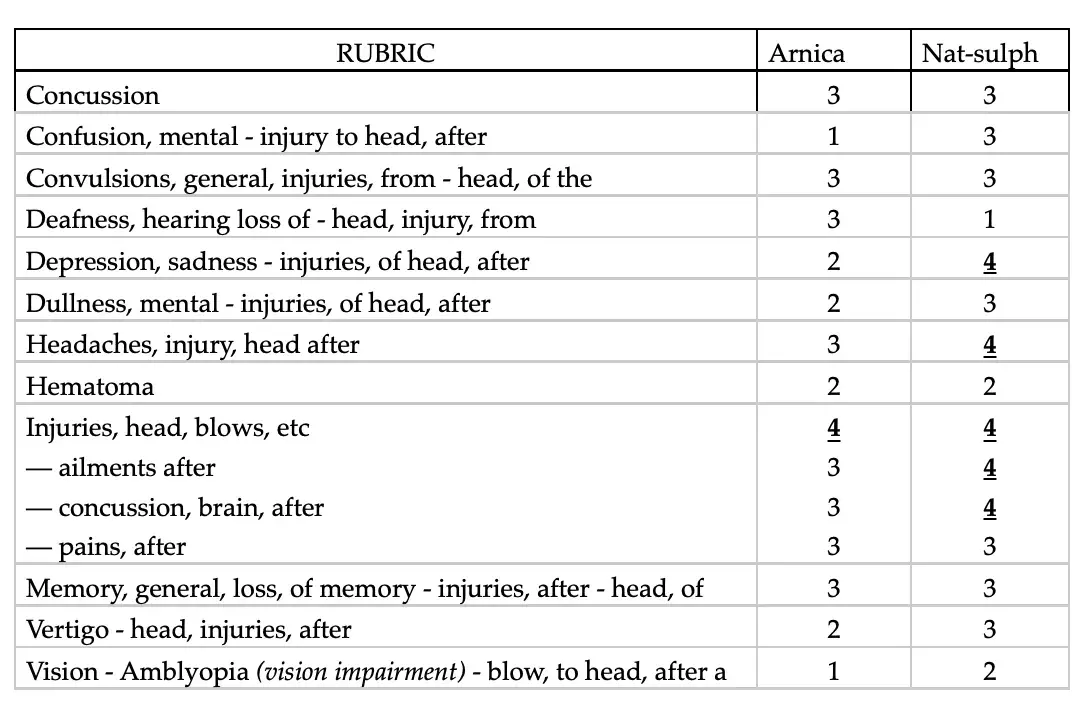 One might think looking at these two brief comparisons of the remedies* that Nat sulph would be the go-to remedy for a head injury. However, look a little closer… most of the rubrics say, “after.”
E.A. Farringon (2018, p 270-271) says, “Arnica is applicable to both the acute and the chronic effects of injuries. The acute injuries for which it is useful are the following: simple bruises… concussions of the brain or spine or of both. We have no remedy which equals Arnica in these last-named cases. Even compression of the brain comes within the range of Arnica, whether this compression be the result of a displaced fragment of bone in cranial fracture, or the result of effusion of blood within the cranial cavity. Arnica can not, of course, cure in the former of these cases; an operation is demanded in order to obtain permanent relief.” Richard Pitt (2015, p. 48) says, “as we know, all injuries basically start with Arnica. It fits the nature of so many injuries, especially at the beginning of an injury, but also very much for chronic consequences of injuries.” This is an important point in differentiating Arnica and Nat sulph. To sum it up too neatly, Arnica is more indicated immediately after the head injury and Nat sulph would come in later as a clean up crew. However, that’s not exactly true; there are more nuances to it, of course. But, it’s a good place to start. Let’s keep looking… (It is true that most home users of homeopathy have Arnica at hand — it is, after all, known as “the gateway” homeopathic remedy because it has such a huge range of uses in treating so many conditions, especially as related to trauma, injuries and surgeries. Arnica is included in virtually every basic homeopathic remedy kit.) Some of the keynotes of Arnica (Morrison 1993):
Some more Arnica keynotes from Morrison’s new book, Clinically Verified Materia Medica, Volume 1‡ (2025):
To clarify further on Arnica from Dr. Morrison’s new book (2025, p. 186), the “trauma created various defensive reactions — the first of which is denial… immediately declaring, ‘I’m fine.’… Other patients said that they were unable to ask for or accept help no matter how dire the circumstance… patients stated a need to remain in control by which they meant to hide or minimize the trauma.” Natrum sulphuricum keynotes (Morrison 1993‡):
Dr. Ratera (2016) says of Nat sulph: “Consequences of head trauma: vertigo, absences, blindness, coma, concussion, convulsions, headache, dullness, madness, sadness, suicidal thoughts, and memory loss.” (The key word to me, here, is “consequences.”) “Often, people who have suffered head injuries present immediately or after some time, with headaches, dizziness, memory loss, bouts of distraction, absences or epileptiform (brain activity that resembles that of epilepsy) seizures, and other disorders of concentration. These disorders can become chronic and be extremely annoying” — Nat sulph is his answer. But, once again, it’s not as clear cut as recent head trauma = Arnica and lingering effects of head trauma = Nat sulph. (That would be too easy!) Arnica, too, can be very helpful way down the road for old head traumas. (A quick search of “Arnica” and “ailments from” in Radar Opus software shows: “Head - injuries, head, blows, etc - ailments, after” and there sits Arnica in bold type. Nat sulph is there, too, in bold underline.) Back to Farrington (2018, p. 271), “In the chronic effects of injury we may use Arnica when diseases (which may even be entirely foreign in their appearance to the ordinary symptomatology of the drug) may be traced to a traumatic origin. No matter what that disease may be whether of the brain, eyes, lungs or nerves, if the injury is the exciting cause, the administration of Arnica is proper.” (See? not so clear cut, right?) So, what does Dr. Farrington (2018, p. 849) have to say about Nat sulph? “In the chronic effects of injury, especially to the head, Natrium sulph is almost indispensable.” … But, then again, it is as simple as what I wrote earlier. If you have hit your head, start with Arnica. If there are lingering effects of that head injury and Arnica isn’t taking care of business, swap to Nat sulph. … and, if years down the line you think, “you know, I haven’t felt right ever since I hit my head,” give Arnica a try. If you readily take part in “brain rattling” activities, you might want to keep both Arnica and Nat sulph handy. Julia Coyte, CHom Classically Practical homeopath #wellnessawaits Arnica and Nat sulph are not the only two well-indicated remedies for head injuries — they are just the most commonly available and well known remedies for head injuries. To read further on homeopathic head injury remedies, consider subscribing to Ruminating on Remedies: Digging Deeper. The first of the next two head injury comparisons will be out in the next week (or so). *Homeopathic repertories are laid out giving a number for each remedy and how well indicated that remedy is for the specific rubric. In Murphy, 4 is the highest (most well-indicated) remedy. **Be certain to seek medical assistance in these conditions! †All the remedies listed in these rubrics (sometimes a couple, sometimes dozens) are all potentially appropriately indicated — it’s just that some are more strongly indicated in a stand-alone rubric. For today, we are just comparing Arnica and Nat sulph. However, it’s important to remember that the right remedy in a case is the right remedy, regardless of how strongly indicated the remedy may be. Homeopathy is so full of nuance and minutiae! ‡This is a bit unfair to Nat sulph as volume 1 stops at Euphrasia! I wish I had the other volumes but they have yet to be published!
0 Comments
 I have a confession to make: I’m always amazed when somebody says they don’t experience headaches. As someone who has been known to experience headaches, it’s unfathomable to me that people exist who have never experienced such a thing. We headache sufferers assume everybody knows what we’re talking about. According to Stovner (et al. 2022), 52% of the world population experiences headaches. 14% experience migraines. Up to 1 adult in 20 has a headache every - or nearly every - day (World Health Organization 2014). Wow. Painful. Disabling. Disruptive. Exhausting. Boring. Troublesome. Worrisome. Irksome. Annoying. I don’t think there are any pleasant words to use for headaches because having a headache is a thoroughly unpleasant experience. I have written previously about headaches and homeopathy (see: “The Road Less Traveled” and now let’s take a look at how the cell salts may help. Headaches are well indicated in most cell salts with the exception of Calc fluor and Kali mur. But, as we have learned previously, my headache is not like your headache and your headache is not like your neighbor’s headache, and so on, and so on, and so on… (See “Garbage In, Garbage Out”.) So let’s break down the cell salt headaches, shall we? Location, causation, pain quality and concomitant (accompanying) symptoms all play an important role in landing on the “right” cell salt for headaches. Calc phos may be worse near the region of sutures (a seam-like immovable junction between two bones; where the skull bones meet). The pain may be burning or throbbing and may be brought on by over-study, watching television or after receiving sad or bad news. Gut issues may be involved, like: diarrhea, flatulence, and nausea. Musculoskeletally speaking, these headaches may accompany trembling hands or rheumatism. Calc sulph has pain around the whole head. It may be caused by injuries or blows or sinusitis and may be accompanied by vertigo and nausea. A Ferr phos headache may feel as if a nail has been driven into the head with throbbing in the temples or over the eyes. These headaches could be caused by weather (cold, sun or heat) or a rush of blood to the head and may be accompanied by fever; photophobia; red eyes and face; a tender scalp or vomiting. Motion and noise may make it worse. Kali phos headaches may be described as “nervous headaches” with what feels like a weight in the back part of the head. Students or others who are worn out and exhausted may need this and may find an empty feeling in the stomach or vomiting with weariness and yawning. These headaches might be worse in the evening or in a heated room and extraneous noise may be unwanted. Kali sulph may feel like the head has been placed in a vice or as if a metal band has been put around the head. These headaches often begin in the evening and may result from becoming heated. Accompanying chills, dizziness or nausea may be present. Mag phos headache pain may be described as darting or excruciating, pounding, shooting, sharp, stinging or spasmodic. These headache sufferers may be irritable with possible sparks in their vision before or during the headache. Nat mur is a big headache remedy — for hammering, throbbing, dull, or periodical headaches with a lot of mucus and/or lachrymation and profuse saliva. Vision may be disturbed. There may be chills or constipation or eye pain. These headaches may be before, during or after a fever. Becoming heated, over-exertion of the eyes, injuries, walking or running, sun exposure or sinusitis may bring this headache on. The person may feel depressed or dull; the headache may be worse in the mornings. Nat phos headaches may be felt on the top of the head, especially on waking in the morning. These headaches are felt as pressure, intense with heat and nausea; the skull feels too full and there is a tight feeling in the head. Drinking wine or milk, as well as eyestrain may bring on this headache which may also be accompanied by gastric issues or sour vomit. Nat sulph is well known for its use in head injuries. These headaches may be felt as a pulsation on the top of the head and may be described as a “sick” headache and be accompanied by nausea and a bitter taste in the mouth with salivation. Dizziness and the vomiting of bile may be worse in damp, warm weather. Silicea headaches may be chronic and experienced as coming up from the nape of the neck. These headaches may be brought on from heat, eyestrain, fasting, overdoing it physically (lifting/straining of muscles), study or sex. The person may be oversensitive. The pain may be accompanied by chills, fever, insomnia, vomiting or weakness. Vision may be disturbed or dim and they may experience noises in the ears, a roaring, as well as being sensitive to noises. Generally speaking, headaches in children respond well to Ferr phos or Calc phos; Calc phos especially if the headache occurs during dentition. Students may respond well to Nat mur, Calc phos or Silicea. Headaches are terrible. Chronic headaches are nearly unbearable. If you are a chronic headache sufferer, click here for a free introductory chat to see if homeopathy may be helpful to you. Julia Coyte, CHom Classically Practical homeopath #wellnessawaits Reference list
Stovner, L. J., Hagen, K., Linde, M. and Steiner, T. J., 2022. The global prevalence of headache: an update, with analysis of the influences of methodological factors on prevalence estimates. The Journal of Headache and Pain [online], 23 (1). World Health Organization, 2014. Headache disorders: How common are headaches? [online]. www.who.int.  On the 11th day of cell salts, Dr. Schüssler gave to us… Natrum sulphuricum.
Nat sulph “is one of our oldest homeopathic remedies, perhaps one of the oldest medicines on earth” (McCabe 2009). Nat sulph is to be considered for those whose illness are caused by damp, wet environments — think mold. Nat sulph, like Nat mur, helps to regulate fluids. Though Nat mur attracts fluid for the body to use, Nat phos attracts fluid for the body to lose, thus Nat sulph is a good kidney support remedy. Conditions which may benefit from Nat sulph:
Mentally and emotionally, melancholy and/or an inner restlessness; those who suffer from SAD (seasonal affective disorder). Additionally, Nat sulph can be helpful for any mental conditions arising from a head injury. Julia Coyte, CHom Classically Practical homeopath #wellnessawaits  No matter what you want to call it … (if you’re squeamish, just know we’re talking about diarrhea and skip forward to the next paragraph). If toilet humor is your thing, here we go: Number 3, Chocolate Thunder, Poo Stew, Rectum Rapids, Turd Tea, Emergency Evacuation, The Squirts, Brown Bomb, Liquid Lunch, Poop Soup … I’ll stop now. (If you would like a few more unseemly names, see Travelers’ Diarrhea.) Don’t worry, I won’t continue with the graphic descriptions. What follows is a long list of situations where one might experience diarrhea and the most highly indicated remedies for each. Once again, if you are experiencing diarrhea beyond an acute bout, please seek professional medical advice. Before embarking on my long list of unfortunate bottom-related circumstances, let me share one of my first amazing homeopathic "wowee!" moments. We were traveling and my then young teenage son was very sick in the night with suspected food poisoning. I was hemming and hawing, trying to remember what I had learned about remedies. I went with Veratrum album and within minutes everything stopped. I mean, everything completely stopped. He slept the rest of the night and woke up fine and dandy. “Better out than in” is what we say around here! As a result of this experience, I keep a little vial of Veratrum album in my little travel kit that accompanies me every time I leave the house with my suitcase. Veratrum album is my go-to homeopathic remedy for if things are coming out of both ends. What else may point to the use of this remedy? The diarrhea (or vomiting) may be violent, voluminous and relentless. Collapse following diarrhea (not the only well indicated remedy in this rubric, but a good place to start). The person may be cold: cold limbs, generally chilly, and/or clammy. Diarrhea with perspiration. Diarrhea after eating fruit; diarrhea after eating cucumbers (technically a fruit, after all). Diarrhea during menses. Diarrhea which is made worse by movement/motion (Bryonia is another one to think of for this symptom). And, here’s one more unusual concomitant symptom for Veratrum album: hiccups during diarrhea. Isn’t that just what you need in that situation?! Children & Diarrhea: If you have an infant with diarrhea, administer Podophyllum on the way to see the doctor — dehydration can set in quickly. Diarrhea while cutting teeth: Chamomilla. Chamomilla is such an excellent remedy for children, in general, and it doesn’t let us down in this situation, either (but these symptoms are not confined to children. With everything homeopathy, if the symptoms match, the remedy would be effective for man, woman, child or animal.) Diarrhea with abdominal pain. Diarrhea: following anger; after taking a cold; after eating and, specifically after eating rhubarb. Emotional diarrhea or from excitement. During hot weather. Painless diarrhea. And, here is a rubric unique to Chamomilla (but hopefully you wouldn’t find this in a child!): diarrhea after smoking. The Elderly & Diarrhea: Like children, the elderly, too, have some remedies with great affinity to their age. In this particular situation, I would lean toward China officinalis. China is so good for enfeebled people, as can often be found in the later years. In particular, China is useful for weak digestion; dyspepsia/indigestion; flatulence; chronic belching. Dysentery, in simple terms, involves frequent bowel movements with blood and mucus in the stool, often accompanied by cramps and pain. Give some China while on the way to see a doctor. Please seek medical assistance if you are experiencing these symptoms. If diarrhea and constipation alternate in older individuals, consider Antimonium crud. On to the general list… If experiencing abdominal pain, and it feels like diarrhea is imminent, Aloe would be my first recommendation. There may be accompanying weakness. Diarrhea after eating and in particular, diarrhea following the slightest dietary indiscretion. Walking makes it worse. Lots of toots during the diarrhea. There are a few rubrics where Aloe and Sulphur “tie” when it comes to diarrhea: burning pain in the rectum; being driven out of bed in the morning, needing the toilet desperately (Sulphur has the specific times of 5-6 am); painless diarrhea; standing makes it worse. Where Sulphur “wins out” over Aloe: diarrhea after beer and nighttime diarrhea, especially after midnight. If the diarrhea alternates with another symptom, such as:
Diarrhea and emotions:
Feeling wiped out after all that wiping? China is a good place to start. If the weakness is particularly pronounced, also consider Phosphoric acid. If the act of wiping actually causes pain: Graphites. Diarrhea during pregnancy: Phosphorus Diarrhea during menopause: Lachesis Diarrhea following an injury: Arnica If it’s coming out as from a hydrant: Podophyllum If it has a really noxious smell: Baptisia Diarrhea following the consumption of:
If you find your appetite increases with diarrhea: Petroleum. Cold hands with diarrhea: Phosphorus Cold feet: Lycopodium Cold limbs: Arsenicum album, Camphora and Veratrum album Positionally speaking: If lying down make it worse: Dioscorea If lying down makes it better: Bryonia (though it may be worse lying on your side) Sitting upright makes it worse: Bryonia Time of day: If it starts after you have risen from bed and moving around: Bryonia or Nat sulph After midnight: Arsenicum album or Sulphur If the diarrhea causes sleeplessness: Phosphorus I changed my mind. I will use one more dysphemism: the sharts, also commonly referred to as “gambled and lost” (Flanagan 2010). If you are having diarrhea during rectal flatus, there are a number of well indicated remedies, but I would start with Aloe — the remedy for an insecure rectum (click that link to read the previous article with the same name.) What would cause an “insecure rectum?” Let’s go back to Giulia Enders’ Gut for this explanation. Apparently we have a pair of “sophisticated” sphincters which Enders takes a few pages to explain and I am going to try and shrink it down to the bare essentials using her words, (but the full explanation is certainly worth a read). “The outer muscle is a faithful servant of our consciousness. When our brain deems it an unsuitable time to go to the toilet, the external sphincter obeys and stays closed with all its might. … Our internal sphincter is a no-nonsense little guy. His motto is, ‘If it’s gotta come out, it’s gotta come out!’ … The external sphincter, on the other hand, has to deal with the vagaries of the outside world and its many options.” Suffice it to say, we need these two sphincters to communicate well. A few more remedies for involuntary stool (not necessarily diarrhea):
As you can see, homeopathy can be invaluable when it comes to diarrhea — there is a homeopathic remedy for almost any situation! Julia Coyte, CHom Classically Practical homeopath #wellnessawaits References:
Enders, G., 2015. Gut : the Inside Story of Our Body’s Most Underrated Organ. Greystone Books. Flanagan, D., 2010. Everybody poops 410 pounds a year : an illustrated bathroom companion for grown-ups. Berkeley, Ca: Ulysses Press. Murphy, R., n.d. Homeopathic Remedy Guide. accessed through Radar Opus software. 
So, what’s the homeopathic answer? Nat sulph. In terms of allergies, the keynote symptoms of Natrum sulphuricum:
With all these symptoms, the person may feel better in outside open air. I used Nat sulph 6x to very good effect many years ago when we were in a rental house which we did not know was full of mold behind some big, thick curtains in the bedroom. I thought I was coming down with a nasty bug. Then, I went outside and lo’ and behold I felt much better. Next morning, I thought I was getting sick again. Same thing, went outside and was instantly well. Then we found the mold. Then I took the Nat sulph and managed the rest of the trip just fine. Nat sulph is one answer to dealing with acute symptoms resulting from mold. If you find you are unable to address your mold symptoms on your own, it may be that you need to work with a professional homeopath to get to the root of the problem. As we head into winter, if you are suffering in the damp and cold, think of homeopathic Nat sulph. Julia Coyte, CHom Classically Practical homeopath #wellnessawaits  “Homeopathic treatment is always worthwhile, even in individuals who are seriously ill and in need of care where there is no hope of complete recovery of health” (Teut and Doppler 2019). This topic is near and dear to me… Arthritis (this article focuses on osteoarthritis). Every time I have had an x-ray done over the last 10 or so years, they came back and said there is arthritis in there. Why would I have so many xrays? Cuz I had pain, that’s why. I have x-ray evidence of arthritis in my hands, (fingers and wrists), feet, ankles, knees and following an injury as a teenager, I was told the left side of my jaw was “bone on bone.” I’m pretty sure that were I to have further imaging on my hips and low back and neck that arthritis would be seen in those places, too. Now, I would like to point out that in that last paragraph I used the past tense. Since using homeopathy to address my arthritis, my pain levels have absolutely plummeted. It’s a rare day when my hands ache. I walk about 3 miles a day and while I do sometimes have some stiffness afterward, it is short-lived and soon forgotten. I’m not going to say all my joints are in perfect working order, but compared to where I was (and, definitely as compared to where I was headed), I have very few complaints at the age of 55. I had way more pain and discomfort 10-20 years ago. (I credit homeopathy for the bulk of my relief, but in addition to exercising regularly, I also eat a good, healthy whole foods diet, including plenty of bone broth and I also credit rolfing, too.) Once we hit age 65, nearly half (47.4%) of Americans have been diagnosed by a doctor as having arthritis (Brooks et al. 2018). If we want to add in people who have not bothered to get an official diagnosis, I’m willing to bet that number is considerably higher. Dr. Andrew Lockie (1993) estimates that 90% of people over the age of 40 have some degree of osteoarthritis in one or more joints. Along with the physical discomfort, osteoarthritis and all its limitations can lead to depression and sleep disturbances (Brooks et al. 2018). Additionally, anxiety and depression can lower your pain threshold and then the chronic pain aggravates the anxiety and depression — resulting in a vicious circle. See? It’s a good thing to try and get a handle on as soon as possible! What exactly is arthritis and who gets it? “Arthritis” is painful inflammation and stiffness of the joints. (Joints, as a reminder, are places where two bones meet.) Osteoarthritis is a degenerative joint disease. Degeneration is structural or functional breakdown. Common symptoms include pain, redness, heat and swelling. The most commonly affected joints are: hands, knees, hips, neck and lower back. In addition to the breakdown, small bone growths (osteophytes or bone spurs see also: The Importance of a Proper Diagnosis) may grow on the edges of the joint. Or, a bit can break off and float inside the joint space. (I had this as a kid when I chipped my patella). Did I mention that I have had more than my fair share of injuries? I was a busy kid, playing hard and getting hurt! The receptionist at the orthopedist’s office once said to me, “you really do love us, don’t you?” Anyone can get it, though generally speaking, it’s not a problem until we age — especially women when it develops after menopause. Though young people can get it as a result of an injury or a genetic defect. Why is osteoarthritis so common? Joint injury, obesity, genetics and anatomical factors affect joint mechanics (Shane Anderson and Loeser 2010). But, wear and tear takes its toll and “age remains the single greatest risk factor for the development of OA in susceptible joints.” So, how can homeopathy help arthritis? It’s very important to remember that conventional medicine doesn’t have a lot to offer in terms of helping osteoarthritis. The first line treatments are pain relievers, according to Mayo Clinic: Tylenol, Advil and Duloxetine (Cymbalta). (I highly recommend looking into the side effects of any medicines you plan on putting in your body. Drugs.com is a quick way to do this.) Other therapies which may be helpful include: physical therapy to strengthen the muscles around the joint; occupational therapy, and Transcutaneous Electrical Nerve Stimulation (TENS*) — low-voltage current to relieve pain. Beyond these, then we’re looking at more serious interventions, including cortisone injections and surgery to replace damaged joints. Homeopathy is not the absolute answer to every problem (though I think it's pretty close!) What homeopathy can do is to assist your body to wellness. When I began using homeopathy to treat my arthritis, as much as I was wanting an overnight success, that’s not how it works. The first few remedies I used went a long way at relieving my immediate discomfort, taking the edge off, so to speak. There is a lot to undo after a lifetime of wear and tear. It wasn't until I got into some deeper remedies that the daily pain disappeared. Let’s start with some support remedies: cell salts, (also known as tissue salts/remedies or biochemical medicine or Schüssler’s tissue salts). Cell salts are derived from substances that are naturally present in the human body, intended to nourish and balance our bodies; they are our building blocks. Dr. Schüssler “worked by the theory of deficiency. The idea of deficiency is that, if we can ascertain exactly which mineral salt or salt the body’s cells are starving for, and if we can give the body those salts in a manner in which it can absorb and digest them, then the cells will be nourished and the balance needed for function, form and good health will result.” “The cell salts are, therefore, a strange balance between allopathy and homeopathy, or, better put, a balance between homeopathy and nutritional medicine.” (McCabe 2009). Dr. Carey (1894) recommends three cell salts** for arthritis: Ferrum phos for an acute attack with very painful joints which are worse on movement. Tenalgia crepitans, (inflammation of a tendon sheath in which movement of the tendon is accompanied by a cracking sound). Natrum phos “is indicated in all cases of rheumatism of the joints.” Natrum sulph should be given alternately with Ferr phos in acute cases, but in chronic cases, Nat sulph alone may be helpful; especially in joints of the fingers. Other cell salts which may be helpful: Kali mur: in acute arthritis may be alternated with Ferr phos. Movement makes the pains worse; tenalgia crepitans. Natrum mur: for chronic arthritis; the joints crack; synovitis; rheumatic arthritis, especially of finger joints; hot, painful swellings of the knee joint. Mag phos is useful for the (violent) pains; excruciating pains which are spasmodic in character. Kali sulph: for pains which shift from one joint to another and are worse by heat. Shifting and wandering rheumatic pains in the joints. Calc phos for bone health, in general. Calc fluor for enlargements of the finger joints. Cell salts are generally given in a 6x potency and they can be combined in the mouth at one time as one dose and taken twice daily. (Martin & Pleasance*** makes a Comb M for rheumatism with equal parts Calc phos, Kali mur, Nat phos and Nat sulph.) On to homeopathy itself. For dealing with the acute pain of arthritis, a quick go-to remedy is T-Relief*** or T-Relief Arthritis***, both are available in either a cream or a tablet. Medinatura*** also makes/sells BHI Arthritis Pain Relief***. All three of these combos are made of slightly different remedies. The individual remedies which are shared between these combinations are worth investigating. Arnica for soreness all over the body. Worse for touch, pressure, cold or cold, damp weather. Worse for motion. Bryonia for excruciating, often stitching pains. Worse for the slightest motion (they just want to be still) and heat. Even though they are worse for moving, they feel restless. Better for pressure and warmth on the painful part, lying still, especially lying on the painful side. Joints may be hot and swollen. May seem irritable. Dulcamera is worse especially in damp weather, and cold damp autumn and the change of weather in general. Better for motion and warmth. Ledum may have some swelling and coldness in the affected joint. Worse for heat or becoming over-heated and motion. Though they may be chilly, they feel better for cold applications or cold bathing. Pain in the small joints, especially the toes and joint pains seem to progress up the body. Ledum is particularly good for the feet and lower legs. The soles of the feet may be painful. Ledum can also be helpful for the after-effects of steroid injections. Rhus tox (see also: Rhymes with Box) is a good remedy for all forms of rheumatism. Worse in the morning on waking, cold, sitting still (resting) and when first moving. Better after getting up and going, continued motion and hot baths or showers. They may be restless and feel better if they keep moving. All of these remedies listed are primarily to address the acute pain of osteoarthritis. Alan Schmukler (2006) mentions that Bryonia or Rhus tox will bring relief in a majority of cases. This is just a small sampling of the most common (and readily available) remedies which may help arthritis pain. I could keep writing on homeopathic arthritis remedies for hours! There's a lot to say and a lot of individual remedies which may be further tailored to specific arthritic symptoms. I highly recommend working with a professional homeopath to try and get to the root of the issue. In the meantime, try one of these above listed remedies and see if you can get a little relief. Life is just way too short to be in constant pain and discomfort. Try some homeopathy and see if you can get back to doing things you love. Julia Coyte, CHom Classically Practical homeopath #wellnessawaits * I have and am very pleased with ireliev’s wireless TENS unit (though, I must say, I really don’t use it very often any more). Again, I have no affiliation with this company, I just like their product. ** It is possible to purchase a mixture of all 12 cell salts. However, I have found better results when choosing just the best indicated cell salts rather than using the full complement. ***I have no affiliation with this company, I just like their products. Reference list:
Anon., 2023. tenalgia crepitans [online]. TheFreeDictionary.com. Arthritis Foundation, 2016. Arthritis and Mental Health [online]. Arthritis.org. Brooks, J. M., Titus, A. J., Polenick, C. A., Orzechowski, N. M., Reid, M. C., MacKenzie, T. A., Bartels, S. J. and Batsis, J. A., 2018. Prevalence rates of arthritis among US older adults with varying degrees of depression: Findings from the 2011 to 2014 National Health and Nutrition Examination Survey. International Journal of Geriatric Psychiatry [online], 33 (12), 1671–1679. Carey, G. W., 1894. The Biochemic System of Medicine. F. August Luyties. Kansal, K. and Kaushal, R., 2015. Textbook of practice of medicine with homeopathic therapeutics. New Delhi: B. Jain. Lockie, A., 1993. The family guide to homeopathy : symptoms and natural solutions. New York: Simon & Schuster. Mayo Clinic, 2021. Osteoarthritis - Diagnosis and treatment - Mayo Clinic [online]. Mayoclinic.org. McCabe, V., 2009. The Healing Echo. ReadHowYouWant.com. Morrison, R., 1998. Desktop companion to physical pathology. Nevada City, Calif.: Hahnemann Clinic Publ. NIAMS, 2019. NIAMS Health Information on Arthritis [online]. National Institute of Arthritis and Musculoskeletal and Skin Diseases. Rath, L., 2022. What Is Arthritis? [online]. www.arthritis.org. Schmukler, A. V., 2006. Homeopathy : an A to Z home handbook. Woodbury, Minn.: Llewellyn Publications. Schüssler, W. H., 2003. Schüssler’s twelve tissue remedies : comprising the theory, therapeutic applications, materia medica and a complete repertory of tissue remedies. Sittingbourne, Kent: Homæopathic Book Service. Shane Anderson, A. and Loeser, R. F., 2010. Why is osteoarthritis an age-related disease? Best Practice & Research Clinical Rheumatology, 24 (1), 15–26. Teut, M. and Doppler, C., eds. 2019. Homeopathy in Dementia: Materia Medica and Case Studies. Emryss. Thornton, P., 2022. Duloxetine: Uses, Side Effects, Dosage, Warnings [online]. Drugs.com.  I live in a desert. I live in a desert for a reason. I like that nice, dry weather, usually with a big, blue sky filled with a sun that has meaning!
Soon, I’m headed to other climes and I must admit, even though I am really looking forward to the trip, I am not looking forward to the cold and damp. The last time I was in this weather in the winter, I would get so cold it took a long time soaking in a deep, hot bath to warm up. Literally. Chilled to the bone is a real thing. Back in the day, I didn’t even know about homeopathy, let alone use it. So, this time, I’m doing a little prep work of what remedies to have along with me. Previously, I wrote about frost bite and the remedies that can help with that. I’ll bring that remedy with me, but that’s very different to the deep-seated cold of damp weather. Three remedies stand out in my search: Dulcamara, Nux moschata, and Rhus tox. These are not the only remedies, just the 3 that keep popping up most clearly and therefore, a good place to start (and the 3 remedies I am going to be sure to bring with me!) Calc carb showed up quite often, but it didn’t really have any distinguishing features, but I’ll leave it in anyway, just cuz. Homeopathic Dulcamara has a strong keynote aggravation from damp weather. “Any condition which has this feature may find its remedy in Dulcamara” (Robin Murphy). Most Dulcamara complaints are related to the mucous membranes (mouth, nose, eyelids, lungs, stomach, intestines). Symptoms unique to Dulcamara in the cold and damp:
A few symptoms where Dulcamara is your best bet (though, Calc carb, Nux moschata and Rhus tox are still indicated, but not as clearly):
Homeopathic Nux moschata is what would be called a dry remedy. (It’s made from nutmeg, so that kind of makes sense to me.) A very dry remed actually; so, it’s no surprise that the person who could benefit from it would not fare well in the cold and damp. Three symptoms that appear in the cold and damp and are unique to Nux moschata:
If you experience any of these symptoms as a result of being in the cold and damp, Nux moschata is most likely the remedy for you. Homeopathic Rhus tox is a remedy that is known for feeling better from heat — generally, the hotter the better! So, it would make sense that a person needing Rhus tox would feel worse in the cold and damp. Specific to Rhus tox as a result of the cold & damp:
A few other rubrics to consider that don’t fit nicely into my (mostly) neatly segregated remedies:
Here’s to sitting by a blazing fire, sipping something hot and lovely! Julia Coyte, CHom Classically Practical homeopath #wellnessawaits |
Julia Coyte, CHomI am passionate about homeopathy and I love sharing this passion. Having a working knowledge of homeopathy shouldn't be kept a secret. If people have the ability to help themselves, their children and their friends when they have minor ailments, life just gets better for everyone. That is the purpose behind Ruminating on Remedies. Archives
October 2026
Categories
All
|
 RSS Feed