 I am currently on vacation but had to share this “super quickie”…
I have a brand new dentist. It took a figurative minute to find one that seemed like a good fit. I was nudged into speeding up this process of finding a new dentist because my tongue wouldn’t leave a tooth alone. I could feel a little hole in the tooth, but no pain. I assumed it was an old filling that had come loose. Nope. Turns out I chomped really hard and damaged two teeth. I was 2 minutes late to the appointment to have this filling and I was back in my car, headed home in 30 minutes. Fastest dental appointment ever for me. He filled the tooth and then he gave me another injection. I’ve never had that before. He told me he injected Traumeel* to reduce the inflammation! Works for me! The other tooth has a very small hole that doesn’t currently need filling. I told him I was working on fixing it homeopathically. He used the little tooth camera and took a picture and said we will keep an eye on the process. I look forward to returning here one day and telling you my tooth has repaired itself. That’s a big goal and I’m excited to see what can be done! 🤞 Julia Coyte, CHom Classically Practical homeopath #wellnessawaits *He did not inject the topical version of Traumeel. They make a special one for injecting. (Once upon a time, I had an acupuncturist who dipped the needles in it.)
0 Comments
 It doesn’t matter what you call it: Studying. Revising. Cramming. “It” is overloading your brain with information. One may be forgiven for thinking school is out for summer, but that is not the case for everyone. One person reached out the other day, saying they and their friends are sharing some problems:
Let’s look at these problematic symptoms. What is causing the inability to focus? Is it distraction? Is it burnout? (These people did just finish law school. I should think the desire to keep at the books right as summer hits could be pretty difficult!) What is getting in the way of feeling well-rested? Is there insomnia? Is all the legalese swirling through your mind when you’re trying to sleep? Is the candle being burned at both ends? Are nutrition needs being met? What is the stress that is being managed? I’ll go in reverse order this time — are nutrition needs being met? This is so hugely important! Is the stress a direct result of not getting sufficient sleep? Is there a hyper-focus on learning the law, thereby causing a lapse in attention to the rest of the details of your life resulting in new levels of stress? I’m going to go out on a limb and say it’s a little bit of everything. Let’s think about this in terms of the repertory. Another way of saying needing to stay focused is being distracted. Dr. Murphy ranks Phosphorus at the top of this list (in terms of remedies which are readily available). I really hate to do this to you when you are already wiped out from studying, but you’ll have to read through these short descriptions to find the best-suited remedy to your specific symptoms! Phosphorus Carroll Dunham’s Lectures on Materia Medica (1878): Phosphorus - Sensorium - Weakness of memory, indisposition (moderate) to exertion; difficulty in collecting and concentrating thoughts; weak feeling in the head, aggravated by thinking and by loud noise, music or hard stepping; these things produce throbbing in the head, a feeling of confusion, dullness and distraction, but especially of weakness in the head. Frans Vermeulen (2015) says it a little more simply: Phosphorus is “easily distracted.” Clarke (1902): “Headache as if too full of blood from intense study.” Douglass (1903): Cannot study nor keep his mind on any particular subject long at a time. Disinclination to study or converse. Gibson (1987): “Is full of fears… of study (owing to mental exhaustion)…” RELEVANT RUBRICS:
Phosphoric acid Douglas Borland says in Digestive Drugs (1940): The mental picture is that of those who are just dead tired. They feel generally indefinite, do not want to talk, cannot concentrate, their thoughts wander away from the subject. Any mental effort is liable to produce an acute headache with a sensation of extreme pressure on the top of the head. On any effort at all these patients are liable to feel giddy. Gibson (1987) adds: The mind is confused, and any effort to concentrate brings on a dizzy feeling. There is great sensitivity, notably to music and also to odours. The subject is easily startled. May complain of various odd sensations such as widespread formication*; may be afflicted with homesickness. Leeser (1935) goes a little further: Poor comprehension and concentration, poor memory, indifference, dullness, inability to perform mental work, lack of ideas, moreover, depression, apathy, dissatisfaction with one’s self, aversion to speaking, in particular homesickness, indicate the psychic state in phosphoric acid. But nervous excitation with sleeplessness and sensitivity to all noises is also observed… a brief sleep may often remove the fatigue and be sufficient to refresh…
Picric acid Blackwood (1906) says: This remedy is indicated in restoring the wasted and worn-out systems of those who are suffering from the effects of close application to study or business and become anaemic and neurasthenic** and asthenic**. Clarke (1902): a patient of mine, previously a good sleeper, to lie awake a long time at nights, exhaustion after the day's studies, fatigue even from a short walk, twitchings of muscles when asleep or awake; hysterical state, loss of will power; constant headache, irregular menses. Any attempt to study = burning along spine; with great weakness of back and legs; soreness of muscles and joints. agg. By study or slightest mental exertion. Inability to keep eyes open when studying. Gibson (1987): The chief characteristic is extreme muscular weakness, accompanied by a compelling desire to lie down and a complete absence of anxiety. Is utterly exhausted; can neither think nor study. Darting pains may be felt in various sites, possibly involving bones.
Then, of course, we have our good old Nux vomica, and, I think this would be my first stop. We know Nux is helpful when things are too much: too much studying; too much not enough sleep; too much snacking while studying. Farrington (1955): "Lesson twenty-five - Nux vomica - General characteristics - Ailments from ANGER; grief; EXCESSIVE MENTAL LABOR; SEDENTARY HABITS; LOSS OF SLEEP; DEBAUCHERY; SEXUAL EXCESSES; ALCOHOL; COFFEE; NARCOTICS; TOBACCO; GETTING CHILLED; suppression of sweat or HAEMORRHOIDS. HYPERSENSITIVENESS; IRRITABILITY; …IMPATIENCE; MALICIOUSNESS; IMPETUOUSNESS; hurry; sadness; …weeping; timidity; dullness; CONFUSION; DIFFICULT CONCENTRATION; weakness of memory; INDOLENCE; IMBECILITY; delirium; INSANITY; MANIA; HYSTERIA; INCREASED SEXUAL DESIRE; debility; trembling." Those are some strong words in there. Suffice it to say, that would be an extreme picture of a Nux vomica state. Gunavante (1998) always sums things up succinctly: “Concentration difficult while studying.” Now, let’s look at a few applicable rubrics for Nux vomica:
SUMMING UP THE REMEDIES (I know your attention span is already shot, so I’ll keep this brief): Phosphorus may be a good place to start if:
Phosphoric acid may be a good place to start if:
Picric acid may be a good place to start if:
Nux vomica may be a good place to start if:
Are these the only remedies? Nope. Far from it. But, I know you’re tired, so I tried to keep it simple. Good luck on your exams! Julia Coyte, CHom Classically Practical homeopath #wellnessawaits * Formication: the feeling that bugs are crawling on your skin **Neurasthenia: an ill-defined medical condition characterized by lassitude, fatigue, headache, and irritability, associated chiefly with emotional disturbance (Oxford University Press 2021). **Ashtenia: abnormal physical weakness or lack of energy (Oxford University Press 2021). Reference list
Blackwood, A. L., 1906. A Manual of Materia Medica, Therapeutics and Pharmacology. accessed through Radar Opus software. Boericke & Tafel. Borland, D., 1940. Digestive Drugs. accessed through Radar Opus software. Choudhuri, N. M., 1916. A study on materia medica and repertory. accessed through Radar Opus software. New Delhi: B. Jain. Clarke, J. H., 1902. A Dictionary of Practical Materia Medica. accessed through Radar Opus software. Douglass, M. E., 1903. Pearls of Homoeopathy. accessed through Radar Opus software. Farrington, H., 1955. Homeopathy and homeopathic prescribing : a study course for graduate physician. accessed through Radar Opus software. New Delhi: B. Jain. Gibson, D. M., 1987. Studies of homoeopathic remedies. accessed through Radar Opus software. Kandern, Germany: Narayana Publishers. Gunavante, S. M., 1998. The ‘genius’ of Homoeopathic Remedies. accessed through Radar Opus software. Leeser, O., 1935. Textbook of homeopathic materia medica : inorganic medicinal substances. accessed through Radar Opus software. New Delhi: Jain. Oxford University Press, 2021. Oxford Dictionary of English. 14.1.1.47 ed. Oxford University Press accessed through mobisystems.com app. Vermeulen, F., 2015. Concordant reference : complete classic materia medica : 1284 remedies. accessed through Radar Opus software. Glasgow: Saltire Books.  Sticta has been stucta in my mind lately. Not sure why, but it won’t let go. Let’s take a quick look at this tiny, little, sticky remedy. Choudhuri’s Study of Materia Medica (1916) says: "This is comparatively speaking a little known and a rarely used remedy but that does not render it any the less important, for those cases that will call for Sticta will need Sticta; there Sticta and none but Sticta will help." This little remedy, Sticta pulmonara, also known as Lobaria pulmonara, is even kinda stucta where it grows. It’s a form of lichen which grows on tree trunks.
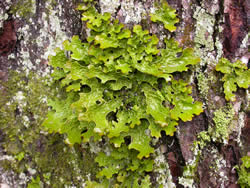
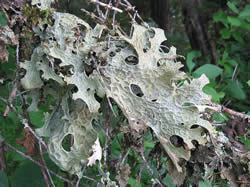
wet Lobaria pulmonara & dry Lobaria pulmonara The second part of its name, pulmonara, is kind of handy, too. Pulmonary = relating to the lungs. Clarke (1902) says: “There cannot be much doubt whence Sticta received its name of Pulmonaria. The likeness of the plant to lung tissue is self-evident.”
"'It was first used’ says Hale, ‘for severe harassing cough,’ and such good results accrued that provings were made to ascertain its full value. 'It was found to cause severe coryza, with violent sneezing, intense headache, and conjunctivitis. 'These attacks were preceded or followed by rheumatic pains and swelling of the small joints.’ The catarrh of Stic. is for the most part obstructive, and if there is discharge it dries quickly, and forms crusts or scurf. Constant need to blow the nose, but no discharge comes on account of dryness." (Clarke 1902) Sticta is known for its “excessive and painful dryness of the mucous membrane is not due to any want of secretion; for secretions occur but they dry up very rapidly leaving thick crusts behind them.” If you have ever experienced the crusts in the nostril problem, it’s easy to envision that wet Lobelia plant above just instantly shriveling up to the dry Lobelia. This is what I refer to as “wallpaper.” Sticta may be useful when there is stuckness in the respiratory system and it also may be useful for stuckness in the joints. Bursitis is the inflammation of a bursa. Bursa is a small, fluid-filled sac that cushions bones and tendons and muscles near the joints. When there is overuse, for example, the bursa gets inflamed resulting in pain and tenderness. Many people with bursitis describe a “stuck” feeling in the affected joint due to the stiffness, swelling and pain rather than a true mechanical lock. The inflamed bursa swells, thickens and irritates surrounding tissues, resulting in a tight feeling. The hip may feel stiff or stuck when standing from sitting. There may be difficulty raising the arm overhead — it feels frozen or stuck halfway. The knee may feel like it’s kind of stuck - unable to bend or straighten all the way. Here is a quick look of grade 3 & 4 rubrics for Sticta:
"Feels as if she must talk, about everything and anything, whether listened to or not.… Confusion of ideas, patient must talk." — Murphy This little remedy has a surprising number of one remedy rubrics, like:
Feeling stuck? Try some Sticta to become unstuckta. Julia Coyte, CHom Classically Practical homeopath #wellnessawaits |
Julia Coyte, CHomI am passionate about homeopathy and I love sharing this passion. Having a working knowledge of homeopathy shouldn't be kept a secret. If people have the ability to help themselves, their children and their friends when they have minor ailments, life just gets better for everyone. That is the purpose behind Ruminating on Remedies. Archives
October 2026
Categories
All
|
 RSS Feed