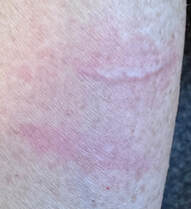
 I set the baking trays on the two cool pots on the back burners not being used. I have done this for decades — every time I make cookies. I wasn’t making cookies. This time I was making some egg/cheese/sausage breakfast-on-the-go muffins which needed to be removed from the hot pan rather than hanging out for a while. I had an oven glove on, but that didn’t stop me from burning my forearm not once, but twice, in quick succession. I went back for more! 😫
Needless to say, it hurt like the dickens*. I immediately sprayed a product which is sadly no longer for sale, Similasan’s Burn Recovery. Why it’s no longer for sale, I have no idea, but it was a marvelous product.** This spray gave a certain amount of immediate relief, but it wasn’t lasting. I then took a dose of Cantharis 30x which was sitting in the kitchen cupboard. Nothing. I sprayed the spray again, to the same effect (immediate non-lasting relief). I then took Cantharis 200c and by the time I ate dinner a couple of hours later, I barely felt it. By the time I went to bed, I no longer felt any pain. I didn’t need to repeat the spray or the pellets. The top burn, as you can see in the photo, bubbled and raised immediately. It felt sticky. When I woke up in the morning, it was smooth and completely painless. What to make of all this? Well, I’m a big fan of having multiple potencies of important remedies in close proximity to where accidents can happen. My kitchen cupboard has a number of items to treat burns and bites and cuts, etc., and over the years various potencies of the same remedies have gathered together here. It works for me. Sometimes potency matters. Having said that, if I hadn’t had a 200c handy, I would have put the 30x into some water and repeated it more frequently. I’m going to go out on a limb and say that it probably would have taken a little longer to get where it got, but I think it most likely would have done the trick eventually. But, the one single dose of 200c kicked in very quickly. Baking season is going to be here any day — make sure you pay attention to how far your oven mitts actually extend up your arm and have some Cantharis handy! Julia Coyte, CHom Classically Practical homeopath #wellnessawaits *I suddenly thought, what the heck are “dickens”, anyway? Writing Explained says it’s a substitute word for devil. Shakespeare used in Merry Wives of Windsor, 1600. **Fortunately for us, we can make our own topical burn relief: the ingredients are:
0 Comments
 When one is a homeopath, one sees a lot of [ahem] coincidences.
One evening someone slips and falls and can barely move and they are expecting to need x-rays the following morning and they take a dose of Arnica and coincidentally, they wake up pretty much back to their old self. A nasty burn on the forearm, and they say — “that’s going to be there for a while.” They take Cantharis and when you see them the next day, they are absolutely amazed that the burn no longer hurts. Someone ate something off — the resulting gas and tummy pain is bad. They take some Arsenicum album and all those bad things vanished. A young person scheduled for a tonsillectomy and they take some Silica and they shortly thereafter spit tonsil stones out of their mouth by the spoonful. Surgery cancelled and years later they still have their tonsils. A young person with frequent, gushing nosebleeds and each time they take the Ferrum phos, the nosebleeds stop (sometimes almost instantly). In fact, not only do they stop when taking the Ferr phos, the following nosebleeds become a little lighter and they show up a little less often. Surgery is completed and a full schedule of pain meds has been provided (including the big guns, you know what I’m talking about!), and, after taking the first dose of the indicated homeopathic remedies, not one single pain killer has been used. The dog that is pacing and panting and totally not behaving like his normal self and a few minutes after a dose of Ignatia, he is sleeping peacefully. All these situations could absolutely be chalked up to coincidence… UNTIL, you see them happen over and over and over again. That’s exactly what you see when you use homeopathy… things that seem too good to be true; things that seem totally coincidental, happening over and over again. Julia Coyte, CHom Classically Practical homeopath #wellnessawaits  Tis the Season for… Burns?! Yes. You catch that holiday spirit and suddenly you’re a baking fool and… that’s the way that went. Are you frantically baking these days? I’m not. I want to be, but traveling was on the front burner this week. (Sorry, couldn’t resist the bad joke.) And, since we have no big at-home festivities planned, I decided to be honest with myself and acknowledge that if I were to start baking now, I would only just eat them all myself. Alas. All my cookie recipes will have to wait til next year. OK, maybe I’ll have to make just one*. Baking. Cooking. Roasting. Heck, even a quick little zap from some old Christmas lights or stomping on an ember that shot out of the fireplace. Hazards of the festive season, I guess. If you are interested in a good fire glove, these have been a really impressive addition to our fireplace.** Juggling all the pots on the stove while fishing the baked goods out of the oven and, boom, there it is… A nasty burn, generally on the hands or wrists in my experience. I’m talking about little burns today. If you get a big, deep burn, be sure to pay a visit to your nearest emergency room. For previous blogs on burns, see: Kitchen Quickie: Burns and Summer Fun 1. According to The Survival Medicine Handbook (Alton and Alton 2016), first degree burns will appear red, warm and dry and be painful to the touch. The conventional treatment is to simply relieve the discomfort. (Second degree burns are moist with blisters and will cause swelling.) So, in addition to the conventional application of a cool cloth, here are a few homeopathic remedies which may help, especially if the remedy is incorporated into the cool cloth. Homeopathic remedies that come to mind for 1st degree burns… For all of these suggestions, repeat the remedy whenever the pain returns. Urtica urens for stinging, burning pains. Burns with itching. Calendula for burns that hurt more than they "should." Richard Hughes, a homeopath from the late 1800s, refers to Calendula as a remedy for "breaches of surface" -- an apt description for a superficial burn. Calendula cream can be applied directly on the minor burn, or, around the edges of the burn if it's too tender. For an interesting study on Calendula and burns, click here. Causticum for burns with a sensation of rawness. Causticum is a good one to turn to if the other well chosen remedies aren’t quite doing the job, or, the burn is slow to heal. It is also useful to help heal up old burn wounds and scars. Hypericum would be especially useful in cases of burns to nerve rich areas like the fingertips. May have a tingling or numb feeling. Cantharis is an excellent choice for really painful burns -- a cutting, smarting pain. Cantharis is said to help prevent blistering from burns. All of these remedies can also be applied topically, as well as taken internally. First Aid with Homeopathy (Ratera 2016) says to dissolve a couple pellets (whatever your tube recommends as a dose) in some saline (e.g. 2 pellets in 200 ml of saline) and to always keep the dressing moist. Another option is to put a few pellets of your chosen remedy into a fresh bottle of clean water. As the pain returns, take a spoonful of the water in your mouth as well as applying some gauze soaked in that remedy water directly to the affected area. How about when you just can’t wait another moment for one of those cookies and you pop it into your mouth before it’s cooled? A dose of Cantharis, Calendula or Causticum would be where I would start. If you decide to try your hand at a figgy pudding and suffer a burn from hot steam, in addition to the remedies listed above, Apis or Kali bich might be useful. If the hot toddy spills on you (or, more likely, the boiling water for the potatoes spills on you) resulting in a superficial burn, Dr. Ratera recommends Causticum. Wishing you and yours a very Merry (and burn free!) Christmas! Julia Coyte, CHom Classically Practical homeopath #wellnessawaits * The cookies I have just now decided to make this year are Brown Sugar and Nutmeg Snaps, a recipe I found in Bon Appetit way back in 1994. (Note: the dough needs to chill for 1 hour.) 1-1/4 cups packed light brown sugar 1/2 cup unsalted butter 1 large egg 1-3/4 cups all purpose flour (Jules gluten free flour** is a terrific substitute) 1 tsp ground nutmeg 1 tsp baking soda 1/2 teaspoon salt Sugar -- Using an electric mixer, beat brown sugar and butter in bowl until fluffy. Mix in egg. Add flour, nutmeg, baking soda and salt; beat until well blended. Chill for 1 hour. Preheat oven to 350. Butter 3 heavy large baking sheets. Roll dough into 1” balls. Roll ball in sugar, coating completely. Arrange on prepared baking sheets, spacing balls 2” apart. Using the bottom of a glass, flatten the cookies to 1-3/4” rounds. Bake until cookies are golden, about 13 minutes. Be careful getting them out of the oven! Cool on baking sheets. (Can be made 1 week ahead. Store in airtight containers.) ** I have no affiliation with this company, I just like their products. Reference list
Alton, J. and Alton, A., 2016. The survival medicine handbook : the essential guide for when help is not on the way. United States: Doom And Bloom. K. Chandran, P. and Kuttan, R., 2008. Effect of Calendula officinalis Flower Extract on Acute Phase Proteins, Antioxidant Defense Mechanism and Granuloma Formation During Thermal Burns. Journal of Clinical Biochemistry and Nutrition [online], 43 (2), 58–64. Ratera, Dr. M. M., 2016. First Aid with Homeopathy. Germany: Narayana Verlag.  Kitchen Quickies… Burns As the name implies, Kitchen Quickies are short and to the point remedy suggestions to get you on your way if you have suffered any mishaps in the kitchen. I open my oven door and pull the rack out to tend to whatever lovely thing is cooking all the time. The other day, however, I managed to singe my forearm on the rack. What did I do? I immediately sprayed it with something I keep in my kitchen for precisely such occasions: Similasan Burn Recovery.* (Note: Mine was a minor burn. If you have anything more serious than a superficial burn, seek medical assistance.) This Burn Recovery bottle has pride of place in my cupboard and is standing ready and available for quick access following silly cooking errors as well as sunburned shoulders. Next to this spray is a little tube of Cantharis, which I also took shortly after using the spray. At bedtime that night, I put a little Boiron Calendula ointment* on the burn and that was that. I didn’t think about it again until my husband saw it and commented a few days later, saying, “that was a nasty burn.” I had pretty much forgotten about it because I didn’t feel it again after the first day. This Similasan burn combination contains homeopathic Calendula, Cantharis, Echinacea, and Urtica urens. All of these homeopathic remedies would likely be just as affective if taken orally when chosen individually, based on the presenting symptoms. But, this spray feels so good! (Additionally, homeopathic pellets can be put in some fresh water and applied to the skin for a similar effect to the commercially available spray.) Homeopathic Calendula is the first remedy I think about for any skin ouchies — big and little. According to K. Chandran (and Kuttan 2008), it’s with good reason. They found “the administration of Calendula officinalis extract significantly decreased the serum level of marker enzymes of tissue damage….” (Note: This research was conducted using an extract of Calendula.) Why these homeopathic remedies?
Keep on cooking, but mind the oven racks! Julia Coyte, CHom Classically Practical homeopath #wellnessawaits * I have no affiliation with this company, I just like their products. K. Chandran, P. and Kuttan, R., 2008. Effect of Calendula officinalis Flower Extract on Acute Phase Proteins, Antioxidant Defense Mechanism and Granuloma Formation During Thermal Burns. Journal of Clinical Biochemistry and Nutrition [online], 43 (2), 58–64.
 I was reading an article the other day about Urinary Tract Infections (UTIs) and antibiotics. According to this CNN story LINK, 47% of women were being prescribed a wrong antibiotic for their UTIs. Nearly half! This is bad on many levels, not the least of which is that the pathogens which cause the UTIs are becoming increasingly resistant to the commonly used antibiotics (Mattoo et al. 2021; Wawrysiuk et al. 2019). UTIs are painful things. There often is burning pain. The urge to urinate that is not relieved by urinating — you have to go, you go and immediately feels like you have to go again. There may be blood in the urine. Cramping pain. They’re not fun and they are not uncommon. A 2011 WHO report “found UTIs contributed to over 8 million office visits and over 1 million hospitalizations” (LaMotte 2021). As for antibiotics for UTIs in general, sometimes they work and sometimes they don’t work. Whether they work or not is irrelevant to what they do to your gut (Ianiro et al. 2016). Some people, women most frequently, experience UTIs multiple times a year and know pretty much exactly what’s going on when they have these symptoms. For children (and their parents), the burning pain can be quite distressing. So, when do you know if it’s time to seek medical treatment? According to Dr. Troy Madsen (University of Utah 2018), if you’re an older man experiencing these troubles, that can be more problematic than if you’re a woman as these symptoms may signify prostate troubles. When to seek medical treatment for a UTI (ER of Texas 2022):
So, what’s the answer to this painful condition that winds up with so many people presenting to the ER and taking (possibly) ill-prescribed antibiotics which may lead to antibiotic resistance? Well, for run-of-the-mill UTIs, homeopathy, of course! For the treatment of minor urinary tract infections, homeopathy can be a marvelous and fast answer to some relief. A few well-indicated homeopathic remedies to address these uncomfortable symptoms, (for men, women, children and pets, too!):
Not only can homeopathy help the immediate symptoms, but using homeopathy has even been found to decrease the recurrence. Pannek (et al. 2018) found adjunctive homeopathic treatment led to a significant decrease in UTIs in patients with spinal cord injury. If you suffer from frequent, recurring UTIs, I highly encourage you to work with a professional homeopath because there’s something else going on there that needs to be brought into the equation. Stop the burning drip and get with the flow! Julia Coyte, CHom Classically Practical homeopath #wellnessawaits Reference list
American College of Emergency Physicians, 2022. Urinary Tract Infections — Know When to Go to the ER [online]. www.emergencyphysicians.org. Chand, K. S. and Kapoor, P., 2020. Two Case Reports of Integrated Management of Antibiotic-Resistant Urinary Tract Infection. Homeopathy : the journal of the Faculty of Homeopathy [online], 10.1055/s0039-1696992. ER of Texas, 2022. When to go to the ER for Urinary Tract Infection Symptoms [online]. ER of Texas. Ianiro, G., Tilg, H. and Gasbarrini, A., 2016. Antibiotics as deep modulators of gut microbiota: between good and evil. Gut [online], 65 (11), 1906–1915. LaMotte, S., 2021. Doctors treat female UTIs with wrong antibiotics nearly half the time, study finds. CNN [online], 24 February 2021. Mattoo, T. K., Shaikh, N. and Nelson, C. P., 2021. Contemporary Management of Urinary Tract Infection in Children. Pediatrics [online], 147 (2). Pannek, J., Jus, M. C. and Jus, M. S., 2012. [Homeopathic prophylaxis of urinary tract infections in patients with neurogenic bladder dysfunction]. Der Urologe. Ausg. A [online], 51 (4), 544–546. Pannek, J., Pannek-Rademacher, S., Jus, M. S., Wöllner, J. and Krebs, J., 2018. Usefulness of classical homeopathy for the prophylaxis of recurrent urinary tract infections in individuals with chronic neurogenic lower urinary tract dysfunction. The Journal of Spinal Cord Medicine [online], 42 (4), 453–459. University of Utah, 2018. ER or Not: It’s Difficult to Pee [online]. healthcare.utah.edu. Wawrysiuk, S., Naber, K., Rechberger, T. and Miotla, P., 2019. Prevention and treatment of uncomplicated lower urinary tract infections in the era of increasing antimicrobial resistance—non-antibiotic approaches: a systemic review. Archives of Gynecology and Obstetrics [online], 300 (4), 821–828. 
 Summer is now officially in full swing! Whether you are jetting across the world or driving to the coast or just visiting your local water park, I hope you are out and about and enjoying the sunshine … with a nice, big, wide-brimmed hat, of course! After decades of being told to avoid the sun, at least one group is warning us that we are not getting enough sun (Alfredsson et al. 2020). As a redhead, I know too well it’s a fine line between too little and too much. Finding that sweet spot of sun is tricky. Sunburn. I’ve been there, done this and I feel your pain! I was always under the impression the sun reflecting off the water played a part in a beach vacation sunburn, but Diffey and Mobley (2018) say otherwise. They claim it is just a simple lack of shade at the beach that is the culprit. Those passing clouds aren’t going to help much, either! According to Cancer Research UK (2019), 90% of the UV rays can still pass through light clouds. And, it’s not just the sun from above… hot sand can result in “beach feet” (Cohen 2019). (My personal thoughts on the water and the clouds are that you just don't feel the intensity of the sun as much in those conditions so you are less likely to be taking the necessary precautions.) Years ago, I watched a TV program which said that adding lycopene (via tomato paste, specifically) to your diet can help keep your skin from burning. Apparently, they weren’t wrong: (Stahl et al. 2001; Cooperstone et al. 2017). Other carotenoids can also be helpful, too (Stahl and Sies 2012). But, if you haven’t eaten enough tomatoes and carrots and instead you find yourself turning into a sun-dried tomato*, I have some homeopathic remedies for you. For each of these sunburn remedy suggestions, repeat a 30c dose, every half hour or so until some relief is felt and then space the doses out. The first remedy to turn to for any burn, whether from the sun, a chemical or a flame, is Cantharis. Burns, as well as burning pains. Restlessness. Sunburn with blisters. Even burning pains in the eyes. Belladonna for dry and hot skin with burning sensations. Swollen skin. Throbbing pains. Bright, red skin. “Burning, pungent, steaming, heat” (Murphy 2020). If your skin is feeling itchy or prickly after a sunburn, Urtica urens is the remedy you’re looking for. Itching, raised, red blotches. (I had a childhood friend who used to get this after any exposure to the sun. I wish I had known then what I know now. Alas.) If your skin is burning up and you’re sweating but are inexplicably NOT thirsty, Pulsatilla may be in order. One more idea is Similasan’s Burn Recovery** for some quick, spray-on relief. That big beautiful glowing thing in the sky not only can be too much on your skin, it can be too much on your entire system. Horrible to experience, but not generally life threatening is a terrible headache resulting from too much sun. Belladonna or Glonoinum is what you need here. As mentioned above for the sunburn, the sun-induced Belladonna headache will be throbbing and intense. A Glonoinum headache will, in addition to throbbing, also be bursting with “waves of terrible, pounding pain” (Murphy 2020) with a rush of blood to the head. The person needing Glonoinum cannot tolerate having heir head laid backward and may also experience twitching or muscle contractions. The person needing Belladonna will be more comfortable with their head laid in a backward position and sitting quietly. This sun headache can be indicative of worse things to come. If you find yourself at this point — get out of the sun now(!) and get some fluids in you. Do whatever you need to do to gently lower your body temperature. The Natural First Aid Handbook (Mars 2017) suggests making a spritzer to cool yourself down by filling an 8-ounce spray bottle with water, 2 teaspoons of witch hazel, 10 drops of lavender essential oil and 10 drops of peppermint essential oil and “spray or sprinkle over yourself.” If you are unsuccessful in regulating your temperature, Heat exhaustion or Heat Prostration is the next step when you’ve been out too long and your body is not able to cool itself. Children are particularly susceptible to this phenomenon (SunSmart 2020). Symptoms of heat exhaustion include confusion, weakness, faintness, headache, muscle cramps, heavy sweating and nausea and/or vomiting. Dr. Colin B. Lessell (1999) recommends giving either homeopathic Carbo vegetabilis for the exhausted person who seems ready to collapse or Bach Rescue Remedy and notes that expert medical assistance should be sought if the patient does not respond rapidly. A further ill-effect from the sun is Heat Stroke or Sunstroke which is a serious condition and requires immediate medical attention. Administer Belladonna or Glonoinum while on the way to the hospital or while waiting for the ambulance. How to tell the difference between Heat Exhaustion and Heat Stroke? According to Lessell (1999, p. 116): If you, like me, have a history of sunburns, check out my article on Sol, yet another homeopathic remedy which can help set things right after too much sun. Now, get a big hat and a bottle of water, grab a friend (or a book) and head to the beach, the pool, the park or your balcony to soak up some (but not too much!) delicious vitamin D! Julia Coyte, CHom Classically Practical homeopath #wellnessawaits * Bonus remedy: Consider some China officinalis if you have experienced any dehydration from too much sweating or not drinking enough water. Note: putting a little pinch of salt in your water (Lessell 1999) can help balance your electrolytes … or, grab nature's electrolyte balancer, coconut water. (Clever thing that coconuts are what you find on an otherwise uninhabitable island!) ** I have no affiliation with this company, I just like their products. Reference list and further reading:
Alfredsson, L., Armstrong, B. K., Butterfield, D. A., Chowdhury, R., de Gruijl, F. R., Feelisch, M., Garland, C. F., Hart, P. H., Hoel, D. G., Jacobsen, R., Lindqvist, P. G., Llewellyn, D. J., Tiemeier, H., Weller, R. B. and Young, A. R., 2020. Insufficient Sun Exposure Has Become a Real Public Health Problem. International Journal of Environmental Research and Public Health [online], 17 (14). Cancer Research UK, 2019. The UV index and sunburn risk [online]. Cancer Research UK. Cohen, P. R., 2019. Beach Feet: A Sand-associated Thermal Injury to the Soles of the Feet and the Plantar Aspect of the Toes. Cureus [online]. Connolly, S., Bertinetti, M., Teague, W. J., Gabbe, B. J. and Tracy, L. M., 2021. Sunburn Injuries Admitted to Burn Services in Australia and New Zealand. JAMA Dermatology [online], 157 (6), 729. Cooperstone, J. L., Tober, K. L., Riedl, K. M., Teegarden, M. D., Cichon, M. J., Francis, D. M., Schwartz, S. J. and Oberyszyn, T. M., 2017. Tomatoes protect against development of UV-induced keratinocyte carcinoma via metabolomic alterations. Scientific Reports [online], 7, 5106. Diffey, B. L. and Mobley, C. D., 2018. Sunburn at the seaside. Photodermatology, Photoimmunology & Photomedicine [online], 34 (5), 298–301. Gauer, R. and Meyers, B. K., 2019. Heat-Related Illnesses. American Family Physician [online], 99 (8), 482–489. Glazer, J. L., 2005. Management of Heatstroke and Heat Exhaustion. American Family Physician [online], 71 (11), 2133–2140. Kenny, G. P., Wilson, T. E., Flouris, A. D. and Fujii, N., 2018. Chapter 31 - Heat exhaustion [online]. ScienceDirect. Lau, W. Y., Kato, H. and Nosaka, K., 2019. Water intake after dehydration makes muscles more susceptible to cramp but electrolytes reverse that effect. BMJ Open Sport & Exercise Medicine [online], 5 (1), e000478. Lessell, C. B., 1999. The world travellers’ manual of homoeopathy. Saffron Walden: C.W. Daniel. Mars, B., 2017. The natural first aid handbook : household remedies, herbal treatments, basic emergency preparedness everyone should know. North Adams, Ma: Storey Publishing. Murphy, R., 2020. Nature’s materia medica : 1,400 homeopathic and herbal remedies. 4th edition. Blackburg, Va.: Lotus Health Institute, November. Pirayesh Islamian, J. and Mehrali, H., 2015. Lycopene as A Carotenoid Provides Radioprotectant and Antioxidant Effects by Quenching Radiation-Induced Free Radical Singlet Oxygen: An Overview. Cell Journal (Yakhteh) [online], 16 (4), 386–391. Stahl, W., Heinrich, U., Wiseman, S., Eichler, O., Sies, H. and Tronnier, H., 2001. Dietary Tomato Paste Protects against Ultraviolet Light–Induced Erythema in Humans. The Journal of Nutrition [online], 131 (5), 1449–1451. Stahl, W. and Sies, H., 2012. Photoprotection by dietary carotenoids: concept, mechanisms, evidence and future development. Molecular Nutrition & Food Research [online], 56 (2), 287–295. SunSmart, 2020. Alarming number of infants, children and teens presenting at Victorian hospital emergency departments with sunburn - SunSmart [online]. Sunsmart.com.au. Tripathi, R., Mazmudar, R. S., Knusel, K. D., Ezaldein, H. H., Bordeaux, J. S. and Scott, J. F., 2021. Trends in emergency department visits due to sunburn and factors associated with severe sunburns in the United States. Archives of Dermatological Research [online], 313 (2), 79–88. |
Julia Coyte, CHomI am passionate about homeopathy and I love sharing this passion. Having a working knowledge of homeopathy shouldn't be kept a secret. If people have the ability to help themselves, their children and their friends when they have minor ailments, life just gets better for everyone. That is the purpose behind Ruminating on Remedies. Archives
October 2026
Categories
All
|


 RSS Feed