 I suppose I should be more specific… some dentists are on it!
A few years ago, I was having a pretty good-sized dental procedure and I was a little worked up about it. My dentist at the time (she sold her practice😩) offered Reiki* during the procedure. I had never experienced Reiki before, but I went for it. I have to say that it was nothing short of amazing. I returned home and my husband thought I had been drugged in some way… that’s how relaxed and unbothered I was from this procedure with the adjunct of Reiki. Fast forward to this year and my husband needed a couple of big dental procedures. The first dentist, a couple of months ago, included Arnica in his after-care instructions (as well as some good, sound nutrition advice). This week, another procedure (and a different dentist). I picked up the box of the mouth rinse to see what horrors he had been given and… the active ingredients were all homeopathic! 🎉 Turns out this company** makes a few dental products and they all appear to be homeopathic… and, all made in the USA, too! So, what’s in this oral rinse? I have never heard of the first remedy listed: Azadirachta indica, but, a quick look in my Radar Opus software tells us it is Margosa Bark, or, Neem. I know Neem for its valuableness in dealing with bug bites but apperently it’s good for teeth, too. The twigs can even be chewed on to improve dental hygiene. Homeopathically, Azadirachta indica would be indicated when there is a bitter or putrid taste in the mouth, a burning tongue and salty saliva. I am starting to see how this could be very helpful following big dental procedures. I have written about the benefits of Calendula and dentistry previously (see: The Eiffel Tower in My Mouth; A Calendula Quickie… for inner bites (and bites!); Brace Face.) Calendula and wound healing go hand in hand. Echinacea purpurea is often included in tooth and gum tonics due to its antimicrobial properties. It has a “well merited reputation” for suppurative conditions and helps with pain (Dewey 2003). Plantago major has been used in its herbal form for pretty much ever. The Herbal of Dodoens from 1558 suggests the juice of the leaves or roots of Plantago for toothache and bleeding gums. (That’s a pretty long documented history of use!) Dr. Robin Murphy lists it in his repertory for toothaches, sensitive teeth and for dry sockets. I am so excited to see these marvelous homeopathic remedies moving into the mainstream. None of the dentists mentioned are “holistic” or alternative practitioners. All these patients are being introduced to homeopathy without even knowing it. I just hope that some (all!) of them take a peek at the ingredient list (or, even the little “homeopathic” word printed on the top of the packaging) and make the connection and have their curiosity stirred up a little bit. 🤞 I can’t wait until the day that homeopathy comes into its own. It’s going to be so exciting!! Thank you to those mainstream dentists out there doing the early leg work of sharing homeopathy! Julia Coyte, CHom Classically Practical homeopath #wellnessawaits * “Reiki is a Japanese technique for stress reduction and relaxation that also promotes healing.… The word Reiki is made of two Japanese words — Rei which means ‘God’s Wisdom or the Higher Power’ and Ki which is ‘life force energy.’… A treatment feels like a wonderful glowing radiance that flows through and around you.” Something wonderful was clearly flowing through me after that treatment! ** I have no affiliation with this company. Reference list Dewey, W. A., 2003. Practical Homoeopathic Therapeutics. accessed through Radar Opus software. B Jain Pub Pvt Limited. Murphy, R., n.d. Homeopathic Remedy Guide. accessed through Radar Opus.
0 Comments
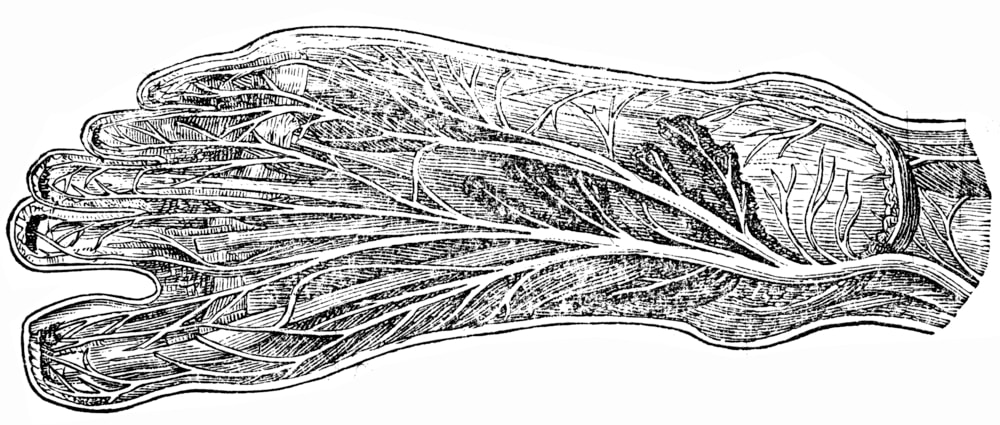 “'Nerves of the foot” an illustration from the encyclopedia publishers Education, St. Petersburg, Russian Empire 1896." I used to love riding horses. Sometimes I think about maybe doing it again one day, but I haven’t done anything about that. (I think I’m OK with that. I think. We’ll see. I digress…)
Once upon a time I was out for a little horse ride on a dirt road. My husband showed up in the car with his sister and her young children. One of them loved loved loved horses and jumped out of the [stopped] car and ran up to pet the horse in her bare feet. The horse stomped on her little foot! Needless to say, the tears came and they hopped (literally) right back in the car and headed to urgent care for an X-ray. Fast forward to this week and a homeopath friend texted… wondering if I had any remedy suggestions to add for her niece who just had her foot stepped on badly by a horse. They were already on the Arnica and Aconite and the other usual trauma remedies but she wanted to make sure she wasn’t overlooking some potentially useful remedy. (See "Remedies to consider following a major accident" for more ideas.) I immediately thought of Hypericum perforatum. Back in the early days of learning homeopathy, I was taught Hypericum is one of the first remedies to consider for a crushing injury and I figured a horse stomp to the foot has to qualify for that description. The average weight of an adult horse is between 900 to 2,200 pounds (Johnston 2023) and when they decide to stomp, that has to be some serious weight/pressure in a concentrated area. In particular, Hypericum is noted (bold and underlined) for crushed nail injuries. Why? Because there are a lot of nerves in the tips of fingers and toes. You see, Hypericum is known as “the Arnica of the nerves” meaning it's the go-to remedy for any injuries of nerve-rich areas. In addition to all those 26 bones in the foot, there are a lot of nerve endings in the feet, in general, not just in the tips of the toes. A quick look at the internet tells me there are many thousands of nerve endings in the feet. That makes sense… how many people do you know who don’t have ticklish feet? All these foot nerves play an important role in sending information to the brain about the world around us — assisting us in balance and controlling the muscles in the feet and detecting hot and cold, to name just a few. Sore feet can radiate up your legs and into your back and up to your neck. Or, conversely, foot pain can be caused higher up and radiate down and end up in the feet. (The all too painful sciatic nerve goes all the way from your buttocks down through the back of your thigh and into your foot. Sometimes this sciatic pain can be confused with plantar fasciitis.) Where else other than a foot stomp might Hypericum be useful?
What is it with homeopaths and their nieces getting their feet stomped on by horses? 🧐 I’m happy to report that neither horse stomp resulted in any broken bones. I wish I had known about Hypericum for my young niece all those years ago. Alas. Julia Coyte, CHom Classically Practical homeopath #wellnessawaits |
Julia Coyte, CHomI am passionate about homeopathy and I love sharing this passion. Having a working knowledge of homeopathy shouldn't be kept a secret. If people have the ability to help themselves, their children and their friends when they have minor ailments, life just gets better for everyone. That is the purpose behind Ruminating on Remedies. Archives
October 2026
Categories
All
|
 RSS Feed