 Do you ever watch a movie or read a book and think, that character needs XXX remedy? I do! I love reading novels. It is without question one of my favorite things to do. I just finished an enjoyable book, My Friends: A Novel by Fredrick Backman. (He wrote another book I liked: A Man Called Ove. In my opinion, read the book, skip the movie.) One line from My Friends keeps playing in my head: “Getting stabbed with a knife is a trauma for the whole body, his leg was probably the part that healed quickest, it was other parts of Ted that were limping” (p 430). This quote so beautifully relates to homeopathy. One thing happens and we generally think only of the tip of the iceberg effects. We assume (incorrectly) that, as in this case, a stab wound affects only the leg, right where it happened. But that is so not true. That wound reverberates throughout the entire system: mind, body and soul… and may linger long after the actual wound is “healed.” I have listened to a lot of lectures* by Dr. Robin Murphy. (I highly recommend doing so yourself if you have anything more than a passing interest in homeopathy.) I was reminded the other day of Dr. Murphy’s thoughts on first aid prescribing while reading a blog post from Lisa Strbac, talking about Ian Watson quoting the great late Robin Murphy from “What Heals Podcast”: The highest form of homeopathy is first aid prescribing. You homeopaths… you think it’s all this fancy miasm stuff and chronic stuff and constitutional? It’s not its first aid [sic]. Almost every chronic case, if you take it back, where did it start? It started as a shock, with a grief, an accident, with a medical procedure that went wrong. It started as a first aid situation and if that had been properly treated in the moment, someone had a home ready kit and they know what to do, this whole chain of health problems would never have needed to happen. Today, I’m going to have a little fun and see how we can address “Ted’s” stab wound. (For this exercise, I will be focusing only on highly indicated remedies for this type of wound, though, in real life, I would look at all possible remedies. It’s important to note that there is also crossover between these remedies and symptoms. For instance, “anger” is a 4 for Staphysagria and a 2 for Ledum and Apis - therefore the rubric only shows up in my list under Staphysagria.) Homeopathically, there are a few big remedies to consider. Note: these would be the same remedies which would be useful in the moment, at the time of the stab wound. I have the added benefit of a little insight into Ted after reading this book and will supply relevant quotes when available. (If a symptom shows up in multiple remedies, I will only put the quote in the first instance, unless there are multiple quotes which fit the bill.) Other symptoms I will include simply from the general sense of the character from the book. It’s a little like taking a homeopathic case! Of course, there is so much more to this than I am writing here. People, even fictional characters, are highly nuanced. I have over-simplified this entire process tremendously… but I had fun doing it! We’re not entirely certain when this stabbing occurred, except we know he was an adult. Did Ted’s history play a part in the ramifications? Probably. All the background of a person will then lead to how a person reacts when such a trauma occurs… miasms, genetics, epi-genetics, environment, experience… it’s all in there in each of us. Looking up “stab” in Dr. Murphy’s Meta Repertory (found in Similia software**), five remedies show up as highly indicated (but I only included 4 of them): Apis, Calendula, Hypericum and Ledum. Those familiar with homeopathic remedies might be saying, “But what about Staphysagria?” Good question. keep reading to find out what I learned about this. For this exercise, I focused primarily on the big 3 or 4 point symptoms in MIND and GENERAL and a quick scan through other highly indicated rubrics from things I remembered from the book. In alphabetical order: APIS From Murphy’s Materia Medica, causations (among others): Grief. Fright. Rage. MIND:
CALENDULA is another good remedy for wounds, but unfortunately, it has not been proven very well (in the traditional sense) but let’s see what we can find. Because of the dearth of level 3/4 rubrics, I opened this MIND search up to levels 1 & 2, as well. (Colin Griffith does have more information on Calendula in his “New Materia Medica Vol. 3,” but that’s a whole other topic which I will (happily!) get to one day soon.) From Murphy’s causations: Cuts. Punctures. Stabs. Surgery. Wounds. MIND:
Interestingly, those who may benefit from Calendula may be ameliorated by walking. HYPERICUM From Murphy’s materia medica: “It is called for in nervous depression following wounds, effects of shock and fright… Pain in old scars.” From Murphy’s causations (among others): ill effects of fright… punctures, lacerations… wounds, stab wounds Note: Hypericum has only one 3/4 level rubric under the MIND section in Murphy, so I added lower level rubrics for this one, too. MIND:
LEDUM From Murphy’s materia medica: “Ledum is for punctured wounds, produced by sharp-pointed instruments or bites, particularly if the wounded parts are cold, this is the remedy… Causations: ill effects punctured wounds, recent or chronic injuries.” MIND:
STAPHYSAGRIA
Has a reputation for “clean” wounds, not jagged, just as a knife would create. Dr. N.M. Choudury, senior professor of Materia Medica at Bengal Allen Homeopathic Medical College and Hospital in Kolkota, says: “We use it both internally and externally for injuries caused by sharp cutting instruments such as knife, glass, etc.” Why it’s not this clear in the repertories, I have no idea. I asked Viva (homeopathic) AI*** why Staphysagria doesn’t show up in the “stab wounds” rubric and it says, “Staphysagria is more commonly associated with emotional trauma and conditions resulting from surgical procedures rather than purely physical injuries like stab wounds. While Staphysagria can be useful for wounds, it is particularly indicated when there is a history of emotional trauma (which Ted has in spades) or when the injury is associated with feelings of anger, resentment, or violation.) To find appropriate rubrics for Staphysagria and knife wounds, one needs to search a little differently for that:
From Murphy’s materia medica: “Surgery. Lacerated tissues.” Causations: “Ill effects of anger and insults, anger suppressed or reserved. Humiliation.” MIND:
Julia Coyte, CHom Classically Practical homeopath #wellnessawaits * It looks like the Lotus Health Institute† may be moving some of their goodies around — I see a podcast and putting his lectures up for online listening. ** Similia has been kind enough to open up the full use of their software for me to play around with in exchange for any feedback I may have for them. Other than that, I have no affiliation with this company, either. *** Staphysagria info from Viva ai† cites the following: “These sources collectively contribute to the understanding of how remedies are classified and used in homeopathy, including the rationale behind the presence or absence of specific remedies in particular rubrics.” The sources cited are: Hahnemann’s Organon of Medicine; Materia Medica Pura; Andrew Lockie’s The Complete Homeopathy Handbook; Boericke’s Homeopathic Materia Medica; Clinical experience; Homeopathic repertories such as Synthesis or Kent’s Repertory “categorize remedies based on symptoms and modalities, providing insight into why certain remedies appear in specific rubrics while others do not.” † I have no affiliation with this or any other company.
0 Comments
 I’m traveling this week and I had the great pleasure of experiencing an exciting storm taking place on a river (not the river pictured below). Watching all the boats racing to cover with thunder all around and then the lightning strikes were close — Boom! Boom! Boom! I thought for sure something had been struck very close and expected to smell smoke and hear the fire engines but fortunately, nothing like that happened. Red Cross tells us that “lightning can ‘flash’ over a person’s body or it can travel through blood vessels and nerves to reach the ground. The electrical energy can cause burn injuries and cardiac arrest. The force of throwing the person can lead to traumatic injuries as well.” I had long been under the impression that if someone has been struck by lightning that one should not touch them lest they, too, would be affected by the electricity, but apparently that is not the case. Red Cross tells us that it is safe to give first aid immediately. This article goes on to say that showering, cell phones and cordless phones are safe to use but not if they are connected to a charger via an outlet and that “it’s best to not use a corded phone during a lightning storm.” The National Weather Service has a 34-page downloadable guide” Dr. Lightning’s Guide to Lightning and Thunder: Victims which is full of interesting factoids, like:
What to do if someone has been struck by lightning? For a start… Call 911 and start CPR, if necessary. Check for spinal injuries and burns. Check the eyes and ears. Keep the person calm. See here for more details. How to protect yourself? This same site says if the time between seeing a flash of lightning and hearing the thunder is less than 30 seconds, take shelter. It also says that if your hairs are standing on end or you see blue halos around objects or hear crackling in the air — a strike is imminent! (Yikes! Is there time to get to shelter?!) If you can’t get to shelter (Jones 2022):
Guess what? Some homeopathy may be useful here, too. I remember learning from a Robin Murphy lecture years ago that Phosphorus is the remedy to turn to if someone has been struck by lightning*. It is one of only 8 remedies in the rubric: Lightning strike, ailments from. Phosphorus is a fearful remedy in general, and it is also specifically for the fear of lightning. Another rubric is loss of vision after a lightning strike. (I will say this rubric is not clear as to whether this is being struck by lightning or watching a lightning strike.🤔 Looking further, some rubrics state: blindness after lightning stroke. Venice.ai* says that “strike” and “stroke” are often used interchangeably but says it can be that the “strike” refers to the event or action of lightning hitting a particular object or location and a “stroke” describes the actual discharge of electricity itself.) Another remedy to consider is Nux vomica. If it appears the person has died but actually is still alive (phew!) as well as asphyxia (oxygen deprivation) after lightning. Vertigo from lightning: Crotalus horridus. It doesn’t mention being struck by lightning, so I’m going to go with watching the lightning caused the vertigo. Note: Crot-h is one of the 8 listed remedies for ailments from lightning strikes. An injury is an injury, so don’t forget Arnica to help with any shock as well as pains. Seek (good!) shelter if lightning is near by and don’t forget to take a little kit of remedies with you on your adventures! Julia Coyte, CHom Classically Practical homeopath #wellnessawaits *As I recall, Dr. Murphy also talked about covering the lightning strike victim in dirt to help discharge the electricity. I can’t be certain because it was years ago and it was an audio lecture. I do know that he scoured all the old books and that’s where a lot of his information originated. I asked Venice.ai** this question and it said that “while covering a victim with earth is not a common practice, the underlying principle of grounding is sound. However, it’s important to prioritize standard first aid procedures and seek medical attention as quickly as possible.” I share this for whatever it’s worth. **I have no affiliation with this company. I have just started using it because it has given me more accurate information than others I have tried (so far) and it says it keeps your stuff private. Reference list
American Red Cross, 2024. Red Cross Training & Certification, and Store [online]. Red Cross. Jensenius, J., n.d. National Weather Service NOAA Dr. Lightning’s Guide To Lightning and Thunder [online]. Jones, C., 2022. First Aid for Lightning Strike [online]. Firstaidtrainingcooperative.co.uk. Venice.ai, 2025. Venice | Private and Uncensored AI [online]. Venice AI.  Back when I was enrolled at Homeopathy School International, which is an on-line school, I was paired up with another student from another part of the country. Lo and behold, the person I was paired up with lived just a few miles down the road from where I grew up and had the same name as my sister. What a small world it is!
Anyway, I learned she was embarking on quite an endeavor — a source “to bridge the information gap between your desire to use natural medicines whenever possible and your health care practitioner’s need to understand what you are taking.” That idea turned out to be a great website called, HomeoSource: Your free guide to selecting individualized natural remedies. The site is nicely laid out and supplies drop-down lists of symptoms for people, pets and plants. Did you know homeopathy can help with plants, too? It’s very cool, though I have yet to dig into it much myself, beyond having read some bits of research about it. All of the remedy suggestions made for each symptom are followed by the sources from which they came. Directions for dosage are provided on each page, as well as a handy-dandy, more generalized dosage chart. The How To’s are very helpful and include:
The Supporting Science section is, like everything in HomeoSource, nicely cited with active links to the articles and research. One interesting page takes a nice look at the Placebo Effect. I am happy to say the longest page on this site is all the links to the research. Don’t let anyone tell you there isn’t any good research about homeopathy. There is plenty of it and more all the time! Under resources, you’ll find a list of sources for finding a homeopath; links to homeopathy schools; links to continuing education for homeopaths; links to professional organizations and even a few links to some study groups in North America. My favorite resource listed, though, is For Health Care Professionals. I would love to see more health care professionals just dip a toe into learning the very basics of homeopathy. Under Remedies, you’ll find a short and sweet materia medica for the most common homeopathic remedies as well as links to purchasing kits. If you haven’t already discovered this wonderful site, head on over there and bookmark it — I’m certain you’ll find yourself visiting it over and over again! Julia Coyte, CHom Classically Practical homeopath #wellnessawaits HomeoSource is a 501(c)3 organization. If you would like to donate, click here. *I have no formal affiliation with HomeoSource, just the honor of knowing the person who created this very useful site. 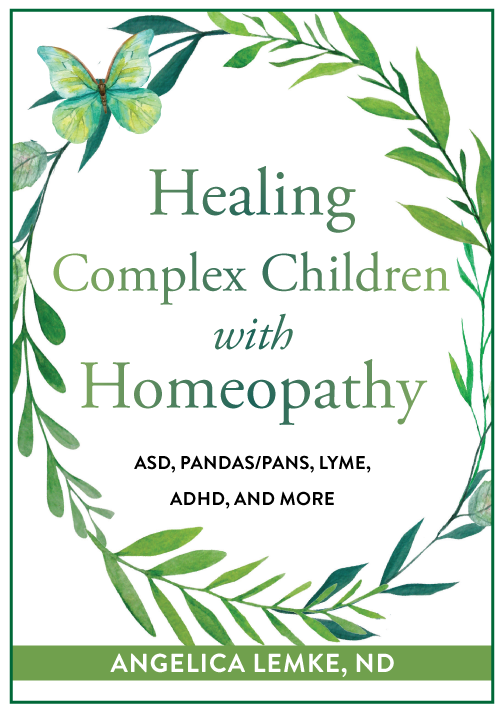 Where has the summer gone? I spoke with someone yesterday who told me their son started kindergarten that morning. I really don’t know how it happens, but once again, school is here! I thought summer vacation seemed short as a kid, but I think it seems even shorter as an adult.
I no longer have school-aged youngsters but there is no escaping all the “back to school” stuff everywhere right now. To read some previous articles about some homeopathic remedies which may help with all the emotions that come along with heading back to the classroom, check these out: Today, though, I’m going to take a little different angle. School is school for most kids — but not all kids. “Among children 8 years in 2022, ASD (Autism Spectrum Disorder) prevalence was 32.2 per 1,000 children (one in 31)” (Shaw 2025). Almost 1 in 6 US children have a developmental disability (Zablotsky et al. 2019). That translates to an awful lot of kids who may need a little extra help in school. Angelica Lemke, ND has written a really amazing book and this little review is not going to do the book justice. Healing Complex Children with Homeopathy: ASD, PANDAS/PANS, LYME, ADHD, and more is a packed (400+ pages), but straightforward and clear book written by “a homeopath and naturopath who specializes in the complex cases of children through an empathic, heart-centered approach. She has empowered many of the parents she works with to ‘find the healer within’, using homeopathy to support their family and the health of their communities.” “Invit[ing] parents to be active participants in the healing of their children” (Lemke 2021*). Before you cast this book aside because the children in your life are not “complex” and don’t suffer from any of the above listed conditions, just know that this book is pretty much a good overview of homeopathic remedies and how to use them in general. I have read a gazillion books on homeopathy and this one provided me with more than a few “aha” nuggets. Here is a link for the table of contents and introduction so you can get an overview of what’s in it. “I wrote this book to empower parents, homeopaths, and healers to use their intuition, along with homeopathic remedies, to heal the growing number of today’s children who suffer from a wide range of complex conditions.” The keyword here for how Angelica works is “intuition.” She teaches parents how to tune into their intuition and their “inner knowing” to connect their child with an appropriate homeopathic remedy. Healing Complex Children begins with chapters on the history and practice of homeopathy and then dives right into miasms (see also: Miasms, a very brief introduction). Unlike most homeopathic books written for the general public, she doesn’t just touch on the explanation of miasms, she shows us how to see them in our children and includes information on some nosodes and what physical and mental symptoms to look for which may indicate the use of these remedies. Her conclusion to this chapter is a nice list of the miasms with key remedies for each. Chapter 4: Animal Remedies: what they are made from, why they would be prescribed and how to recognize the symptoms which may lead to an animal remedy. This chapter looks at lacs (milks), spiders, insects, birds, mollusks, fish, reptiles and amphibians. Within each sub-section is a list of “notable features” which can be found in complex children. Before describing those remedies, though, Lemke provides us with a short and sweet differential list of how these remedies may show up on the physical plane, followed by a few questions which may help find an animal remedy. Each sub-section has a generalized overview of the remedy family, followed by a succinct paragraph or two with a basic introduction to each remedy — as is the case for all her remedy write-ups, they are just enough to whet the appetite and send one digging further into the materia medica. Chapter 5: Plant Remedies: includes another nice little list of a few physicals/organs and some commonly associated remedies. She writes, “While there are thousands of plant remedies that could be included here, this chapter focuses on those that I have found to be most useful in complex children. In particular, plant remedies can be critical to help address pain sensations in the body. When a child is in pain and their life revolves around it, this is the main symptom that should be addressed and plants become prime candidates.” At this point, she has a sidebar/box with a little information about Gemmos and Bach flowers. I love Gemmos and Bach flowers and am always happy to see that info being shared!! Next are questions to help find a plant remedy, followed by each plant family with a short overview and then the paragraph or two of each remedy. Chapter 6: Mineral and Periodic Table Remedies: "Mineral remedies assist with issues of structure, function, and deficiency in the body… For children who are building up their bodies, their sense of self, and their ability to process information, mineral remedies are key to helping them develop in a solid, stable way.” Lemke touches on Jan Scholten’s Element Theory and proceeds essentially through the periodic table in her listing of remedies. Within the many sub-sections are tables listing the various remedies within certain elements, e.g. carbon-based remedies; the multiple Natrum remedies, Magnesia remedies, Kali remedies, etc. We are just over halfway through this book and the huge number of remedies already covered is impressive! Chapters 7 & 8: Nosodes & Sarcodes. As mentioned above, not many homeopathy books aimed at the general population (as opposed to being written for homeopaths) include much information on Nosodes and Sarcodes. Lemke lists core sensations, physical symptoms, and gastrointestinal symptoms which may lead to the use of a nosode, followed by how to use them. In my estimation, this chapter on nosodes alone is worth the price of admission. There is so much amazingly useful information here! There is also a really nice, long section on Lyme disease and concurrent co-infections. The Sarcodes section is divided into matridonal remedies and hormones, glands and neurotransmitters — again with a paragraph on each remedy. Sarcodes are another area where there is a dearth of useful information and Healing Complex Children helps to shed some light on these important remedies… what they are, how to use them, why to use them. She explains that, “the purpose of the treatment with a sarcode is to heal the tissue so it can go back to its normal job, not to replace the energy of the tissue, such as with thyroid medication.” Chapter 9: Tautopathy. Another topic for which good information is hard to find. This book is chock-a-block full of useful stuff! Chapter 10, the final chapter in the book, is “Remedies by Categories of Complex Kids.” Sub-sections include, among others: Children with Acute Rage and Panic; Highly Anxious Children; Sad, Serious Children; Angelic Children; Hyperactive Children and ends with Common Remedies for Parents, noting: “It is of utmost importance for parents to heal themselves along with their children.” There are plenty of “woo woo” ideas in this book, which I have heard some homeopaths object to, e.g. if they “flit” from one thing to the next, they may need a Butterfly remedy. Let’s be honest here — all homeopathy is a little “woo woo.” If you have a complex child for which nothing has been able to help, maybe finding a remedy based on the fact the child “flits” is exactly what that child needs! Going beyond her book, back in 2015, based on Angelica Lemke’s practice of focusing on special needs children, she began the School of Intuitive Homeopathy: “Integrating an intuitive approach with a traditional homeopathy foundation, creating a new paradigm for the future of medicine.” Courses include:
Healing Complex Children with Homeopathy is available in the usual places, but it’s also available on her own website. And, I’m really excited about this… I just learned this book is now available on Kindle. I have a well-loved, well-thumbed, dog-eared, underlined copy and I have been hoping for an electronic version because this is a book that I return to over and over again and now I can search it electronically. Yay!! If you are interested in learning homeopathy, don’t discard this book because “children” is in the title. Know that this book is an incredibly helpful overview of this amazingly powerful modality called homeopathy; touching on all the important topics and introducing us to many remedy families as well as a large range of individual remedies. Happy reading! Julia Coyte, CHom Classically Practical homeopath #wellnessawaits * All further quotes in this article are coming from Angelica Lemke’s Healing Complex Children with Homeopathy. |
Julia Coyte, CHomI am passionate about homeopathy and I love sharing this passion. Having a working knowledge of homeopathy shouldn't be kept a secret. If people have the ability to help themselves, their children and their friends when they have minor ailments, life just gets better for everyone. That is the purpose behind Ruminating on Remedies. Archives
October 2026
Categories
All
|
 RSS Feed