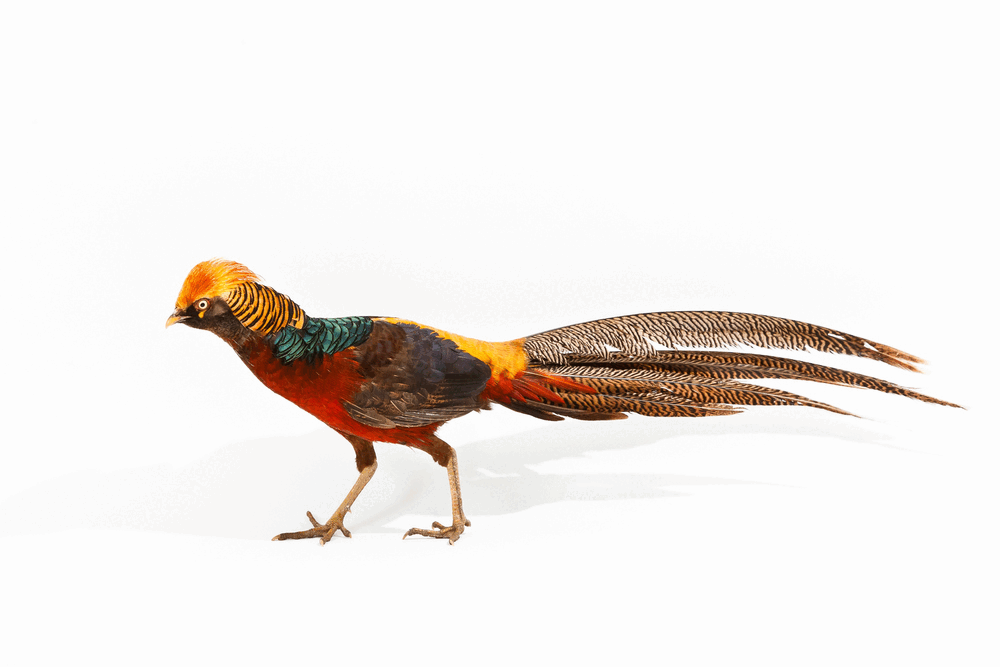
 Not a photo of the bird that adopted us, but this one looks almost as good as he did.😂 The flu is for the birds and the bird flu, well… I was asked about homeopathic remedies the other for backyard chickens. We used to have chickens (and a peacock and a Chinese pheasant adopted us for a while, too) and I can tell you that homeopathic remedies work beautifully for birds. (See Homeopathy to the Rescue.) Let’s start with giving remedies to the birds. Some say to put the remedies directly in their water. If you have a large flock, this might be the only way to do it. But, if you have a small backyard flock and it’s easy to see if only 1 or 2 birds are sickening, I like to put the pellets in a little water (or bone broth) and add some rice to the small bowl because I knew they would always go for the rice, even if they weren’t going to go for the water. (See also Making a Water Dose.) This way, you can isolate the sick chickens and make sure those who are most in need are actually getting the remedy. Another reason I like to give the remedies in a small bowl of water is that when you put the remedies directly in the birds’ waterer, it’s important to remember that every sip is a dose. However, if you have a large flock and you already have some sick birds, “dosing” the entire flock is probably the best way to approach this problem. As for the bird flu that is going around, the first thought that comes to mind is Oscillococcinum. (“Oscillococcinum 200 actually a patent property of Boiron Laboratory, France” (Julian 1980)). Well, that’s a bit simplistic, isn’t it… just to suggest using a major homeopathic flu remedy for the bird flu? Well, no, actually. The main ingredient in Oscillococcinum* is Anas barbariae which is made from the heart and liver of wild duck. Pierre Schmidt (Schmidt 2025), a homeopath of the 20th century (1894-1987), says “Oscillococcinum is for ‘influenza at the beginning as a preventative, as well as during convalescence.’” “This is the remedy at the beginning of influenza, of rhinitis and otitis. Given early it is very efficacious. To obtain good results in a case which begins and to cut short the manifestations of influenza, it is necessary to use one dose of Oscillococcinum 200c every 2 to 3 hours or repeat only if necessary” (Murphy). See here and here and here and here and here for some studies and here* for a review of Oscillococcinum trials. (Note: I think it is fair to say that at this point in history, there are not many fans of homeopathy in the mainstream medical system, and that includes researchers. Finding positive research on homeopathy is tough going for a couple of reasons: The main one, in my opinion, is that mainstream medicine has not been educated about homeopathy and therefore dismiss it as quackery. The other important reason why it is hard to find good research on the efficacy of homeopathy is that at its core, homeopathy is individualized medicine — a remedy that works for one person’s symptoms may not necessarily work for the next person’s symptoms. (See also: What to Expect.) Could Oscillococcinum work for birds and bird flu? I would certainly be willing to try it if I still had my backyard flock and if I was worried about bird flu. Apparently, bird flu is in my area (said my chicken-keeping neighbor), so I looked up what to look for in the flock. According to the Australian Government (2023):
So, what I’m seeing in these government documents, other than the combs and wattles and egg laying, are signs of the flu, but in chickens. With that in mind, symptoms are symptoms and remedies are remedies… meaning… it doesn’t matter if it’s a bird or a dog or a human, the symptoms will be noticeable and those symptoms can be addressed through the same homeopathic remedies regardless of showing up in a bird or a dog or a human. Sneezing is sneezing. Watery eyes are watery eyes. Fevers are fevers. Weakness is weakness. The only difference here, though, the chicken can’t tell us if the watery eyes or the diarrhea are acrid or bland. They can’t tell us if they they ache. Chickens run hot compared to humans (106 F) (Hobby Farms 2019), so telling if they have a fever could be a little tricky to begin with. My last article, When you have to get up… has a nice, long list of flu symptoms and possible remedies. I would say any chicken symptoms you could match with that list would work fine and dandy. The trick is translating what you’re seeing in your birds into human language. A more severe form of this disease which “presents suddenly, often with very high mortality, with affected birds developing swollen heads [emphasis mine], a blue coloration of the comb and wattles, dullness, lack of appetite, respiratory distress, diarrhea and significant drop in egg production” (2025) is another matter. Looking back in time a bit, The Poultry Doctor (Chambers 2018) originally published in 1891, mentions a swelled head: “From some cause not clear, the heads of hens will often swell greatly and be very hot. Exposure to draughts of air, however, is a fruitful cause of both swelled heads and swollen eyes. Spongia has given relief in many cases but Belladonna is the indicated remedy for this trouble; Bryonia also will relieve.” All three of these remedies are excellent flu remedies, in general. What else may help ward off the bird flu in your flock? This article has a short list of possible flu preventatives which may be applicable:
Prior to any symptoms showing up, Hyland’s Bioplasma* (or any other source of the combined cell salts — this is just the easiest to come by in most natural food stores in the US) is another good option. A couple of pellets of this combination of the twelve cell salts could easily be dropped in the flocks’ waterer for a while to help shore up their immune systems. We birds of a homeopathic feather need to flock together to keep sharing information on homeopathic remedies for humans and fowl alike! — if you would like to schedule a consult with me, drop me a line at [email protected]. Julia Coyte, CHom Classically Practical homeopath #wellnessawaits * I have no affiliation with this company, I just like their products. ** This review is not really in favor Oscillococcinum, however, I think it’s very important to note that in the “Authors’ conclusions” that it “could have a clinically useful treatment effect but, given the low quality of the eligible studies, the evidence is not compelling. There was no evidence of clinically important harms due to Oscillococcinum.” [emphasis mine] Reference list
Australian Government, 2023. Bird flu (Avian influenza) - DAFF [online]. Agriculture.gov.au. Beghi, G. M. and Morselli-Labate, A. M., 2016. Does homeopathic medicine have a preventive effect on respiratory tract infections? A real life observational study. Multidisciplinary Respiratory Medicine, 11 (1). Boericke and Tafel, 2018. The Poultry Doctor: The homeopathic treatment and care of chickens, turkeys, gees, ducks and singing birds. 2018 ed. Colombo, G. L., Di Matteo, S., Martinotti, C., Oselin, M., Bruno, G. and Beghi, G. M., 2018. The preventive effect on respiratory tract infections of Oscillococcinum®. A cost-effectiveness analysis. ClinicoEconomics and Outcomes Research [online], Volume 10, 75–82. Dutta, A., Manna, A., Ghosh, S., Mundle, M., Saha, M., Kumar Gourav, Sukhdeb Maiti and Chattopadhyay, B., 2024. Prespecified Homeopathic Medicines in the Prevention of Confirmed and Suspected Cases of COVID-19: A Community-Based, Double-Blind, Randomized, Placebo-Controlled Prophylaxis Trial. Complementary Medicine Research, 31 (2), 140–148. Hobby Farms, 2019. Chickens & Body Temperature: What You Need to Know [online]. Hobby Farms. Homeopathy Plus, 2024. Bird Flu: Are We at Risk [online]. Homeopathyplus.com. Julian, O. A., 1980. Treatise on Dynamised Micro-Immunotherapy. First Indian Edition, 1980. New Delhi - 110055 (India): B. Jain Publishers (P.) Ltd. Mathie, R. T., Frye, J. and Fisher, P., 2015. Homeopathic Oscillococcinum® for preventing and treating influenza and influenza-like illness. Cochrane Database of Systematic Reviews. Murphy, R., 2006. Nature’s materia medica : 1,400 homeopathic and herbal remedies. Blackburg, Va.: Lotus Health Institute, November. Schmidt, P., 2025. Pierre Schmidt [online]. Remedia-homeopathy.com. Scottish Government, 2025. Avian influenza (bird flu): how to spot and report the disease - gov.scot [online]. www.gov.scot. UCHealth, 2024. The bird flu has spread to dairy cows. Do you need to worry about another pandemic? [online]. UCHealth Today. Vickers, A. J. and Smith, C., 2004. Homoeopathic Oscillococcinum for preventing and treating influenza and influenza-like syndromes. Cochrane Database System Review.
0 Comments
 My latest read arrived in the mail today. “Pigs: The Homeopathic Approach to the Treatment and Prevention of Diseases.” Once I have read it, it will sit on the shelf next to “Homeopathy for the Heard: A Farmer’s Guide to Low-Cost, Non-Toxic Veterinary Care of Cattle” and the “Practical Handbook of Veterinary Homeopathy: Healing Our Companion Animals from the Inside Out.” I have more like this on the shelf, but that’s not the point of this article. The purpose of this article is to point out how marvelously well homeopathy works for all creatures. I have recently written about Rufus and his troubles ["An insecure rectum"& "What Hurts?"], but homeopathy has in the past helped our chickens and our peacock, too. Now, let's take a look at our imaginary creatures from the title of this article. I have no doubt this powerful medicine would be able to help “The Lion in Love.” That’s the Aesop’s Fable where the poor lion, in love with the woodsman’s daughter, was de-fanged and de-clawed and still denied the woodsman’s daughter anyway. This poor fellow most certainly could have been helped by Natrum muriaticum, the preeminent remedy for unrequited love. Though tiger balm isn’t made from any part of a tiger (at least not that I can find!), and can be useful for straining injuries — the mechanism behind the active ingredient is to numb and block nerve sensations to make the area feel temporarily less painful. Now, if our imaginary tiger from an Aesop’s fable was in need of tiger balm, I’m not certain it would do him much good due to his thick coat and skin. BUT, homeopathy could help him. Helios pharmacy makes a lovely remedy they call “Helios Injury.” This is a combination of Arnica, Rhus tox and Ruta grav which will bring relief to strains and sprains and bruises (oh, my! — sorry, I couldn’t resist). If you are not near a Helios (located in the UK), you can make your own combination remedy by putting a couple of pellets of each of the 3 remedies in your mouth at one time and letting them dissolve together to create this powerful remedy. The bear in Aesop's “The Bear and The Bees,” who was stung so terribly by the whole hive from whom he was trying to steal their honey… Apis mellifica is the remedy needed if the area is warm, red and swollen. But, if the sting area feels cold and it is relieved by cold, then Ledum palustre is the better choice. Whether it’s a chicken or a peacock or a dog or a pig or a whole herd of cows… homeopathy can help clear up what ails them quickly, safely and non-toxically. If you are interested in setting an appointment for your lion, tiger or bear, I'm willing to give it a try! Contact me at classicallypractical.com. |
Julia Coyte, CHomI am passionate about homeopathy and I love sharing this passion. Having a working knowledge of homeopathy shouldn't be kept a secret. If people have the ability to help themselves, their children and their friends when they have minor ailments, life just gets better for everyone. That is the purpose behind Ruminating on Remedies. Archives
October 2026
Categories
All
|
 RSS Feed