 We are definitely in the dog days of summer here in the desert southwest. It is monsoon season but the rain is not landing on us. We do have a couple of rooms in the house that have a little air conditioner, the rest of the house is cooled with a swamp cooler. For the most part, I definitely prefer the swamp over refrigerated air — the windows need to be open for them to work properly (we still hear the birds and the the little fountain!) and we’re not hermetically sealed inside and they add some much needed moisture into our desert house. For those unfamiliar, a swamp cooler is an evaporative cooler, meaning it only works during low humidity. How high does the humidity need to be for the swamp cooler to turn the house swampy? Not very — once we go above 30% humidity, it starts to feel fruitless. See here for more information. As I write this, the swamp has cooled our porch down to 80 (from the 99 outside), but with 56% humidity I have the unusual (for us) experience of a water glass covered in condensation. These hot and (relatively) humid days, remind me of the movie 12 Angry Men. Have you seen it? The original film with Henry Fonda (1957)? Fantastic movie. If you haven’t seen it, put it on the list — again, the original black and white movie. (You’ll get over it not being in color soon enough. You can do it.) 12 Angry Men is about the 12 jurors stuck in a jury room where one juror holds out against the others — and, of course they have to confront their own biases and demons while enduring a hot, sweaty environment. There’s so much to say about this movie — swimming against the current… doing what is right even though you’re alone and it’s difficult… bias, prejudice and yes, anger. I’m not the only homeopath who watches a movie and wonders what homeopathic remedy may benefit each character. (See also, Fictional Wounds for a previous take.) I wish I had taken notes during the movie to flesh out the characters and their anger. In hindsight, it was really only 11 angry men and 1 who was determined, rather than angry. With these memories of this movie popping into my head with these hot and sweaty days, I thought I would take a look at different kinds of anger. Well, sort of — more of how anger is expressed or what sets it off. Let’s now look at our 12 angry men. It has been a couple of years since I last watched it and I didn’t take notes, so I did ask Grok for a review of the characters to refresh my memory (turns out I did pretty well without any notes — the movie must have made a bigger impression on me than I realized!)
Let’s ruminate on some anger remedies (and, rubrics)! Are there other rubrics? Absolutely! It’s a movie, I went very surface level, here! Note: I used Murphy (via RadarOpus) unless otherwise noted and I kept it to just two possible remedies for each man — just enough to get a broad overview of the anger aspect of each remedy. For the man who had to be right (#1) I would consider Platinum metallicum or Lycopodium.
#2, the man who was angry about missing a ball game, Ignatia or Gelsemium.
Man #4 is an angry bigot. The top 2 remedies are Causticum and Lycopodium.
Our 5th man is timid and doesn’t take kindly to being talked over. Here comes Lycopodium again, as well as Staphysagria.
Juror #6 is the man who is angry about being looked down upon due to his upbringing. Once again, we are comparing between Staphysagria and Lycopodium.
Angry man #7 is the one who would get angry when he felt the older jurors were not being shown the respect he thought they deserved. Colocynthis and Causticum.
#8 (should probably be #1 since he was the foreman) is frustrated by the lack of order — he worked hard to keep thing running properly. Aurum metallicum and Calcarea carbonica are two remedies which take their responsibilities seriously.
The 9th man was indignant about how he perceived others’ prejudices clouding their judgement. The two remedies I would think about for this man are Nux vomica and Ignatia.
Juror #10 is the man who was righteously angry that others were not showing the proper respect to the justice system. This was a harder one to figure out, but I came down to Kali carb and Cuprum metallicum.
#11 is a man who was irritated at having to be inconvenienced. This one, too, has so many underlying possibilities, it’s hard to get a handle on it, but I am going to make a couple of assumptions in my rubric choices. The main remedy that comes up is Nux vomica but further down the way were two rubrics that led me to an interesting choice of remedy that I would not have thought about: Ipecac.
12 Angry Men nicely illustrates the individualization of homeopathy — there is not one remedy that would address the various expressions of anger in all these men. Their past experiences and the way their anger shows up and what they do with that anger — these are all very important considerations in finding a suitable homeopathic remedy. This article has been rolling around in my head since I last saw this movie a couple of years ago and I now know why it took so long to see the light of day — it’s actually a really big topic. (Look for the Digging Deeper into Angry Remedies soon.) It turns out, though, that I was more than happy to while away some of these really hot days sitting in front of my fan, listening to my little fountain outside the open window and finally putting some possible homeopathic remedies to these characters. Julia Coyte, CHom Classically Practical homeopath #wellnessawaits Reference listArndt, H. E., 1904. First Lessons in the Symptomatology of Leading Homoeopathic Remedies. accessed through Radar Opus software.
Buck, H., 1895. The Outlines of Materia Medica & Clinical Dictionary. accessed through Radar Opus software. B. Jain Publishers. Clarke, J. H., 1902. A Dictionary of Practical Materia Medica. accessed through Radar Opus software. Cowperthwaite, A. C., 1909. A Text-book of Materia Medica and Therapeutics, Characteristic, Analytical and Comparative. accessed through Radar Opus software. Farrington, H., 1935. Homeopathy and homeopathic prescribing : A study course for graduate physician. Master, F., 2017. Clinical observations of children’s remedies. New Delhi, India: B. Jain Publishers (P) Ltd. Master, F. J., 2003. Suppressed staphysagria. B. Jain Publishers. Murphy, R., 2003. Homeopathic medical repertory : a modern alphabetical repertory. Blacksburg, Va.: H.A.N.A. Press. New England Journal of Homeopathy, 1995, 4 (2). accessed via Radar Opus software New England Journal of Homeopathy, 1996, 5 (2). accessed via Radar Opus software Shore, J., 1990. Seminar Glasgow [Scotland]. Presented at the Seminar Glasgow. Accessed through Radar Opus software Vermeulen, F., 2004. Prisma : the arcana of materia medica illuminated : similars and parallels between substance and remedy. accessed through Radar Opus software. Haarlem, Netherlands: Emryss.
0 Comments
 I used to think I wanted to live forever. My then-young son told me that wasn’t a good idea. He couldn’t really explain to me at the time what he was thinking, but he was adamant. Later, we read one of his school assigned-reading books together, Tuck Everlasting by Natalie Babbitt, and the penny finally dropped for me. (Forget the fact this is a children’s book and pick up a copy — it’s excellent.)
I was recently speaking with a man in his early 90s, who said, “My mom is dead. My dad is dead. My brother is dead. My sister is dead. My wife is dead. I’ve outlived them all.” For some, this could be touted as a victorious feat and worn with a badge of honor; for others, it could be a desolate situation. If one is not feeling triumphant in this position, that is a heavy place to sit. This particular gentleman still has his best friend (same age), and he has lots of younger people around him all the time, including some good friends who are a decade or so behind him. But, it seems to me after talking to him that there is a different level of loneliness when you’re the last of your ilk. There is a tendency, I think, to assume one who is lonely is also sad. Though this may not always be the case, Julia Métraux in Everyday Health says depression and loneliness appear to reinforce each other. From that same article, Drew Maygren, DO, a psychiatrist at Kaiser Permanente in Oakland, California says, “Among a cohort of older adults in the UK, there was a 29% increase in depressive scores of those that reported loneliness compared with those who did not report loneliness.” For other reasons, loneliness is also increasing among young people with 1 in every 3 young adults reporting feeling lonely. Gone are the days of mandatory human interaction, replaced, instead by technological interfacing which some say can make loneliness “more like virtual isolation.” In some respects, you can’t fix normal. This is simply a sad situation. I think, though, homeopathy can help one cope with this heavy, lonely burden. Let’s look at some possible MIND rubrics, using various repertories (Mangialavore*; Murphy (both Homeopathic Remedy Guide and Meta*); Saine; Schroyens), followed by the number of remedies listed in each, including the remedies I have chosen to highlight (note: when rubrics were available in multiple repertories, I chose to use the one with the largest number of remedies available):
There are other, smaller, more specific rubrics which I will not throw into the mix, such as: “being a castaway” or “imaginations, alone, graveyard, in a” — but I think it’s useful to know these rubrics exist. **Continuing the theme from the Language of Rubrics earlier this month: Delusion: in modern parlance, we may equate this with someone who is “delusional,” implying someone with a mental illness. That is not necessarily the case in the language of rubrics. Delusion = a false judgement of objective things. Dr. Muhammed Rafeeque’s Reverse Repertory of the Mind explains further:
“Wrong perception” sums it up nicely, I think. Now, let’s see what remedies are indicated for these thoughts… Rafeeque lists some of the important drugs for delusions/hallucinations and illusions: Argentum nitricum; Belladonna; Coccinum; Hyoscyamus; Ignatia; Lachesis; Petroleum; Phosphoric acid; Sabadilla; Stramonium; Sulphur (which is found only in the large “loneliness” rubric). (The bold remedies in this list are also represented in our rubrics listed above.) It’s important when choosing a remedy to consider the following differentiation: is this a rubric to lift the delusion or idea, or, is this a rubric addressing the loneliness? What are we trying to achieve? There are many, many homeopathic remedies which may be relevant here, but I have chosen just a couple of commonly available remedies to compare. Natrum muriaticum, Aurum metallicum, Phosphorus, Pulsatilla, Argentum nitricum and Arsenicum album are all well indicated; in fact, all of them are also in Murphy’s “elderly constitutions” rubric (90). For each head to head comparison, both remedies are indicated, but one may be a little more indicated than the other and I tried to simply give a flavor of each remedy in regard to how they may relate to loneliness. Nat mur and Aurum are both excellent sadness/depression remedies.
Phosphorus and Pulsatilla both hate to be alone. In very broad terms, Phosphorus is more fearful and Pulsatilla is sadder.
Arsenicum album and Argentum nitricum are two more "fearful/anxious” remedies (both are level 4 in Murphy in the anxiety rubric). Again, both of these remedies are in all of these rubrics; I have just highlighted the higher ranked remedies.
Bellis perennis showed up very strongly in Massimo Mangialavore’s*** rubric: Age - old people - mind - forsaken feeling… so I went looking a little further and I was surprised to see it in the ailments from death of loved ones rubric. Most people know Bellis as a “deeper” Arnica — something to try when Arnica doesn’t quite do what it is needed to do on a physical level. Let’s take a little look at some prominent mental symptoms of Bellis perennis (Schroyens & Murphy’s Meta*): Anxiety about their or their or loved one’s health. Indifference: to pain; to loved ones; stoical to what happens. (The word “stoical” is in this rubric so I am going to assume this is different than “apathy.” note: Mangialavori has this remedy in both “heroic” and “stoic.”) Too much sense of duty. Dictatorial/domineering. Aversion to being touched. Aggravated by consolation. Abandoned/forsaken feelings. Ailments from agony/anguish; ailments from grief. Anger alternating with indifference. Fastidious. Fearful of impending danger and heart disease. Panic attacks. Feels friendless; forsaken feeling. Silent grief; cannot cry. They feel better from physical exercise. Aggravated by company. Oversensitive to criticism/reprimands. All of these, ultimately overlapping, remedies may help regardless of age, or reason for the loneliness. Look a little beyond the surface of loneliness and see what lies underneath to find the most well-suited remedy. Julia Coyte, CHom Classically Practical homeopath #wellnessawaits *Both Mangialavore’s and Murphy’s Meta repertory are (will be?) available in Similia.io†. **This note is beneath the list of rubrics, in the text. ***I recently listened to a talk by Massimo Mangialavore and he was talking about the idea that perhaps we don’t need more homeopathic remedies but that maybe we should work on the quality of the information we have on our existing remedies rather than keep adding more. He also says he doesn’t “consider a good case something where the follow-up is not at least four, five years.” With that, I put a little more stock in the remedies in his repertory because they generally come with a lot of reflection. †I have no affiliation with this company other than they have been kind enough to open up the full software for me to play around with it. I have to say, I really like Similia and I enjoy using it. Reference list Métraux, J. and Vann, M. R., 2012. Dealing With Depression and Loneliness [online]. EverydayHealth.com. MUHAMMED., D. and Salini, J. P., 2021. Reverse Repertory of the Mind. B. Jain Publishers (P.) Ltd. Newport Institute, 2022. Loneliness and Depression in Young Adults [online]. Newport Institute. 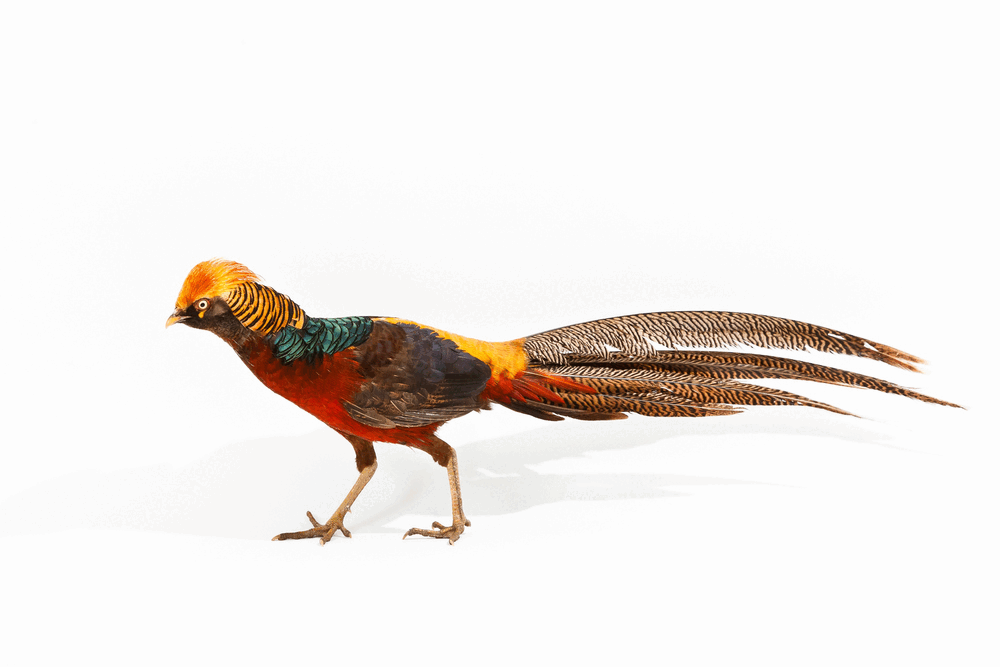 Not a photo of the bird that adopted us, but this one looks almost as good as he did.😂 The flu is for the birds and the bird flu, well… I was asked about homeopathic remedies the other for backyard chickens. We used to have chickens (and a peacock and a Chinese pheasant adopted us for a while, too) and I can tell you that homeopathic remedies work beautifully for birds. (See Homeopathy to the Rescue.) Let’s start with giving remedies to the birds. Some say to put the remedies directly in their water. If you have a large flock, this might be the only way to do it. But, if you have a small backyard flock and it’s easy to see if only 1 or 2 birds are sickening, I like to put the pellets in a little water (or bone broth) and add some rice to the small bowl because I knew they would always go for the rice, even if they weren’t going to go for the water. (See also Making a Water Dose.) This way, you can isolate the sick chickens and make sure those who are most in need are actually getting the remedy. Another reason I like to give the remedies in a small bowl of water is that when you put the remedies directly in the birds’ waterer, it’s important to remember that every sip is a dose. However, if you have a large flock and you already have some sick birds, “dosing” the entire flock is probably the best way to approach this problem. As for the bird flu that is going around, the first thought that comes to mind is Oscillococcinum. (“Oscillococcinum 200 actually a patent property of Boiron Laboratory, France” (Julian 1980)). Well, that’s a bit simplistic, isn’t it… just to suggest using a major homeopathic flu remedy for the bird flu? Well, no, actually. The main ingredient in Oscillococcinum* is Anas barbariae which is made from the heart and liver of wild duck. Pierre Schmidt (Schmidt 2025), a homeopath of the 20th century (1894-1987), says “Oscillococcinum is for ‘influenza at the beginning as a preventative, as well as during convalescence.’” “This is the remedy at the beginning of influenza, of rhinitis and otitis. Given early it is very efficacious. To obtain good results in a case which begins and to cut short the manifestations of influenza, it is necessary to use one dose of Oscillococcinum 200c every 2 to 3 hours or repeat only if necessary” (Murphy). See here and here and here and here and here for some studies and here* for a review of Oscillococcinum trials. (Note: I think it is fair to say that at this point in history, there are not many fans of homeopathy in the mainstream medical system, and that includes researchers. Finding positive research on homeopathy is tough going for a couple of reasons: The main one, in my opinion, is that mainstream medicine has not been educated about homeopathy and therefore dismiss it as quackery. The other important reason why it is hard to find good research on the efficacy of homeopathy is that at its core, homeopathy is individualized medicine — a remedy that works for one person’s symptoms may not necessarily work for the next person’s symptoms. (See also: What to Expect.) Could Oscillococcinum work for birds and bird flu? I would certainly be willing to try it if I still had my backyard flock and if I was worried about bird flu. Apparently, bird flu is in my area (said my chicken-keeping neighbor), so I looked up what to look for in the flock. According to the Australian Government (2023):
So, what I’m seeing in these government documents, other than the combs and wattles and egg laying, are signs of the flu, but in chickens. With that in mind, symptoms are symptoms and remedies are remedies… meaning… it doesn’t matter if it’s a bird or a dog or a human, the symptoms will be noticeable and those symptoms can be addressed through the same homeopathic remedies regardless of showing up in a bird or a dog or a human. Sneezing is sneezing. Watery eyes are watery eyes. Fevers are fevers. Weakness is weakness. The only difference here, though, the chicken can’t tell us if the watery eyes or the diarrhea are acrid or bland. They can’t tell us if they they ache. Chickens run hot compared to humans (106 F) (Hobby Farms 2019), so telling if they have a fever could be a little tricky to begin with. My last article, When you have to get up… has a nice, long list of flu symptoms and possible remedies. I would say any chicken symptoms you could match with that list would work fine and dandy. The trick is translating what you’re seeing in your birds into human language. A more severe form of this disease which “presents suddenly, often with very high mortality, with affected birds developing swollen heads [emphasis mine], a blue coloration of the comb and wattles, dullness, lack of appetite, respiratory distress, diarrhea and significant drop in egg production” (2025) is another matter. Looking back in time a bit, The Poultry Doctor (Chambers 2018) originally published in 1891, mentions a swelled head: “From some cause not clear, the heads of hens will often swell greatly and be very hot. Exposure to draughts of air, however, is a fruitful cause of both swelled heads and swollen eyes. Spongia has given relief in many cases but Belladonna is the indicated remedy for this trouble; Bryonia also will relieve.” All three of these remedies are excellent flu remedies, in general. What else may help ward off the bird flu in your flock? This article has a short list of possible flu preventatives which may be applicable:
Prior to any symptoms showing up, Hyland’s Bioplasma* (or any other source of the combined cell salts — this is just the easiest to come by in most natural food stores in the US) is another good option. A couple of pellets of this combination of the twelve cell salts could easily be dropped in the flocks’ waterer for a while to help shore up their immune systems. We birds of a homeopathic feather need to flock together to keep sharing information on homeopathic remedies for humans and fowl alike! — if you would like to schedule a consult with me, drop me a line at [email protected]. Julia Coyte, CHom Classically Practical homeopath #wellnessawaits * I have no affiliation with this company, I just like their products. ** This review is not really in favor Oscillococcinum, however, I think it’s very important to note that in the “Authors’ conclusions” that it “could have a clinically useful treatment effect but, given the low quality of the eligible studies, the evidence is not compelling. There was no evidence of clinically important harms due to Oscillococcinum.” [emphasis mine] Reference list
Australian Government, 2023. Bird flu (Avian influenza) - DAFF [online]. Agriculture.gov.au. Beghi, G. M. and Morselli-Labate, A. M., 2016. Does homeopathic medicine have a preventive effect on respiratory tract infections? A real life observational study. Multidisciplinary Respiratory Medicine, 11 (1). Boericke and Tafel, 2018. The Poultry Doctor: The homeopathic treatment and care of chickens, turkeys, gees, ducks and singing birds. 2018 ed. Colombo, G. L., Di Matteo, S., Martinotti, C., Oselin, M., Bruno, G. and Beghi, G. M., 2018. The preventive effect on respiratory tract infections of Oscillococcinum®. A cost-effectiveness analysis. ClinicoEconomics and Outcomes Research [online], Volume 10, 75–82. Dutta, A., Manna, A., Ghosh, S., Mundle, M., Saha, M., Kumar Gourav, Sukhdeb Maiti and Chattopadhyay, B., 2024. Prespecified Homeopathic Medicines in the Prevention of Confirmed and Suspected Cases of COVID-19: A Community-Based, Double-Blind, Randomized, Placebo-Controlled Prophylaxis Trial. Complementary Medicine Research, 31 (2), 140–148. Hobby Farms, 2019. Chickens & Body Temperature: What You Need to Know [online]. Hobby Farms. Homeopathy Plus, 2024. Bird Flu: Are We at Risk [online]. Homeopathyplus.com. Julian, O. A., 1980. Treatise on Dynamised Micro-Immunotherapy. First Indian Edition, 1980. New Delhi - 110055 (India): B. Jain Publishers (P.) Ltd. Mathie, R. T., Frye, J. and Fisher, P., 2015. Homeopathic Oscillococcinum® for preventing and treating influenza and influenza-like illness. Cochrane Database of Systematic Reviews. Murphy, R., 2006. Nature’s materia medica : 1,400 homeopathic and herbal remedies. Blackburg, Va.: Lotus Health Institute, November. Schmidt, P., 2025. Pierre Schmidt [online]. Remedia-homeopathy.com. Scottish Government, 2025. Avian influenza (bird flu): how to spot and report the disease - gov.scot [online]. www.gov.scot. UCHealth, 2024. The bird flu has spread to dairy cows. Do you need to worry about another pandemic? [online]. UCHealth Today. Vickers, A. J. and Smith, C., 2004. Homoeopathic Oscillococcinum for preventing and treating influenza and influenza-like syndromes. Cochrane Database System Review.  I have a confession to make: I’m always amazed when somebody says they don’t experience headaches. As someone who has been known to experience headaches, it’s unfathomable to me that people exist who have never experienced such a thing. We headache sufferers assume everybody knows what we’re talking about. According to Stovner (et al. 2022), 52% of the world population experiences headaches. 14% experience migraines. Up to 1 adult in 20 has a headache every - or nearly every - day (World Health Organization 2014). Wow. Painful. Disabling. Disruptive. Exhausting. Boring. Troublesome. Worrisome. Irksome. Annoying. I don’t think there are any pleasant words to use for headaches because having a headache is a thoroughly unpleasant experience. I have written previously about headaches and homeopathy (see: “The Road Less Traveled” and now let’s take a look at how the cell salts may help. Headaches are well indicated in most cell salts with the exception of Calc fluor and Kali mur. But, as we have learned previously, my headache is not like your headache and your headache is not like your neighbor’s headache, and so on, and so on, and so on… (See “Garbage In, Garbage Out”.) So let’s break down the cell salt headaches, shall we? Location, causation, pain quality and concomitant (accompanying) symptoms all play an important role in landing on the “right” cell salt for headaches. Calc phos may be worse near the region of sutures (a seam-like immovable junction between two bones; where the skull bones meet). The pain may be burning or throbbing and may be brought on by over-study, watching television or after receiving sad or bad news. Gut issues may be involved, like: diarrhea, flatulence, and nausea. Musculoskeletally speaking, these headaches may accompany trembling hands or rheumatism. Calc sulph has pain around the whole head. It may be caused by injuries or blows or sinusitis and may be accompanied by vertigo and nausea. A Ferr phos headache may feel as if a nail has been driven into the head with throbbing in the temples or over the eyes. These headaches could be caused by weather (cold, sun or heat) or a rush of blood to the head and may be accompanied by fever; photophobia; red eyes and face; a tender scalp or vomiting. Motion and noise may make it worse. Kali phos headaches may be described as “nervous headaches” with what feels like a weight in the back part of the head. Students or others who are worn out and exhausted may need this and may find an empty feeling in the stomach or vomiting with weariness and yawning. These headaches might be worse in the evening or in a heated room and extraneous noise may be unwanted. Kali sulph may feel like the head has been placed in a vice or as if a metal band has been put around the head. These headaches often begin in the evening and may result from becoming heated. Accompanying chills, dizziness or nausea may be present. Mag phos headache pain may be described as darting or excruciating, pounding, shooting, sharp, stinging or spasmodic. These headache sufferers may be irritable with possible sparks in their vision before or during the headache. Nat mur is a big headache remedy — for hammering, throbbing, dull, or periodical headaches with a lot of mucus and/or lachrymation and profuse saliva. Vision may be disturbed. There may be chills or constipation or eye pain. These headaches may be before, during or after a fever. Becoming heated, over-exertion of the eyes, injuries, walking or running, sun exposure or sinusitis may bring this headache on. The person may feel depressed or dull; the headache may be worse in the mornings. Nat phos headaches may be felt on the top of the head, especially on waking in the morning. These headaches are felt as pressure, intense with heat and nausea; the skull feels too full and there is a tight feeling in the head. Drinking wine or milk, as well as eyestrain may bring on this headache which may also be accompanied by gastric issues or sour vomit. Nat sulph is well known for its use in head injuries. These headaches may be felt as a pulsation on the top of the head and may be described as a “sick” headache and be accompanied by nausea and a bitter taste in the mouth with salivation. Dizziness and the vomiting of bile may be worse in damp, warm weather. Silicea headaches may be chronic and experienced as coming up from the nape of the neck. These headaches may be brought on from heat, eyestrain, fasting, overdoing it physically (lifting/straining of muscles), study or sex. The person may be oversensitive. The pain may be accompanied by chills, fever, insomnia, vomiting or weakness. Vision may be disturbed or dim and they may experience noises in the ears, a roaring, as well as being sensitive to noises. Generally speaking, headaches in children respond well to Ferr phos or Calc phos; Calc phos especially if the headache occurs during dentition. Students may respond well to Nat mur, Calc phos or Silicea. Headaches are terrible. Chronic headaches are nearly unbearable. If you are a chronic headache sufferer, click here for a free introductory chat to see if homeopathy may be helpful to you. Julia Coyte, CHom Classically Practical homeopath #wellnessawaits Reference list
Stovner, L. J., Hagen, K., Linde, M. and Steiner, T. J., 2022. The global prevalence of headache: an update, with analysis of the influences of methodological factors on prevalence estimates. The Journal of Headache and Pain [online], 23 (1). World Health Organization, 2014. Headache disorders: How common are headaches? [online]. www.who.int.  On the 9th day of cells salts, Dr. Schüssler gave to us… Natrum muriaticum. Nat mur is made from Chloride of Soda, also known as Common Table Salt. It is a water distributor — bringing balance to the distribution of fluids in the body. Nat mur is the cell salt for mucous membranes — any time things are too dry or too wet: watery discharges (like tearing eyes) or dryness and dehydration. Conditions which may benefit from Nat mur:
Mentally and emotionally, low spirits, irritability, especially from little things; melancholy, weeps easily; grief. Julia Coyte, CHom Classically Practical homeopath #wellnessawaits Reference list
Carey, G. W., 1996. The Biochemic System of Medicine. Health Research Books. Chapman, E., 1960. How to Use the Twelve Tissue Salts. Nutri Books. Dewey, W. A. and Boericke, W., 2022. The Twelve Tissue Remedies of Schüssler: Comprising the Theory, Therapeutic Application, Materia Medica, and a Complete Repertory of These Remedies. H. Legare Street Press. Hyland's, 2024. Cell Salt #1 Calc Fluor [online]. Hyland’s. McCabe, V., 2009. The Healing Echo. ReadHowYouWant.com. Schuesslertissuessalts.com.au, n.d. Schuessler Tissue Salts - 150 Years Of Natural Medicine In Australia [online]. Schuessler Tissue Salts. Schüssler, W. H., 2003. Schüssler’s twelve tissue remedies : comprising the theory, therapeutic applications, materia medica and a complete repertory of tissue remedies. Sittingbourne, Kent: Homæopathic Book Service. Strbac, L., 2024. Schuessler’s Tissue Salts Rediscovered. Weintraub, S., 1999. Natural healing with cell salts. Pleasant Grove, Ut: Woodland Pub.  The point of life is balance, not perfection. This sentiment keeps popping up everywhere I turn. I’m taking it as a direct communication from the universe to me. You see, I’m not very good at balance — I’ve always been a kind of an all or nothing sort of gal. Physically, I’m pretty decent with balance. In a former life, I was a recreational figure skater and I could do my spirals and my spins and I could land my basic jumps on one blade. I used to slalom water ski as well as snow ski and those take balance. When we had to do gymnastics in PE, I was horrible at every single part of it, except the balance beam. Mentally, that’s another story. I used to think I was good at balance but only because I was juggling lots of things at once — which, in fact is not a demonstration of balance at all, just an act of mental acrobatics. I start making jewelry and that’s all I think about for the next couple of years. I decide to try my hand at art and I am almost paralyzed by the need for it to feel “perfect” and then I’m unable to do anything at all. I discover homeopathy and I drop everything else and decide there simply aren’t enough hours in the day to study this fascinating system of medicine. So, having this mentality, I have perfected the art of giving stuff up, that’s for sure. (Remember, "all or nothing" was my motto.) I'm pretty good at embracing an all-encompassing deep dive on things, often at the expense of other things. Even writing these articles -- recently taking a step back from writing weekly weighs on my mind heavily. It's a struggle to remember that "about weekly" (as I stated in the "about" section of Ruminating on Remedies) is not the same thing as weekly. However, it's never too late to start a good habit and I have finally come to the realization that it’s time to accept the idea of Wabi Sabi. I’ve heard of this concept before, but I am new to putting it into practice, but I like it, and I’m thinking this might be a good answer for me. Wabi Sabi is a traditional Japanese aesthetic that celebrates the beauty of imperfection and impermanence. Perhaps embracing this philosophy is the way out of my all or nothing mentality. Perfection, or the pursuit thereof, is an admirable goal, I suppose. But, it’s really not a very healthy way to live a life. I always tell my clients when using homeopathy that we are NOT looking for perfection, we’re looking for improvement. (See: What Now and Perfect is the Enemy of the Good.) What is it we are looking for? As a reminder, we are looking for the symptoms to pop up a little less often and when they do, to be a little less intense and hopefully we see an improvement in mood and/or energy. If one struggles with the idea of needing to be perfect, there are some excellent homeopathic remedies to consider. Ignatia is the first remedy that comes to mind for perfection. Ailments from disappointments. Unhappy love. Idealistic. Nervous. High goals, high ambitions, high ideals and high expectations and a burning desire to fulfill them (Master 2009). Intolerant of contradiction. Expectation of others to be perfect. Strong sense of inner duty. Nux vomica for overstudy; "close application to business, with its cares and anxieties" (Vermeulen 2015). These mental strains may lead to the use of stimulants, possibly in excess. Keeping late hours and displaying an irritable temper. Everything makes too strong an impression on this overloaded nervous system. See also: Overwhelmed for further discussion comparing Ignatia and Nux vomica. Arsenicum album for the fastidious person who wants everything neat and clean and tidy and just right. Even when feeling poorly, the person who may benefit from Arsenicum alb may direct someone to tidy up the sick room a bit. This is a person who, in the words of George Vithoulkas, takes "order and cleanliness to the point of expending inordinate energy constantly cleaning and straightening" (Vithoulkas 2015). Natrum muriaticum for one who is responsible and perfectionistic. They may "be compulsively fastidious, trying to control the environment". They may display a "type of hypochondria… expressed as an anxious desire to find the cause of every blemish or pimple" (Morrison 1993). Nat mur cell salt also plays an important role in balancing fluids in the body… if there is excessive dryness or excessive mucus production (for example), Nat mur may be of help. As American poet Henry Van Dyke very eloquently states, “Use what talents you possess; the woods would be very silent if no birds sang there except those that sang best.” Life is too short. Drop the idea of perfection. Let it go. Sing the song, regardless of talent. Paint the picture. Write the story. Live a good life and enjoy yourself while you're at it. Julia Coyte, CHom Classically Practical homeopath #wellnessawaits Reference list: all books accessed through RadarOpus software
Master, F. J., 2009. Clinical Observations of Children Remedies B. Jain Publishing. Morrison, R., 1993. Desktop guide to keynotes and confirmatory symptoms. Nevada City, Calif.: Hahnemann Clinic Pub. Vermeulen, F., 2015. Concordant reference : complete classic materia medica : 1284 remedies. Glasgow: Saltire Books. Vithoulkas, G., 2015. Essence of materia medica. Usa: B. Jain Publishers (P) Ltd.  The Bristol stool scale was developed at the Bristol Royal Infirmary in 1997 and is based on the poops of approximately 2,000 people. Developed by Dr. Ken Heaton, this scale makes it a little easier for people to discuss what comes out the other end. One way of looking at this scale is to think about how much water is in each type of poop. 1 & 2 are very dry and may be seen when one is constipated. 6 & 7 are considered diarrhea — plenty of water in these poops. #4 is Goldilocks (Goldilogs?!) and 3 & 5 are either side of “just right” and considered pretty good. NOTE: if you consistently pass either the hard poops or the mushy poops, OR, if you switch back and forth between the two, then you may want to speak with a physician.  Let’s talk about how these poops come about. For this information, I’m going to rely primarily on Gut: The Inside Story of our Body’s Most Underrated Organ by Giulia Enders* (2015). (Sometimes word for word and sometimes paraphrased. Rest assured, all this technical info is coming from here, unless otherwise mentioned.) Poops are 3/4 water. 1/3 of the solids are bacteria. Another 1/3 is indigestible vegetable fiber. (The more fruit and veg you eat, the more feces you excrete per bowel movement.) The last 1/3 is stuff your body wants out: remains of medicines, food coloring or cholesterol. Enders says the type of poop can indicate how long it takes for the indigestible particles to pass through one’s gut. With this in mind, she says Type 1, the rabbit pellets — the hard, little lumps — can take around 100 hours to pass through the system. On the other end, Type 7 — the diarrhea — can whiz through in 10 hours (or less!). Let me add here that Lewis and Heaton (1997) found the Bristol Stool Scale is a useful guide to intestinal transit time. If you are in the envied position of regularly doing 3s and 4s, Enders says to make sure to observe how quickly they sink. If they sink too quickly it may indicate they still contain nutrients that weren’t digested properly. Kate Deering, author of How to Heal Your Metabolism (2015) describes a healthy feces as "firm, about 6-8 inches in length and about an inch in diameter." She continues: "If you are having a hard time eliminating you may be dehydrated and need to add in more minerals (primarily salt), fruit and water-containing foods to your diet." How long should it take to poop? That’s a trickier question than it first appears to be. Soft Matter journal (Yang et al. 2017) says the average mammal — regardless of size — takes just 12 seconds to poop. According to Mayo Clinic (Rajan 2019), it takes about 6-8 hours for food to pass through the stomach and small intestine. Then it moves into the large intestine for further digestion, absorption of water … taking about 36 hours to get all the way through the system. Dr. Sonpal (Migala 2020) says it should take no more than 5-10 minutes to complete a poop with “minimal straining.” What’s the best way to get the poop out? Back to Gut again, an Israeli doctor, Dov Sikirov, had 28 test subjects poop in three different positions (normal toilet, half sit/half squat on a low toilet and squatting without a seat) and recorded how long they each took and recorded how much straining each position required: “The results were clear. In a squatting position, the subjects took an average of 50 seconds and reported a feeling of full, satisfaction bowel emptying. The average time when seated was 130 seconds and the resulting feeling was deemed to be not quite so satisfactory.” Japanese researchers wanted a bit more assurance and they actually fed their volunteers “luminous substances” and x-rayed them while pooping in various positions. Again from Gut, “squatting does indeed lead to a nice, straight intestinal tract, allowing for a direct, easy exit.” Long story short here: if you have problems getting the poop out, try a squatting stool* (Do a quick search for “squat” and “toilet” and see the options available.) OK, back to the Bristol Stool Scale… NOTE: If you experience the following symptoms during bowel movements (pain, blood, excessive mucus), especially if they are ongoing, or, if you have recently had a change in bowel habits, be sure to seek professional medical advice. Homeopathy is all about balancing the entire system. The best way to do this is with a full consultation with a professional homeopath who is taking all sorts of everything into consideration. With that in mind, a good stool remedy is a good stool remedy. Bryonia may be my go-to remedy to think about for constipation (a “3” in Murphy’s repertory), but it’s also listed under the opposite: forcible, sudden, gushing, but this time it is a “1”. I am putting out a few remedies to consider for various stool issues, but don’t lock yourself into a hard-line of thinking here — there is flexibility. Don’t get stuck into, “but Bryonia is a dry poop remedy” way of thinking — Bryonia can be a good remedy for stools, in general. Type 1: also known as rabbit droppings. I have known young mothers who didn’t mind when their little ones had these — they could skip the diaper change and literally just pull the little pellets out of the diaper and carry on with the day. Easy? I suppose so. But if your little one is popping out this kind of poop, there might be some dehydration issues going on. Seriously. Don’t take this as normal. Homeopathically, we could look at rubrics such as: Stool, Balls, Stools like; or, like small balls; or, like laurel berries. There are lots of good remedies listed for this, but I would start with Alumina, Bryonia, Nat mur or Plumbum. (Can I just say how much I love the name Plumbum? It’s Latin for lead and I think it’s just perfect — it’s helpful for plumbing the bum and getting the lead out when one is all bunged up 🤣.) Dry stool is an even bigger rubric with a lot of the above-repeating rubrics. However, I would start with Bryonia or Nux vomica. If it’s a dry and crumbling stool, Alumina. If it’s a dry stool which kind of starts and stops and then recedes, start with Silica. Type 2: still dry, but this time the pebbles have been fused together. For this one, all of the above dry stool remedies are worth considering, but I would probably start with Nux vomica. If it’s a lumpy stool covered with mucus**, start with Alumina. A dry and crumbling stool, Alumina or Nat mur. A lovely rubric: Stool, Sheep, dung, like - agglutinated, masses of: Plumbum. Type 3: is a little tougher to distinguish, homeopathically speaking. 3 is moving toward the “Goldilog” so perhaps just a little more fluid in your diet should do the trick? Type 4: smooth sailing — keep up the good work! Type 5: the pediatric Bristol Stool Form Scale describes this as “chicken nuggets” — soft blobs with clear-cut edges (passed easily). Like Type 3, I think we’re hovering around “good to go” — there may not be an issue here that needs to be addressed. Type 6: A mushy stool — not formed. If it looks like corn meal: Bryonia. Other remedies to consider: Rhus tox and Podophyllum. If it’s an involuntary soft stool, start with Aloe. Type 7: entirely liquid — now we’re moving into total diarrhea territory and there are many, many remedies to address this. I will be writing more in-depth about diarrhea shortly, but for today, let’s just start with Arsenicum album, China officinalis or Phosphoric acid. Once again, if your regular stool is not hovering around 3, 4, and 5, please seek a professional medical opinion. Don’t forget to check out the deposits you make into the porcelain bank! Any regular stools on either end of this scale should be evaluated by a medical professional. Julia Coyte, CHom Classically Practical homeopath #wellnessawaits * I have no affiliation with this book, I just really like it — very fun and highly readable! ** (Note: A small amount of mucus on the stool is usually not a cause for concern. Mucus lines your intestines to keep your colon running smoothly, among other tasks. However, if there is excessive mucus in or on the stool it may be a sign of an underlying condition such as: Irritable Bowel Syndrome, Inflammatory Bowel Disease, Crohn’s Disease, Ulcerative Colitis, food poisoning, bowel obstruction or blockage, cancer of the rectum or colon. If you have excessive mucus or even a small amount of mucus which is on-going, seek professional medical advice, especially if it is accompanied by abdominal pain, bloody stools, fever or weight loss (Mayo Clinic). Check out this article for more information.) REFERENCES:
Deering, K., 2015. How to heal your metabolism : stop blaming aging for your slowing metabolism! : learn how the right foods, sleep, the right amount of exercise, and happiness can increase your metabolic rate and help heal your broken metabolism. United States: Createspace Independent Publishing Platform. Enders, G., 2015. Gut : the Inside Story of Our Body’s Most Underrated Organ. Greystone Books. Lewis, S. J. and Heaton, K. W. (1997) ‘Stool Form Scale as a Useful Guide to Intestinal Transit Time’, Scandinavian Journal of Gastroenterology, 32(9), pp. 920–924. Migala, J., 2020. How Long It Should Take to Have a Healthy Poop, According to Gastroenterologists [online]. Livestrong.com. Yang, P. J., LaMarca, M., Kaminski, C., Chu, D. I. and Hu, D. L., 2017. Hydrodynamics of defecation. Soft Matter, 13 (29), 4960–4970.  As seen many, many months ago in my news feed. I have no idea where it comes from, but I like it. Anybody out there getting stressed out watching the news?
I suppose this post could have been written at any point in history, but 2024 seems to be gearing up for a new level of stressful watching/listening/reading. If you find yourself getting upset by the news, have a think about a few of these homeopathic remedies: Ignatia is a good place to start. (SEE: Homeopathy Can Make a Heavy World a Little Lighter) Homeopathic Ignatia can be found in the following rubrics:
Now, a short list of a few other remedies which may be applicable (as found in a quick look of Robin Murphy's Repertory): Obsessive compulsive disorder (as may be acutely exhibited through an irrepressible need to keep checking the updated news feeds): Nux vomica or Argentum nitricum Trembling with anger: Staphysagria or Gelsemium Trembling from anxiety: Gelsemium or Argentum nitricum Trembling as if frightened: start with Gelsemium but also Aconite, Coffea, Ignatia Headaches following depressing or sad news: Gelsemium or Ignatia Shock from hearing bad news: Gelsemium, Ignatia or Calc carb Vertigo from bad news: Calc carb Obsessed with justice: Causticum If all these thoughts are creating anxiety: Argentum nitricum If all of these stories and images and thoughts keep you from sleeping: Coffea If all these thoughts are keeping you from concentrating: Nux vomica If your mind is preoccupied with thoughts of the future: Argentum nitricum. Persistent thoughts: Argentum nitricum is the place to start, but also: Calc carb or Nat mur. Witnessing traumatic events: Aconite Rapid thoughts: Coffea Repetition of thoughts: Argentum nitricum Shock from bad news: Calc carb, Gelsemium and Ignatia One more thing to do, as seen on many on-line posts… unclench your jaw. soften your forehead. relax your shoulders. breathe. Julia Coyte, CHom Classically Practical homeopath #wellnessawaits  I am so not amused. The winds are picking up and I am really missing my Similasan eye drops. The powers that be in the USA have removed the choice of using these eyedrops from us. When they removed them from the store shelves in 2023, they did so without cause, as far as I’m concerned. They didn’t cite any adverse reactions to these eye drops. In fact, they didn’t even cite a single case of anything negative. Not cool.
So, what do we do without access to this really helpful product? Fortunately, homeopathic remedies work on the entire system — eyes included. The Similasan eye drops may feel delightful when you use them, but the drops are not a required method of delivery for the homeopathic remedies to address the eyes. There are 5 homeopathic remedies that I think of right off the bat when someone comes to me for help with their allergic eye symptoms:
If you are suffering from bland tears — tears that do not burn and bother — your best bet is Allium cepa or Pulsatilla. If your eyes feel like there is dust or sand in them: Euphrasia or Nat mur. If your eyes are stuck together or the eyelids are sticky: Euphrasia or Pulsatilla. If the pain in your eyes is a stinging pain: Apis, Pulsatilla or Euphrasia. If the pain in your eyes causes you to wink and blink: Euphrasia or Apis. (If the sun causes you to wink and blink, look to Nat mur.) If your eyes feel filmy: Euphrasia or Pulsatilla. If your eyes feel dry: Nat mur, Pulsatilla or Euphrasia. Aching pain in the eyes: Pulsatilla is your best bet. (If you have aching pain above your eyes, try Allium cepa.) If the removal of homeopathic remedies from the store shelves irks you like it irks me, go to Americans for Homeopathy Choice and use their handy-dandy, easy-to-use form to send a message to congress and let them know you would like to have the option to purchase these safe and effective eyedrops once again. Until that time, go the old-fashioned homeopathic route and try one of the above mentioned remedies which best match your symptoms. If you suffer from more than just the occasionally irritated eyes from allergies, I highly recommend contacting a professional homeopath to see how they can help. Julia Coyte, CHom Classically Practical homeopath #wellnessawaits  There is no shortage of books and movies about betrayal. These are the plots that make us gasp out loud at the audacity of the baddies or weep for the wrong that has been done to someone. The Fugitive, Oppenheimer, The Beach (the book was much better), Au Revoir les Enfants, The Kite Runner, Julius Caesar (and many other Shakespeare plays)… spy movies and gangster movies all seem to have some level of betrayal in them. Heck, probably most popular fiction and movies portray disloyalty, backstabbing, treachery, treason and unfaithfulness.
There is a reason why betrayals make for great novels and movie plots and that’s because we have all experienced it at some point in time and we can all empathize with what we’re seeing/reading. In a movie or book, sometimes we can see it coming. In real life… Boom! We never see it coming; even if we saw it coming in hindsight, we never see it before it’s there. Betrayals are sometimes big and clear cut, like an extramarital affair and sometimes they are little, like promises broken to a child. Even if it seems like “nothing” from the outside, it can sit heavily on the one who feels they were betrayed. It's not unusual to carry that heavy weight along with them for years. How can homeopathy help? Well, let’s look at the results for someone who feels betrayed. Children may display their effects through anxiety, depression, anger, nightmares or even physical pain like stomach aches. Betrayed adults may suffer from intrusive thoughts or anger or sadness, even deep depression, and, adults, too, may find their feelings translated into physical symptoms like stomach pain or insomnia. The long and the short of it is, however, these effects can stick around for a long time and homeopathy can help clear out this unpleasantness. (Since the reaction to a betrayal is so individual, I highly suggest working with a professional homeopath so your specific symptoms can be addressed properly.) Nat mur comes to mind because ultimately what is often experienced after such an experience is sadness. I’ve written a few times about Nat mur and sadness: Happy Pills, Musical Resonance, The Big Goodbye. Pulsatilla is another remedy that sounds about right. Pulsatilla is known for feeling forsaken and being betrayed certainly falls under the definition of forsaken: to be or feel abandoned. Calvin Knerr’s Repertory of Hering’s Guiding Symptoms lists: "as if slapped in the face." That sounds about right, too. Pulsatilla is the only remedy listed in that rubric. Ailments from being alone. Exaggerated anxiety with palpitations or anxiety felt in the stomach. Depression and apathy. Beside oneself. Desires to be carried or caressed. Clinging behavior. A strong need for company and if that company offers consolation, they find that very helpful. (This desire for consolation and company is the opposite to Nat mur, fyi.) Crying makes them feel better and they may feel like crying all the time. Loneliness. Feelings of mourning. Ailments from being deceived and feeling dejected. Ailments from disappointments. Ailments from grief. Elisabeth Kübler-Ross talks about the five stages of grief, DABDA: Denial, Anger, Bargaining, Depression, Acceptance. Pulsatilla is a bold-type remedy for bargaining. The betrayal doesn’t have to be fresh. Homeopathic remedies can help clear out old icky feelings, too. Life is too short to stay focused on the bad. Try homeopathy and see if it can help you re-focus on the good. Julia Coyte, CHom Classically Practical homeopath #wellnessawaits |
Julia Coyte, CHomI am passionate about homeopathy and I love sharing this passion. Having a working knowledge of homeopathy shouldn't be kept a secret. If people have the ability to help themselves, their children and their friends when they have minor ailments, life just gets better for everyone. That is the purpose behind Ruminating on Remedies. Archives
October 2026
Categories
All
|
 RSS Feed