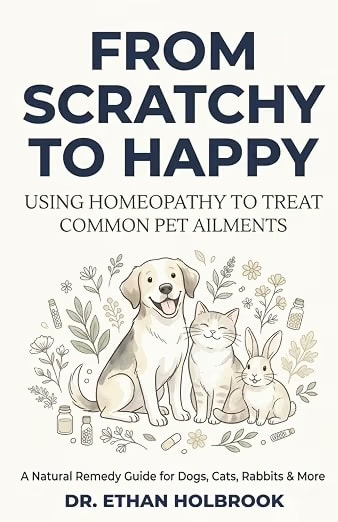
 As I opened my new book, I made a very conscious decision to put myself in the mind of someone who had zero experience with homeopathy, and it appears that was the exact right thing to do with this book. Dr. Ethan Holbrook tells us right away (on page 3) what this book is all about: This book is a practical guide to using homeopathy for common pet ailments. It is written for pet owners — people who love their animals and want to be active, informed participants in their health — not for veterinary professionals or homeopathic practitioners. Like all homeopathy books for “newbies,” Dr. Holbrook then includes a few short pages explaining “Like Cures Like” and “The Minimum Dose” and how to choose the correct potency.
Chapter 3 explains how to observe the pet in order to learn what to really look for. Yes, your pet is not his usual self, but as with all things homeopathy, there is more to it than just “limping, scratching, vomiting, or hiding.” There are clues which can help lead you to the best remedy for your pet’s discomfort. He then gets into the technicalities of homeopathic remedies: what to buy, where to buy them and how to administer them. He then jumps right into the nitty gritty: Skin & Coat Issues; Digestive Troubles; Respiratory and Ear Issues; Behavioral & Emotional Health; Joint & Mobility; Minor Injuries & First Aid; Eye & Dental Health. Each chapter has a nice chart to sum up common remedies for each condition as well as the all-important “When to Call Your Vet” guidelines. I paid particular attention to the “Joint & Mobility” section because this is where my beloved Rufus suffered most. In fact, I just learned Rufus wasn’t alone and “that over 80% of dogs over the age of eight show radiographic signs of osteoarthritis, even if they are not yet showing symptoms.” The book then guides your attention to pertinent questions about the onset and history, the location and the homeopathic-relevant “Pain Characteristics.” Dr. Holbrook spends a few pages breaking down the major remedies and what to look for. In the joint & mobility case, Rhus tox, Bryonia and Arnica are listed first, followed by a little chart differentiating Rhus tox and Bryonia. He then continues to break down further remedies: 9 in total for this chapter. Following the materia medica, he describes specific conditions: Arthritis (Chronic Osteoarthritis); Hip Dysplasia; Cruciate Ligament Injury; Elbow Dysplasia; Spondylosis and Tendon and Ligament Injuries. The end of each chapter describes how to build a support plan or maintenance routine. In the Joint & Mobility section, there are common sense suggestions, like providing orthopedic bedding and exercise as well as a list of supplements to consider, followed by how best to use the homeopathic remedies. Chapter 11 returns to more guidance on the prescribing process and how to monitor the remedy response as well as when to switch and when to escalate. Next is a walk-through of an example case with a page dedicated to keeping simple records — a piece of the puzzle we so frequently forget to do (but is so very important!) Case studies are then followed by a chapter on Safety, Ethics & Limits, including good guidelines of what homeopathy can do and what homeopathy is not able to do; what constitutes an emergency and how to work with your veterinarian. Honestly, this is a very thorough book and I would absolutely suggest this to any pet owner interested in helping their pets naturally. I only scratched the surface of what is included in these 200+ easy to read and follow pages. Julia Coyte, CHom Classically Practical homeopath #wellnessawaits *I have no affiliation with this book or the author — I stumbled upon it and it impressed me enough that I thought I needed to bring it to your attention!
0 Comments
 A quickie look at the books where I started my dive into homeopathic potency.
Margriet Plouvier-Suijs’ About Potencies
Happy Reading! Julia Coyte, CHom Classically Practical homeopath #wellnessawaits 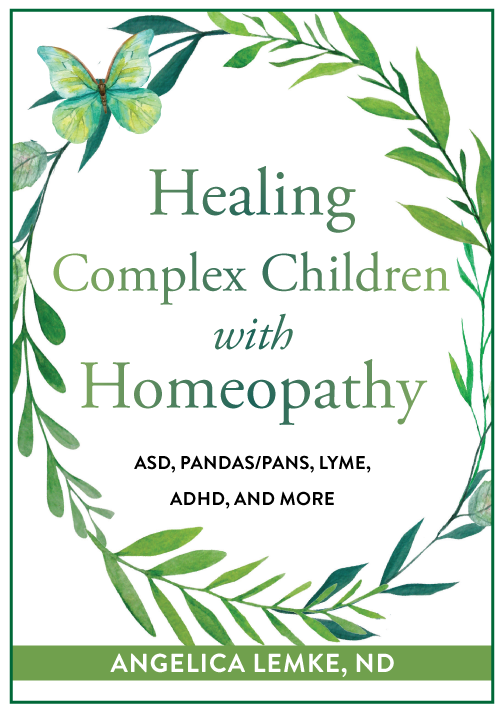 Where has the summer gone? I spoke with someone yesterday who told me their son started kindergarten that morning. I really don’t know how it happens, but once again, school is here! I thought summer vacation seemed short as a kid, but I think it seems even shorter as an adult.
I no longer have school-aged youngsters but there is no escaping all the “back to school” stuff everywhere right now. To read some previous articles about some homeopathic remedies which may help with all the emotions that come along with heading back to the classroom, check these out: Today, though, I’m going to take a little different angle. School is school for most kids — but not all kids. “Among children 8 years in 2022, ASD (Autism Spectrum Disorder) prevalence was 32.2 per 1,000 children (one in 31)” (Shaw 2025). Almost 1 in 6 US children have a developmental disability (Zablotsky et al. 2019). That translates to an awful lot of kids who may need a little extra help in school. Angelica Lemke, ND has written a really amazing book and this little review is not going to do the book justice. Healing Complex Children with Homeopathy: ASD, PANDAS/PANS, LYME, ADHD, and more is a packed (400+ pages), but straightforward and clear book written by “a homeopath and naturopath who specializes in the complex cases of children through an empathic, heart-centered approach. She has empowered many of the parents she works with to ‘find the healer within’, using homeopathy to support their family and the health of their communities.” “Invit[ing] parents to be active participants in the healing of their children” (Lemke 2021*). Before you cast this book aside because the children in your life are not “complex” and don’t suffer from any of the above listed conditions, just know that this book is pretty much a good overview of homeopathic remedies and how to use them in general. I have read a gazillion books on homeopathy and this one provided me with more than a few “aha” nuggets. Here is a link for the table of contents and introduction so you can get an overview of what’s in it. “I wrote this book to empower parents, homeopaths, and healers to use their intuition, along with homeopathic remedies, to heal the growing number of today’s children who suffer from a wide range of complex conditions.” The keyword here for how Angelica works is “intuition.” She teaches parents how to tune into their intuition and their “inner knowing” to connect their child with an appropriate homeopathic remedy. Healing Complex Children begins with chapters on the history and practice of homeopathy and then dives right into miasms (see also: Miasms, a very brief introduction). Unlike most homeopathic books written for the general public, she doesn’t just touch on the explanation of miasms, she shows us how to see them in our children and includes information on some nosodes and what physical and mental symptoms to look for which may indicate the use of these remedies. Her conclusion to this chapter is a nice list of the miasms with key remedies for each. Chapter 4: Animal Remedies: what they are made from, why they would be prescribed and how to recognize the symptoms which may lead to an animal remedy. This chapter looks at lacs (milks), spiders, insects, birds, mollusks, fish, reptiles and amphibians. Within each sub-section is a list of “notable features” which can be found in complex children. Before describing those remedies, though, Lemke provides us with a short and sweet differential list of how these remedies may show up on the physical plane, followed by a few questions which may help find an animal remedy. Each sub-section has a generalized overview of the remedy family, followed by a succinct paragraph or two with a basic introduction to each remedy — as is the case for all her remedy write-ups, they are just enough to whet the appetite and send one digging further into the materia medica. Chapter 5: Plant Remedies: includes another nice little list of a few physicals/organs and some commonly associated remedies. She writes, “While there are thousands of plant remedies that could be included here, this chapter focuses on those that I have found to be most useful in complex children. In particular, plant remedies can be critical to help address pain sensations in the body. When a child is in pain and their life revolves around it, this is the main symptom that should be addressed and plants become prime candidates.” At this point, she has a sidebar/box with a little information about Gemmos and Bach flowers. I love Gemmos and Bach flowers and am always happy to see that info being shared!! Next are questions to help find a plant remedy, followed by each plant family with a short overview and then the paragraph or two of each remedy. Chapter 6: Mineral and Periodic Table Remedies: "Mineral remedies assist with issues of structure, function, and deficiency in the body… For children who are building up their bodies, their sense of self, and their ability to process information, mineral remedies are key to helping them develop in a solid, stable way.” Lemke touches on Jan Scholten’s Element Theory and proceeds essentially through the periodic table in her listing of remedies. Within the many sub-sections are tables listing the various remedies within certain elements, e.g. carbon-based remedies; the multiple Natrum remedies, Magnesia remedies, Kali remedies, etc. We are just over halfway through this book and the huge number of remedies already covered is impressive! Chapters 7 & 8: Nosodes & Sarcodes. As mentioned above, not many homeopathy books aimed at the general population (as opposed to being written for homeopaths) include much information on Nosodes and Sarcodes. Lemke lists core sensations, physical symptoms, and gastrointestinal symptoms which may lead to the use of a nosode, followed by how to use them. In my estimation, this chapter on nosodes alone is worth the price of admission. There is so much amazingly useful information here! There is also a really nice, long section on Lyme disease and concurrent co-infections. The Sarcodes section is divided into matridonal remedies and hormones, glands and neurotransmitters — again with a paragraph on each remedy. Sarcodes are another area where there is a dearth of useful information and Healing Complex Children helps to shed some light on these important remedies… what they are, how to use them, why to use them. She explains that, “the purpose of the treatment with a sarcode is to heal the tissue so it can go back to its normal job, not to replace the energy of the tissue, such as with thyroid medication.” Chapter 9: Tautopathy. Another topic for which good information is hard to find. This book is chock-a-block full of useful stuff! Chapter 10, the final chapter in the book, is “Remedies by Categories of Complex Kids.” Sub-sections include, among others: Children with Acute Rage and Panic; Highly Anxious Children; Sad, Serious Children; Angelic Children; Hyperactive Children and ends with Common Remedies for Parents, noting: “It is of utmost importance for parents to heal themselves along with their children.” There are plenty of “woo woo” ideas in this book, which I have heard some homeopaths object to, e.g. if they “flit” from one thing to the next, they may need a Butterfly remedy. Let’s be honest here — all homeopathy is a little “woo woo.” If you have a complex child for which nothing has been able to help, maybe finding a remedy based on the fact the child “flits” is exactly what that child needs! Going beyond her book, back in 2015, based on Angelica Lemke’s practice of focusing on special needs children, she began the School of Intuitive Homeopathy: “Integrating an intuitive approach with a traditional homeopathy foundation, creating a new paradigm for the future of medicine.” Courses include:
Healing Complex Children with Homeopathy is available in the usual places, but it’s also available on her own website. And, I’m really excited about this… I just learned this book is now available on Kindle. I have a well-loved, well-thumbed, dog-eared, underlined copy and I have been hoping for an electronic version because this is a book that I return to over and over again and now I can search it electronically. Yay!! If you are interested in learning homeopathy, don’t discard this book because “children” is in the title. Know that this book is an incredibly helpful overview of this amazingly powerful modality called homeopathy; touching on all the important topics and introducing us to many remedy families as well as a large range of individual remedies. Happy reading! Julia Coyte, CHom Classically Practical homeopath #wellnessawaits * All further quotes in this article are coming from Angelica Lemke’s Healing Complex Children with Homeopathy. My copy of Homeopathy at Home: Everyday Treatments for Common Complaints by Marcus Fernandez has arrived and it is every bit as good as I expected! (See here and here for a little about Marcus.)
Let me begin by saying how much I enjoyed his introduction. Following his own story of finding homeopathy (I love to hear how people have found their way to homeopathy! -- see below), he states: “My aim is to enhance the health and wellbeing of humankind through the use of homeopathy.” What a wonderful goal! He continues: “I wanted to write a simple and accessible guide to managing common acute and minor complaints using homeopathic remedies at home. I want people to feel empowered. We all have innate health. Homeopathic remedies act like keys to a lock — choose the correct key and it turns the lock, stimulating the body to heal itself. It’s good to remember that the body has a natural healing wisdom; we just need to turn the key and remind it what it needs to do.” I told you I enjoyed reading his introduction! What follows is a simply organized A-Z list of common complaints with a page or so describing each condition suggesting possible causations, as well as some “actions that might help” to relieve symptoms. Then, a nice selection of (mostly) commonly available remedies to choose from with clearly written descriptions of each to help the reader differentiate between them . This book is just what the beginning homeopath/mom/family/student needs in their life! In addition to his well chosen homeopathic remedies for each symptom, he also offers suggestions for other home remedy ideas. For instance, since we’re in the middle of the flu season, he suggests a couple of lovely sounding drink blends to soothe sore throats and reduce inflammation. If you are ready to take the next step in helping yourself and your families, Homeopathy at Home is the perfect place to start. But wait, there’s more! I have a copy to give away. Write in the comments below how you were introduced to homeopathy and I will put those names in a hat and choose one commenter at random and ship the book to you, free of charge. (I will be picking the name at random on 1/16/25.) Julia Coyte, CHom Classically Practical homeopath #wellnessawaits * I have no affiliation with Marcus Fernandez or this book. I’m just a big fan! The Homeopath in Your Hand by Lisa Strbac The Homeopath in Your Hand is a brand new book that I did not realize was missing from the world of homeopathic books! In just a few short pages at the beginning of this book, homeopath Lisa Strbac gives a short, (but nice!), overview of the basics of homeopathy: symptoms; the history of homeopathy and the theory behind it; how remedies are made; potency; how to choose remedies and specifically how to choose remedies based on her own HEALS™ technique. HEALS™ stands for: Helps or Hinders E for Event A for Accompanying symptoms L for Location S for Sensations Following this, she has a couple pages on how to dose the remedies and some frequently asked questions to round out the introduction. Then, we get to the good stuff. Lisa has a 2-page spread for 77 common remedies, making for a very handy household materia medica. At the top of each page is the name of the remedy with one quick line to sum up the remedy. On the left hand side, she lists the key symptoms and some fun little graphics that I find very helpful in getting to the remedy you need quickly. At the bottom of the page are her Hindered/Helped by symptoms (what homeopaths refer to as modalities -- what makes the person better or worse).
Pages from The Homeopath in Your Hand reproduced with permission from the author. The right hand page provides a little more information on the remedy… the full name of the remedy, other names by which we may know the substance and where the substance may be found in nature.
This materia medica is simple enough (and, the pictures make it engaging enough!) to be useful for everybody, including children. If you are a homeschooling family learning to use homeopathy, this would be a terrific book to have around. At the end of the book is a short list of “essential combination remedies” including:
The final few pages are dedicated to symptoms, or, in homeopathic terms, a repertory. For each heading (e.g. Burns, Cramps, Headaches, Mastitis, Wounds) listing a handful of remedies which might be indicated. The Homeopath in Your Hand is a great little book that I certainly wish I had when I was just starting out with homeopathy. Stockists can be found on her website, or, better yet, ask your local bookseller to carry it: ISBN 978-1399964906. Also on her site, Lisa offers courses and you can even pre-order her exclusive remedy kit to accompany the book. Now that would be an amazing present for somebody this upcoming holiday season! Julia Coyte, CHom Classically Practical homeopath #wellnessawaits
 Homeopathy: An A to Z Home Handbook by Alan V. Schmukler
This was my first book on homeopathy. All those years ago, this felt like a book of magic spells that I didn’t have the ability to access. I read through it many, many times. I turned down corners and marked up all sorts of pages. I may have even tried a remedy or two, but I’m thinking I probably didn’t. I was too nervous. It felt completely forbidden and a little scary. In reality, it’s a straight forward book with good, useable information. Maybe the introduction scared me off. Way back in 2006, Schmukler says, “I call this a handbook for survival, because in the coming years we may find ourselves in survival situations for the following reasons: 1. Natural disasters 2. Terrorism 3. Antibiotic-resistant infections [Where he writes, “The medical system could easily be overwhelmed by thousands of cases of untreatable infections.” That sounds familiar now that we have lived through 2020!] 4. Exotic diseases 5. Chemical or drug sensitivity 6. Genetic engineering 7. No medical insurance" Maybe this list was too heavy for my relatively young and naïve self when I first found this book and homeopathy was completely foreign to me. I’ve made it to 2021 and am a little wiser to the ways of the world now. But, even before the nightmare of the last 18 months I had discovered the full importance of homeopathy in all these potential scenarios as well as every day life. Chapter 1 is a nice explanation of homeopathy, why you would choose it, what it does and a brief history. Chapter 2 dives right into the rules for using the remedies and taking the case. Chapter 3 starts the nitty gritty. Beginning with “Abscess” and closing out with “Yellow Fever,” he doesn’t quite make it all the way through the alphabet (that's because Zika wasn't widely known in 2006!) but the ailments he includes are meatier than other, similar books (as one might expect when one is writing a book for survival situations). For each ailment he includes a brief description, followed immediately by a list of suggested remedies, each described in just a few lines. He keeps it simple and succinct. He also suggests a few starred remedies which are highly indicated for each condition. Example from Homeopathy: Ailments A to Z, pages 198-199: “Sprains A sprain is an injury to the ligament around a joint. Symptoms include pain, swelling, and sometimes bruising. * Arnica: Immediately after the injury. * Rhus tox: Stiffness and pain, which is worse after rest and better from continued motion. Must keep shifting position. Bryonia: Worse from any motion, better from pressure, better from lying on the affected part. Ruta: Tendons, especially the ankle, heel and wrist. Repetitive motion syndrome. Worse after rest. Hypericum: When nerves are damaged and there is much pain.” You can’t get much clearer than those quick descriptions to get you on your way to healing. Chapter 4 is a nice addition of “Organ Remedies” not often found in most “consumer” homeopathy books. Chapter 5 is “Remedy Description,” also known as a Materia Medica in homeopathy-speak. “Pregnancy and Birth,” “Preventing Illness with Homeopathy,” “First Aid Remedies for Specific Occupations and Activities,” “Economizing: Making Your Remedies Last Forever” are chapters that definitely separate this book from its neighbors on the book shelf. Schmukler rounds out the book with “Homeopathy Around the World” and “How to Use a Repertory” (which is basically a book of symptoms) and includes a mini-repertory. He finishes the book up with “Remedies for Your Home Kit,” which of course has a nod to some unusual remedies for when the survival situations get tough. Schmukler, A.V. (2006). Homeopathy : an A to Z home handbook. Woodbury, Minn.: Llewellyn Publications. |
Julia Coyte, CHomI am passionate about homeopathy and I love sharing this passion. Having a working knowledge of homeopathy shouldn't be kept a secret. If people have the ability to help themselves, their children and their friends when they have minor ailments, life just gets better for everyone. That is the purpose behind Ruminating on Remedies. Archives
October 2026
Categories
All
|


 RSS Feed