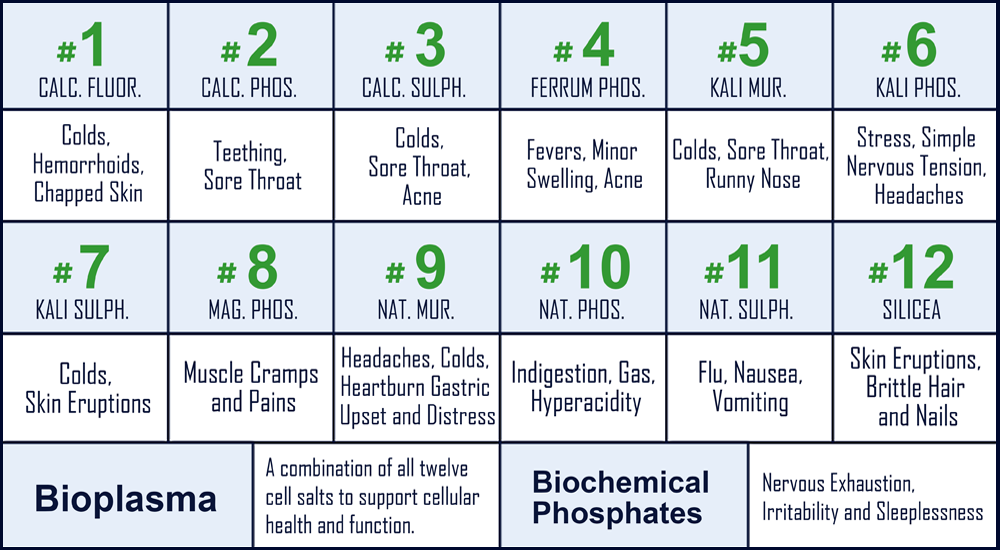
 This image was taken from an internet search and appears to be from Hyland's. I just realized that I have mentioned individual cell salts many, many times previously but I’ve never covered these marvelous little goodies as a whole. Let’s talk about cell salts! Cell salts, also known as tissue salts, Schüssler salts or Schüssler biochemical cell salts, are a very gentle way to support your body Cell salts lie somewhere between a homeopathic remedy and a nutritional supplement — “in a limbo between material medicine (that which is used in allopathic treatments) and energy medicine (that which is common to such treatments as homeopathic medicine and acupuncture, among other therapies) (McCabe 2009). “Micro dosed prepared minerals which support the healing processes in the body by regulating mineral levels in the cells” (Schuesslertissuesalts.com.au 2023). German physician Dr. Willhelm Heinrich Schüssler discovered that when body tissue is reduced to ashes, what remains are the tissue salts. “He looked at that ash and at its component parts, searching among them to identify the building blocks, the chemical compounds that give the structure and function to the human body. … It was important to Schuessler* that these substances be ‘native’ to the human system because of his belief in the concept of deficiency. Since he believed that the health of the body as a whole was determined by the health of each individual cell of the body, it was of great importance to him that each of those cells had all the nutrients it required to form, grow and function” (McCabe 2009). Because all these substances are naturally present in the human body, “each of the twelve remedies is totally benign. Schuessler’s treatments are nourishing to your system and to your health. They bring balance to our bodies; a balance of nutrition, form, and function that can lead to a state of total health” (McCabe 2009). Dr. Schüssler did his thing back in the late 1800s and since that time, many more “tissue salts” have been added to the original list, though the biochemic system remains with only the original 12 salts. McCabe goes on to state that the cell salts “represent a simplification of homeopathy, they are well within the easy grasp of every person who is seeking a means by which they can encourage good health.” Cell salts can be used individually or in combination (on their own, or, in conjunction with homeopathic remedies or even with allopathic medicine) to address all sorts of physical ailments. “When your body lacks these important cell salts, you are more vulnerable to common health concerns. By replenishing them, your body is better prepared to treat illnesses and enjoy better overall wellness” (Hyland’s 2024). “A disturbance of the molecular motion of one of the inorganic materials in a tissue causes a sickness, for the cure of which it suffices that a minimal dose of the same inorganic substance be furnished, since the molecules of the material thus used as a remedy fill the breach in the chain of molecules of the cell-salts or tissue-salts under consideration.” —W.H. Schuessler (McCabe 2009) Cell salts are limited in their potency to 12x ensuring each remedy still has its nutrient substance. (For further information, see X? C? Homeopathic potency briefly explained.) Avogadro's number is a point of dilution where nothing of the original substance remains and that level of dilution is 23x or 12c. (That’s right! Most homeopathic remedies have “nothing” in them — nothing that our current instruments can see. Since cell salts are all 12x and below, something of the original substance remains in each remedy.) All of the cell salts are “compound remedies” meaning they are made from more than one substance before they are made into their homeopathic form. Author Vinton McCabe does a nice job explaining the importance behind this. “The easiest way… to think about the cell salt remedies is as if they were the children of specific marriages between parents. Each remedy will share some aspects with each of its parent remedies. Natrum Muriaticum will have some of the attributes common to the Natrums and some attributes that it gets from the Muriaticum side of the family. In the same way, each of the compounds will ‘inherit’ a mix of traits, divided between the two parent remedies.” (The below family information all comes from McCabe’s The Healing Echo: Discovering Homeopathic Cell Salt Remedies.)
Each of the individual 12 salts correspond to specific bodily functions. A very brief overview follows with information taken from various sources:
How do our cells become depleted of these tissue salts? The usual culprits which deplete us: sickness, whether bacterial or viral; injury; stress; poor diet. Cell salts are excellent for growing children as well as for the elderly. How to take Schüssler cell salts? Every author offers a variation on a theme, but what they all hold in common is repetition. (For this list I have referred to Skye Weintraub’s Natural Healing with Cell Salts” — which is a very nice and easy book to use!)
To apply topically:
Why not mix all of them together? You can do this. The 12 cell salts combined are most frequently found in the US under the name Bioplasma** by Hyland’s. I have found this combination to be excellent at the start and then, not so much. I have heard it referred to as a “picker-upper” and in the beginning of taking it, it seems to be just that. It replenishes what is missing and then the benefits don’t actually wear off, per se, they just aren’t as useful in the full complement. If you have tried this and then found it to be not quite so helpful after a while, it is a good indication that it is time to fine tune your cell salts and by doing so, I am sure great benefit will be found. Sometimes one single cell salt is all you need. However, they work beautifully in combination with each other. For example, let's look at the first few entries in Weintraub's Eye section:
Another readily available combination is known as Biochemical Phosphates. This is a combination of 5 phosphates to help address stress and overload. It’s a beautiful thing! My old container from Hyland’s says it’s for: Nervousness, Irritability and Occasional Sleeplessness. (Note: It appears Hyland’s has renamed this product to “Nerve Tonic.”) These little cell salt beauties are powerful healers. There are even practitioners who treat their clients with nothing other than cell salts. Pick up a cell salt book and get started — I think you’ll be pleasantly surprised. (As mentioned above, I really like Weintraub's Natural Healing with Cell Salts and Lisa Strbac's newly published Schuessler's Tissue Salts Rediscovered: The 21st Century Guide to Self-Healing is great, too!) Julia Coyte, CHom Classically Practical homeopath #wellnessawaits * Various authors spell his name differently. When I have quoted a text, I have used the spelling used by the author. ** I have no affiliation with this or any other company. Reference list
Carey, G. W., 1996. The Biochemic System of Medicine. Health Research Books. Chapman, E., 1960. How to Use the Twelve Tissue Salts. Nutri Books. Dewey, W. A. and Boericke, W., 2022. The Twelve Tissue Remedies of Schüssler: Comprising the Theory, Therapeutic Application, Materia Medica, and a Complete Repertory of These Remedies. H. Legare Street Press. Hyland's, 2024. Cell Salt #1 Calc Fluor [online]. Hyland’s. McCabe, V., 2009. The Healing Echo. ReadHowYouWant.com. Schuesslertissuessalts.com.au, n.d. Schuessler Tissue Salts - 150 Years Of Natural Medicine In Australia [online]. Schuessler Tissue Salts. Schüssler, W. H., 2003. Schüssler’s twelve tissue remedies : comprising the theory, therapeutic applications, materia medica and a complete repertory of tissue remedies. Sittingbourne, Kent: Homæopathic Book Service. Strbac, L., 2024. Schuessler’s Tissue Salts Rediscovered. Weintraub, S., 1999. Natural healing with cell salts. Pleasant Grove, Ut: Woodland Pub.
0 Comments
 The point of life is balance, not perfection. This sentiment keeps popping up everywhere I turn. I’m taking it as a direct communication from the universe to me. You see, I’m not very good at balance — I’ve always been a kind of an all or nothing sort of gal. Physically, I’m pretty decent with balance. In a former life, I was a recreational figure skater and I could do my spirals and my spins and I could land my basic jumps on one blade. I used to slalom water ski as well as snow ski and those take balance. When we had to do gymnastics in PE, I was horrible at every single part of it, except the balance beam. Mentally, that’s another story. I used to think I was good at balance but only because I was juggling lots of things at once — which, in fact is not a demonstration of balance at all, just an act of mental acrobatics. I start making jewelry and that’s all I think about for the next couple of years. I decide to try my hand at art and I am almost paralyzed by the need for it to feel “perfect” and then I’m unable to do anything at all. I discover homeopathy and I drop everything else and decide there simply aren’t enough hours in the day to study this fascinating system of medicine. So, having this mentality, I have perfected the art of giving stuff up, that’s for sure. (Remember, "all or nothing" was my motto.) I'm pretty good at embracing an all-encompassing deep dive on things, often at the expense of other things. Even writing these articles -- recently taking a step back from writing weekly weighs on my mind heavily. It's a struggle to remember that "about weekly" (as I stated in the "about" section of Ruminating on Remedies) is not the same thing as weekly. However, it's never too late to start a good habit and I have finally come to the realization that it’s time to accept the idea of Wabi Sabi. I’ve heard of this concept before, but I am new to putting it into practice, but I like it, and I’m thinking this might be a good answer for me. Wabi Sabi is a traditional Japanese aesthetic that celebrates the beauty of imperfection and impermanence. Perhaps embracing this philosophy is the way out of my all or nothing mentality. Perfection, or the pursuit thereof, is an admirable goal, I suppose. But, it’s really not a very healthy way to live a life. I always tell my clients when using homeopathy that we are NOT looking for perfection, we’re looking for improvement. (See: What Now and Perfect is the Enemy of the Good.) What is it we are looking for? As a reminder, we are looking for the symptoms to pop up a little less often and when they do, to be a little less intense and hopefully we see an improvement in mood and/or energy. If one struggles with the idea of needing to be perfect, there are some excellent homeopathic remedies to consider. Ignatia is the first remedy that comes to mind for perfection. Ailments from disappointments. Unhappy love. Idealistic. Nervous. High goals, high ambitions, high ideals and high expectations and a burning desire to fulfill them (Master 2009). Intolerant of contradiction. Expectation of others to be perfect. Strong sense of inner duty. Nux vomica for overstudy; "close application to business, with its cares and anxieties" (Vermeulen 2015). These mental strains may lead to the use of stimulants, possibly in excess. Keeping late hours and displaying an irritable temper. Everything makes too strong an impression on this overloaded nervous system. See also: Overwhelmed for further discussion comparing Ignatia and Nux vomica. Arsenicum album for the fastidious person who wants everything neat and clean and tidy and just right. Even when feeling poorly, the person who may benefit from Arsenicum alb may direct someone to tidy up the sick room a bit. This is a person who, in the words of George Vithoulkas, takes "order and cleanliness to the point of expending inordinate energy constantly cleaning and straightening" (Vithoulkas 2015). Natrum muriaticum for one who is responsible and perfectionistic. They may "be compulsively fastidious, trying to control the environment". They may display a "type of hypochondria… expressed as an anxious desire to find the cause of every blemish or pimple" (Morrison 1993). Nat mur cell salt also plays an important role in balancing fluids in the body… if there is excessive dryness or excessive mucus production (for example), Nat mur may be of help. As American poet Henry Van Dyke very eloquently states, “Use what talents you possess; the woods would be very silent if no birds sang there except those that sang best.” Life is too short. Drop the idea of perfection. Let it go. Sing the song, regardless of talent. Paint the picture. Write the story. Live a good life and enjoy yourself while you're at it. Julia Coyte, CHom Classically Practical homeopath #wellnessawaits Reference list: all books accessed through RadarOpus software
Master, F. J., 2009. Clinical Observations of Children Remedies B. Jain Publishing. Morrison, R., 1993. Desktop guide to keynotes and confirmatory symptoms. Nevada City, Calif.: Hahnemann Clinic Pub. Vermeulen, F., 2015. Concordant reference : complete classic materia medica : 1284 remedies. Glasgow: Saltire Books. Vithoulkas, G., 2015. Essence of materia medica. Usa: B. Jain Publishers (P) Ltd. |
Julia Coyte, CHomI am passionate about homeopathy and I love sharing this passion. Having a working knowledge of homeopathy shouldn't be kept a secret. If people have the ability to help themselves, their children and their friends when they have minor ailments, life just gets better for everyone. That is the purpose behind Ruminating on Remedies. Archives
October 2026
Categories
All
|
 RSS Feed