 Fall must be approaching. It doesn’t feel like it here in the desert southwest; we are still seemingly in the throes of straight summer with temperatures remaining 10+ degrees above average. In fact, it almost feels like we have hit the breaks on moving toward fall and reversed into actual summer. You see, we had a relatively humid summer. (See "12 Angry Homeopathic Remedies” if you care to know a bit more about our summer this year.) And, today, September 10th, 2026 (and 11th, I didn’t quite get everything finished yesterday), we finally have our normal sky — cloudless and bright blue. Boy, have I missed seeing that! A New Mexico 9% humidity sky. 😍 Even though we have been humid (for New Mexico), we have had no rain worth mentioning. Our trees are dying 😫. Rivers are just beds of stones. The monsoons never developed this year. Despite this lingering heat, autumnal bugs are beginning their march into town. The internet tells me October is the month where things really get going. However, this morning I saw in my email that Stanford University-run WastewaterSCAN program indicates that SARS-CoV-2 is currently “high” nationwide, with a significant upward trend in the last 3 weeks. I checked the WastewaterSCAN Dashboard and New Mexico doesn’t appear. However, a Today show article claims it is increasing nationwide. Cold, Flu, Covid, the Crud, the Suds** — whatever seasonal ailment is getting you, homeopathy is a good place to start. It’s important to remember that homeopathy doesn’t care the name of what ails you — homeopathy is (for the most part) only interested in your symptoms. With that, let’s look at a few remedies to have handy. As Benjamin Franklin taught us, an ounce of prevention is definitely worth a pound of cure! All of these homeopathic remedies work really well when taken at the first sign of any symptoms. Repeat every few hours, or, follow the manufacturer’s direction.
So far this month, I’m seeing a bunch of throat stuff and huge fatigue, in addition to milder cold-like symptoms and one person with some stomach issues thrown in for good measure. For what it’s worth, Gelsemium has been helpful for a couple of people I have encountered. Why Gelsemium? Gelsemium symptoms (keynotes from Morrison are bolded):
When the stomach plays a larger role, consider Arsenicum album. A quick comparison between Gelsemium and Arsenicum for cold/flu symptoms: 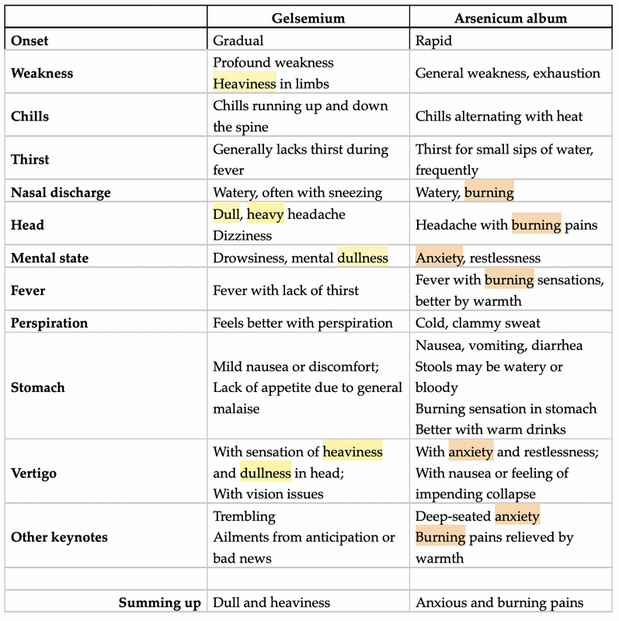 These early days of flu/cold-like symptoms mark the beginning of what could be a long season of yuckiness. Homeopathy may just be able to set things right before they are able to take hold.
Julia Coyte, CHom Classically Practical homeopath #wellnessawaits *I have no affiliation with this or any other company — I just like their stuff! **Spongebob Squarepants gets the suds — Good stuff!
0 Comments
 The yucks hit my house in very early January. For the next couple of weeks, I sometimes felt like I was on the verge of succumbing to something yucky. Many weeks later, I can safely say I skirted it.
The important piece of this puzzle, is this: Your remedies do not have to be perfect. Remedies are forgiving. Many remedies share many symptoms and many overlapping symptoms. In most cases, there is not one single remedy that you have to get absolutely right in order to feel better. I did all the usual things when one feels like they might be getting ill:
When I really thought I was in trouble and realizing that all those things I had been doing didn’t actually do what needed to be done, I was ready to acquiesce; I was ready to throw in the towel. Then, the shaky quakes, as I call them, set in. I felt so weak and trembly. I had gone to bed really early (the headache was too much) and I slept really hard and I slept late and I did not want to get out of bed the next morning. I did get out of bed and I had some breakfast — even though the thought made me nauseous (I did feel better after eating) — I knew I had only a short amount of time to get the bills paid and do a quick couple of other things with deadlines before I was no longer going to be able to get to them for a while. But then, when this new symptom set in, I decided to throw one more remedy at it. Main symptom? Trembling and weakness. Just sitting and opening the bills was too much. I was waffling between Arsenicum album and Gelsemium (both really good flu remedies, in general; and, both are in the “eating ameliorates” rubric, so that fit, too). I went with Gelsemium because the trembling was the chief complaint. Within 30 minutes, the trembling had completely disappeared. The weakness remained, however. Gelsemium no longer felt right, even though it had done what was asked of it, so I switched to Arsenicum album. I couldn’t tell you now and I don’t think I could have told you then why the Gelsemium no longer felt right. Could it have done the job just as well? Perhaps. One dose of each and the world was quite simply a happier place. I continued to feel better hour by hour. By the next day, I was completely back to normal. I know I (and others) have said, that if a remedy is working, stick with it, but I broke that rule and I’m pleased I did. I took the “chase the symptoms route.” (See also, tis the season… for the crud.) After a couple weeks of occasionally using good, general flu remedies to ward off symptoms that seemed to maybe be trying to creep in from time to time, I decided to focus on just the new main symptoms - one at a time. Once again, I never actually felt unwell until the very end — I just didn’t want anything to take hold. It is entirely possible there simply weren’t good symptoms to follow previously - just a general sense of uh-oh. If I had worked with another homeopath, perhaps they could have seen something, but, I couldn’t see it in myself. Had I taken these two remedies earlier in my battle of the on again/off again possible yucks, would I have put it all in my rearview mirror sooner? Maybe. The symptoms calling for these remedies, if they were there, they were very, very quiet and I couldn’t hear them. There is another possibility… Maybe I didn’t, in fact, dodge the yucks and was just “homeopathically unwell” : translation, I had a bug, but the remedies were working well enough to keep me going — and these last two remedies were the clean up crew. (Arsenicum album and Gelsemium are both indicated in convalescence.) Will I ever know? Nope. Do I care? Only in that I could have shared more detailed information so others may learn from my experience. Stay well — spring is coming to the rescue soon! Julia Coyte, CHom Classically Practical homeopath #wellnessawaits Here they are again, just like clockwork!  My phone is abuzz with colds and headaches and snot. I guess it’s that time of year again and following close on the heels of the colds, you know what’s next…
The bugs tried to hit my house in the last week or so, too and, so far we have beaten them back. Historically, the go-to in our house is either Cold Calm (my husband’s favorite) or, the Banerji Protocol of Aconite + Bryonia. (See also, Ho Ho Ho; When you Have to Get Up; Digging Deeper into the Flu remedies #1 & #2 and Ahh-Choo!) I have recently added another remedy to my line-up of homeopathic considerations when things are going south… Narayani Flu Pack, mix 79. Narayani Flu Pack pretty much leaves no stone unturned being a combination of 4 other Narayani combinations, plus a single remedy, too. “That’s a lot of remedies,” you say? “Yes, it is,” I answer. “What are you thinking taking so many remedies?” I think I am putting these nasty viruses back where they belong — outside my body! You see, homeopathy is pretty intelligent stuff. If your body doesn’t need it — if your body doesn’t resonate with a remedy, it will just put it aside and not bother with it. To clarify, if one repeatedly keeps taking a remedy that one does not require, it can cause the symptoms it is otherwise supposed to quell, also known as a “proving”. (See also, The Original Drug Testing… Homeopathic Provings.) “How would one know which remedy to try? You have listed an awful lot of choices!” You are correct. There is hardly ever just one right answer when it comes to which homeopathic remedy to take. Many homeopathic remedies share overlapping symptoms with many other remedies. In an, ideal, classical homeopathic world, a professional homeopath could take your case and decide which single remedy would best serve. I don’t know about you, but when I’m feeling crummy, I want answers ASAP. In short, in this case, the remedy that is nearest is most appropriate because time is of the essence — We want to nip this in the bud so it can’t take hold. Here is how I would consider these remedies.
“Alright then, I’ll bite — tell me more about this Flu Pack.” Narayani remedies were created to address practical healthcare challenges in resource-limited settings, particularly in India and South Africa. As the story goes, they didn’t expect to be able to see their otherwise rural patients again too soon, so they loaded them up with remedies, particularly combination formulas for specific ailments. They’ve been in use for over 50 years, so there must be something worth looking into here. I know I have yet to be disappointed with any I have tried. (See also, The Narayani Kit.) So, let’s break down the Flu Pack and see what is included… Helios’ The Narayani Combination Remedies guide tells us the Flu Pack is “for fever, chest, lungs and muscles.” Breakdown: Chest, Cough & Asthma (mix 71) to “deal with the chest and lungs; whole body aching in bones and flesh.” Eupatorium perfolatum: “chest sore, patient must support it; nausea; vomiting bile.” Eupatorium perfolatum is a personal favorite of mine. I love this stuff for when the aches and the fatigue are both really heavy. Fever & Infection Balance (BR10) & General Fever (mix 18): “these deal with the fever by holding it (not lowering it), so that it may burn out the virus; it must be remembered that no virus can be killed by any drug; it can only be burnt out by the fever produced by the body.” War (mix 35): “to hold the infection, preventing it from spreading through the body, and to deal with it.” Take a dose as soon as one feels flu is coming on and see what you think. I think you might just be pleasantly surprised. Here’s to keeping the yucks at bay this year! Julia Coyte, CHom Classically Practical homeopath #wellnessawaits 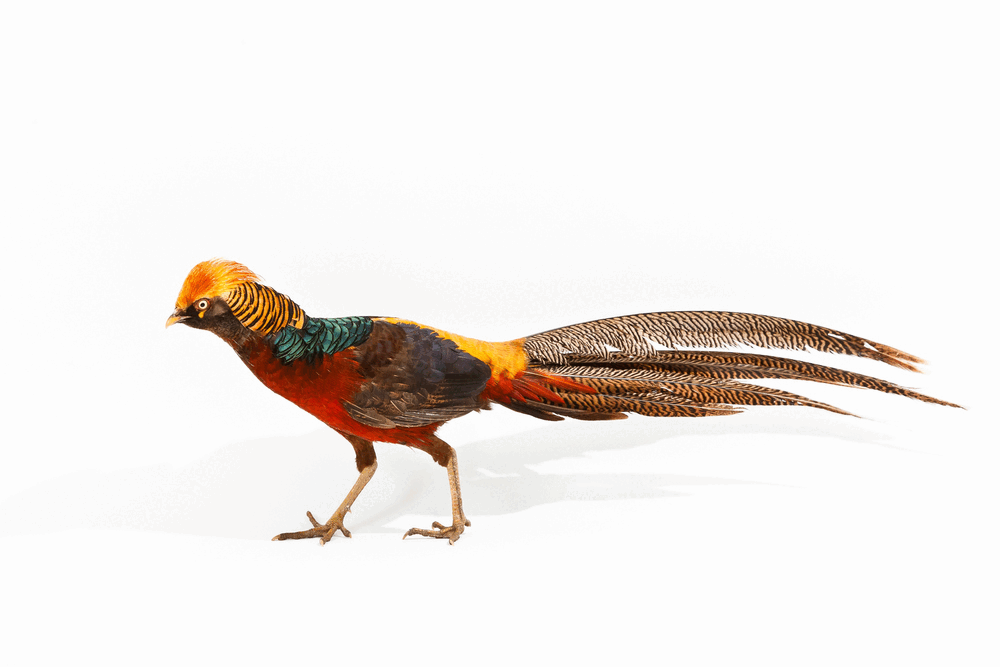 Not a photo of the bird that adopted us, but this one looks almost as good as he did.😂 The flu is for the birds and the bird flu, well… I was asked about homeopathic remedies the other for backyard chickens. We used to have chickens (and a peacock and a Chinese pheasant adopted us for a while, too) and I can tell you that homeopathic remedies work beautifully for birds. (See Homeopathy to the Rescue.) Let’s start with giving remedies to the birds. Some say to put the remedies directly in their water. If you have a large flock, this might be the only way to do it. But, if you have a small backyard flock and it’s easy to see if only 1 or 2 birds are sickening, I like to put the pellets in a little water (or bone broth) and add some rice to the small bowl because I knew they would always go for the rice, even if they weren’t going to go for the water. (See also Making a Water Dose.) This way, you can isolate the sick chickens and make sure those who are most in need are actually getting the remedy. Another reason I like to give the remedies in a small bowl of water is that when you put the remedies directly in the birds’ waterer, it’s important to remember that every sip is a dose. However, if you have a large flock and you already have some sick birds, “dosing” the entire flock is probably the best way to approach this problem. As for the bird flu that is going around, the first thought that comes to mind is Oscillococcinum. (“Oscillococcinum 200 actually a patent property of Boiron Laboratory, France” (Julian 1980)). Well, that’s a bit simplistic, isn’t it… just to suggest using a major homeopathic flu remedy for the bird flu? Well, no, actually. The main ingredient in Oscillococcinum* is Anas barbariae which is made from the heart and liver of wild duck. Pierre Schmidt (Schmidt 2025), a homeopath of the 20th century (1894-1987), says “Oscillococcinum is for ‘influenza at the beginning as a preventative, as well as during convalescence.’” “This is the remedy at the beginning of influenza, of rhinitis and otitis. Given early it is very efficacious. To obtain good results in a case which begins and to cut short the manifestations of influenza, it is necessary to use one dose of Oscillococcinum 200c every 2 to 3 hours or repeat only if necessary” (Murphy). See here and here and here and here and here for some studies and here* for a review of Oscillococcinum trials. (Note: I think it is fair to say that at this point in history, there are not many fans of homeopathy in the mainstream medical system, and that includes researchers. Finding positive research on homeopathy is tough going for a couple of reasons: The main one, in my opinion, is that mainstream medicine has not been educated about homeopathy and therefore dismiss it as quackery. The other important reason why it is hard to find good research on the efficacy of homeopathy is that at its core, homeopathy is individualized medicine — a remedy that works for one person’s symptoms may not necessarily work for the next person’s symptoms. (See also: What to Expect.) Could Oscillococcinum work for birds and bird flu? I would certainly be willing to try it if I still had my backyard flock and if I was worried about bird flu. Apparently, bird flu is in my area (said my chicken-keeping neighbor), so I looked up what to look for in the flock. According to the Australian Government (2023):
So, what I’m seeing in these government documents, other than the combs and wattles and egg laying, are signs of the flu, but in chickens. With that in mind, symptoms are symptoms and remedies are remedies… meaning… it doesn’t matter if it’s a bird or a dog or a human, the symptoms will be noticeable and those symptoms can be addressed through the same homeopathic remedies regardless of showing up in a bird or a dog or a human. Sneezing is sneezing. Watery eyes are watery eyes. Fevers are fevers. Weakness is weakness. The only difference here, though, the chicken can’t tell us if the watery eyes or the diarrhea are acrid or bland. They can’t tell us if they they ache. Chickens run hot compared to humans (106 F) (Hobby Farms 2019), so telling if they have a fever could be a little tricky to begin with. My last article, When you have to get up… has a nice, long list of flu symptoms and possible remedies. I would say any chicken symptoms you could match with that list would work fine and dandy. The trick is translating what you’re seeing in your birds into human language. A more severe form of this disease which “presents suddenly, often with very high mortality, with affected birds developing swollen heads [emphasis mine], a blue coloration of the comb and wattles, dullness, lack of appetite, respiratory distress, diarrhea and significant drop in egg production” (2025) is another matter. Looking back in time a bit, The Poultry Doctor (Chambers 2018) originally published in 1891, mentions a swelled head: “From some cause not clear, the heads of hens will often swell greatly and be very hot. Exposure to draughts of air, however, is a fruitful cause of both swelled heads and swollen eyes. Spongia has given relief in many cases but Belladonna is the indicated remedy for this trouble; Bryonia also will relieve.” All three of these remedies are excellent flu remedies, in general. What else may help ward off the bird flu in your flock? This article has a short list of possible flu preventatives which may be applicable:
Prior to any symptoms showing up, Hyland’s Bioplasma* (or any other source of the combined cell salts — this is just the easiest to come by in most natural food stores in the US) is another good option. A couple of pellets of this combination of the twelve cell salts could easily be dropped in the flocks’ waterer for a while to help shore up their immune systems. We birds of a homeopathic feather need to flock together to keep sharing information on homeopathic remedies for humans and fowl alike! — if you would like to schedule a consult with me, drop me a line at [email protected]. Julia Coyte, CHom Classically Practical homeopath #wellnessawaits * I have no affiliation with this company, I just like their products. ** This review is not really in favor Oscillococcinum, however, I think it’s very important to note that in the “Authors’ conclusions” that it “could have a clinically useful treatment effect but, given the low quality of the eligible studies, the evidence is not compelling. There was no evidence of clinically important harms due to Oscillococcinum.” [emphasis mine] Reference list
Australian Government, 2023. Bird flu (Avian influenza) - DAFF [online]. Agriculture.gov.au. Beghi, G. M. and Morselli-Labate, A. M., 2016. Does homeopathic medicine have a preventive effect on respiratory tract infections? A real life observational study. Multidisciplinary Respiratory Medicine, 11 (1). Boericke and Tafel, 2018. The Poultry Doctor: The homeopathic treatment and care of chickens, turkeys, gees, ducks and singing birds. 2018 ed. Colombo, G. L., Di Matteo, S., Martinotti, C., Oselin, M., Bruno, G. and Beghi, G. M., 2018. The preventive effect on respiratory tract infections of Oscillococcinum®. A cost-effectiveness analysis. ClinicoEconomics and Outcomes Research [online], Volume 10, 75–82. Dutta, A., Manna, A., Ghosh, S., Mundle, M., Saha, M., Kumar Gourav, Sukhdeb Maiti and Chattopadhyay, B., 2024. Prespecified Homeopathic Medicines in the Prevention of Confirmed and Suspected Cases of COVID-19: A Community-Based, Double-Blind, Randomized, Placebo-Controlled Prophylaxis Trial. Complementary Medicine Research, 31 (2), 140–148. Hobby Farms, 2019. Chickens & Body Temperature: What You Need to Know [online]. Hobby Farms. Homeopathy Plus, 2024. Bird Flu: Are We at Risk [online]. Homeopathyplus.com. Julian, O. A., 1980. Treatise on Dynamised Micro-Immunotherapy. First Indian Edition, 1980. New Delhi - 110055 (India): B. Jain Publishers (P.) Ltd. Mathie, R. T., Frye, J. and Fisher, P., 2015. Homeopathic Oscillococcinum® for preventing and treating influenza and influenza-like illness. Cochrane Database of Systematic Reviews. Murphy, R., 2006. Nature’s materia medica : 1,400 homeopathic and herbal remedies. Blackburg, Va.: Lotus Health Institute, November. Schmidt, P., 2025. Pierre Schmidt [online]. Remedia-homeopathy.com. Scottish Government, 2025. Avian influenza (bird flu): how to spot and report the disease - gov.scot [online]. www.gov.scot. UCHealth, 2024. The bird flu has spread to dairy cows. Do you need to worry about another pandemic? [online]. UCHealth Today. Vickers, A. J. and Smith, C., 2004. Homoeopathic Oscillococcinum for preventing and treating influenza and influenza-like syndromes. Cochrane Database System Review. 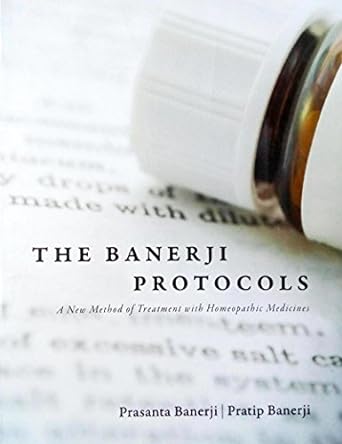 Last week I wrote about the Narayani remedies, primarily because I had just used TapRoots* fabulous kit again and I wanted to sing its praises. (See below for information on their Banerji Protocol kits.) My first homeopathic combination love, though, needs a little attention: the Banerji Protocols. I have told this story before, but the amazingly wonderful and powerful Banerji Protocols are what convinced me to become a homeopath. Two weeks after beginning a bunch of combination remedies, in addition to a couple of individual homeopathic remedies all taken according to the schedule provided by my homeopath at the time, Joette Calabrese, — (I didn’t do this on my own!), I felt better than I had in many years. Just two weeks and the relief I felt was nothing short of miraculous. It was truly, truly life-changing stuff. So life changing that I immediately began taking classes in the Banerji Protocols offered by Joette Calabrese** and after a few months when I had finished all there was on offer that way, I enrolled in homeopathy school. (It’s funny. When I first spoke with Joette she mentioned her classes and asked if I would be interested. I responded that I didn’t have any time, as interesting as they sounded. Little did I know how much time I would want for studying all this new-to-me stuff called homeopathy! There simply aren’t enough hours in the day, even all these years later! I literally abandoned all my other interests at that point and dove straight in -- never even coming up for air!) I think it’s fair to say that not all classically trained homeopaths are overly fond of practical, or, what is also referred to as clinical homeopathy. Some can be rather snooty about it, actually. (I have clients who have been "fired" by their classical homeopath because the individual took additional homeopathic remedies on their own accord.) In particular, classical homeopaths seem to take umbrage with the Banerji Protocols. Why they do this, I can’t be certain, but I have my suspicions. The Banerji Protocols were developed by the Drs Banerji (father and son) in Calcutta, India. This is a 4th generation family of homeopaths and for all that time, their clinic has been keeping records of which remedies helped which conditions. They have 10 doctors/homeopaths in their clinic who each see 100 patients a day. That’s 1,000 patients a day (!) upon which to base their information. They have some marvelous success rates and those results are replicated over and over again. It is truly impressive. How do the Banerji Protocols differ from the Narayani remedies? The Banerji Protocols are elegant combinations of homeopathic remedies. The Narayani remedies are still wondrous creations, but they are much larger combinations of homeopathic remedies — often mixing not just individual homeopathic remedies but also adding homeopathic nosodes, sarcodes and even Bach flower essences into the mix, too. The Banerji Protocols use some combination remedies (generally combinations of only 2 remedies at a time) but mostly using individual remedies, but taking them as part of the same protocol (see below for an example). Remember, at it's core, classical homeopathy involves using one single remedy and then waiting and seeing what comes from that. The Banerji Protocols repeat remedies … sometimes weekly; sometimes daily; sometimes multiple times a day. Because it has been in the news lately, let’s look at the Banerji’s first line (more on this later) protocol for the Measles***:
If it works so well, why do classical homeopaths balk at that and not embrace it? Even though these protocols have been used for decades in India, they’re fairly new to us in other corners of the world. More importantly, as a classically trained homeopath, I can tell you that we are taught that every remedy we suggest to a client needs to be based on meticulous case-taking and that (single) remedy needs to be tailored to the specific symptoms that person is expressing — the Similimum. This is the really impressive aspect of homeopathy that differentiates it from every other form of medicine out there. Classical homeopathy doesn’t treat a disease, it treats the individual. And, what a beautiful thing it is! I agree… in principle. However, in today’s day and age where we have excellent diagnoses available to us through imaging and testing, finding the similimum is not always necessary. This is where the Banerji Protocols can step right up and take their very valuable spot. (See also: The Importance of a Proper Diagnosis.) The Banerjis, with all their many thousands of case histories to rely upon, have learned what works for commonly diagnosed conditions. To name but a few:
The Banerji Protocols: A New Method of Treatment with Homeopathic Medicines is, in my never-to-be-humble opinion, an indispensable book. My copy is well loved and beginning to fall apart as I have read through and studied the approximately 200 conditions over the years. For each condition addressed, they (generally speaking) list 3 “lines”:
We’re also taught in classical homeopathy schools that remedies should never be combined with other remedies. The logic here is sound: homeopathic remedies are tested or “proved” (using the homeopathic terminology) one at a time. To my knowledge, there has not been any official testing or provings of combined homeopathic remedies (just long, positive track records, like the records the Banerjis keep). Having said that, to my understanding, there have not been any problems with using said combined remedies. There are certainly plenty of them out there*: Boiron, Hylands, Heel, UNDA, Narayani, Dr. Reckeweg — (there are more but this list should suffice to get anyone who has an interest in such things started). How else do the Banerji Protocols differ from classical homeopathy?
Now, let’s turn to Dr. Samuel Hahnemann, the father of homeopathy. The other most important aspect of homeopathy is found in aphorism #1 in Hahnemann’s Organon of Medicine: “The physician’s highest and only calling is to make the sick healthy, to cure, as it is called.” This beautiful ideal is from 1842, written in the 6th edition of Dr. Hahnemann's magnum opus, 32 years after his first edition. During these years, his methods changed and grew and who knows where his experimentation would have ended up if he had been able to get to the 10th or 20th editions of The Organon? I happen to believe that Dr. Hahnemann would have eventually come around to the idea of combination remedies, but that’s just my opinion. What does it matter if one remedy at a time is used or if multiple remedies are combined… as long as the person experiences relief? I know of successful classical homeopaths who say they use a particular remedy in their practice weekly. I’m going to go out on a limb here and say that is not necessarily truly classical homeopathy. This, to me, does not really sound like they are getting the single best remedy that is “homeopathic to the case.” It can’t possibly be. If these homeopaths were going about their homeopathy in a completely classical fashion, the chances of them using the same remedy as the similimum for multiple clients in the same same week or month (outside of an epidemic/pandemic) are quite low. Or, they say, “I use this remedy for this condition.” Again, this is essentially using a protocol — they are just their own protocols. After all, protocols are procedures based on previous experience to deliver an expected outcome. I am certainly not knocking these homeopaths for doing this. On the contrary! This is exactly the point of practical or clinical homeopathy. Lots of people need similar or even the same remedies to help treat the conditions from which they suffer. For this reason, I incorporate many ways of finding remedies for my clients. I suggest remedies based on how my clients want to work: if they want a single remedy, great! I’m on it. If they want a schedule of combination remedies, I can do that, too. If they want a mix of everything - done! I am happy to work with people in whichever way makes them comfortable. My goal as a homeopath is to help people feel better. Julia Coyte, CHom Classically Practical homeopath #wellnessawaits * I have no affiliation with these companies or people — just a big fan! ** Joette Calabrese is THE person from whom to learn the Banerji Protocols. Her many great webinars (and Facebook Live videos) are personable, interesting, entertaining and absolutely chock-a-block full of information. The hows and whys, the stories, her time spent with the Drs Banerji… definitely well worth the investment of time and money if you have any interest in learning about the Banerji Protocols. *** I have intentionally left out the potencies. The Banerji Protocol book is a marvelous resource to have on your shelf and it will fill in the rest of the protocol information for you. Note: Some of their protocols call for remedies prepared in a liquid. Additionally, occasionally, they list potencies which we do not use in the west (in fact, sometimes these potencies are not even available in the west). Please be sure to take this into consideration if you purchase this terrific book and use caution when you encounter potencies which seem “unusual” to you. TapRoots* also offers not one, but two (!) Banerji Protocol kits. The first one, The Banerji Protocols Combination set is $199 ($269.99 with a booklet). This is a little 50-remedy kit full of their handy-dandy combinations, like:
Reference list
Banerji, Dr. P., n.d. The Diaries of a Stubborn Homeopath. Banerji, P. and Banerji, P., 2013. The Banerji Protocols : a New Method of Treatment with Homeopathic Medicines. India: Pratip Banerji. Boiron, 2020. Boiron USA - World Leader in Homeopathic Medicines [online]. BoironUSA. Calabrese, J., 2024. JoetteCalabrese.com - Homeopathy works with us...not on us. [online]. JoetteCalabrese.com. Dr. Reckeweg, 2022. Home [online]. Dr. Reckeweg. Hahnemann, S. and Wenda Brewster O'reilly, 1996. Organon of the Medical Art. Palo Alto, Ca: Birdcage Books. Homeopathy School international, 2025. Home - HOMEOPATHY SCHOOL INTERNATIONAL [online]. HOMEOPATHY SCHOOL INTERNATIONAL. Hylands, 2025. Hyland’s [online]. Hyland’s. MediNatura, 2021. MediNatura [online]. MediNatura. Narayani Remedies, n.d. NARAYANI REMEDIES [online]. narayaniremedies.com. SHASTRI, D. and LEE, M., 2025. What to know about measles outbreaks in Texas and New Mexico [online]. AP News. TapRoots, 2025. Homeopathic Kits [online]. TapRoots.  Flu season has returned. Well, colds, flu, Covid, influenza, whatever you want to call it — it’s back.
I’ve said it before and I’ll say it again - homeopathy doesn’t give a hoot what you call it. Homeopathy only cares about the symptoms you are experiencing. Here is a short and sweet list of remedies to keep handy - to take at the first sign of feeling unwell; whether that be cold symptoms or fatigue setting in or aches or sneezing.
Not homeopathic but pretty impressive… Last December while traveling in England, everyone around me was coming down with whatever it was everybody was coming down with. I was in Helios pharmacy picking up some remedies and I saw A. Vogel Echinaforce tablets on the shelf. I took these, as well as Ferrum phos 6x and never had so much as a sniffle. I would use that combination again in a heartbeat. If you don’t get there in time with the above remedies and the yucks have made themselves at home, see Flu Remedies to Consider. With all of these remedy suggestions (unless otherwise noted), take a dose at the first sign of feeling unwell. Repeat every 3-12 hours. When feeling better, stop the remedy. If the symptoms return, start the remedy again. Now, go out there, make merry and celebrate the joyous season like you used to! Julia Coyte, CHom Classically Practical homeopath #wellnessawaits |
Julia Coyte, CHomI am passionate about homeopathy and I love sharing this passion. Having a working knowledge of homeopathy shouldn't be kept a secret. If people have the ability to help themselves, their children and their friends when they have minor ailments, life just gets better for everyone. That is the purpose behind Ruminating on Remedies. Archives
October 2026
Categories
All
|
 RSS Feed