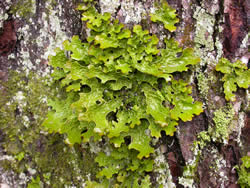
 Sticta has been stucta in my mind lately. Not sure why, but it won’t let go. Let’s take a quick look at this tiny, little, sticky remedy. Choudhuri’s Study of Materia Medica (1916) says: "This is comparatively speaking a little known and a rarely used remedy but that does not render it any the less important, for those cases that will call for Sticta will need Sticta; there Sticta and none but Sticta will help." This little remedy, Sticta pulmonara, also known as Lobaria pulmonara, is even kinda stucta where it grows. It’s a form of lichen which grows on tree trunks.
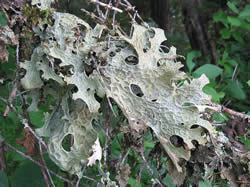
wet Lobaria pulmonara & dry Lobaria pulmonara The second part of its name, pulmonara, is kind of handy, too. Pulmonary = relating to the lungs. Clarke (1902) says: “There cannot be much doubt whence Sticta received its name of Pulmonaria. The likeness of the plant to lung tissue is self-evident.”
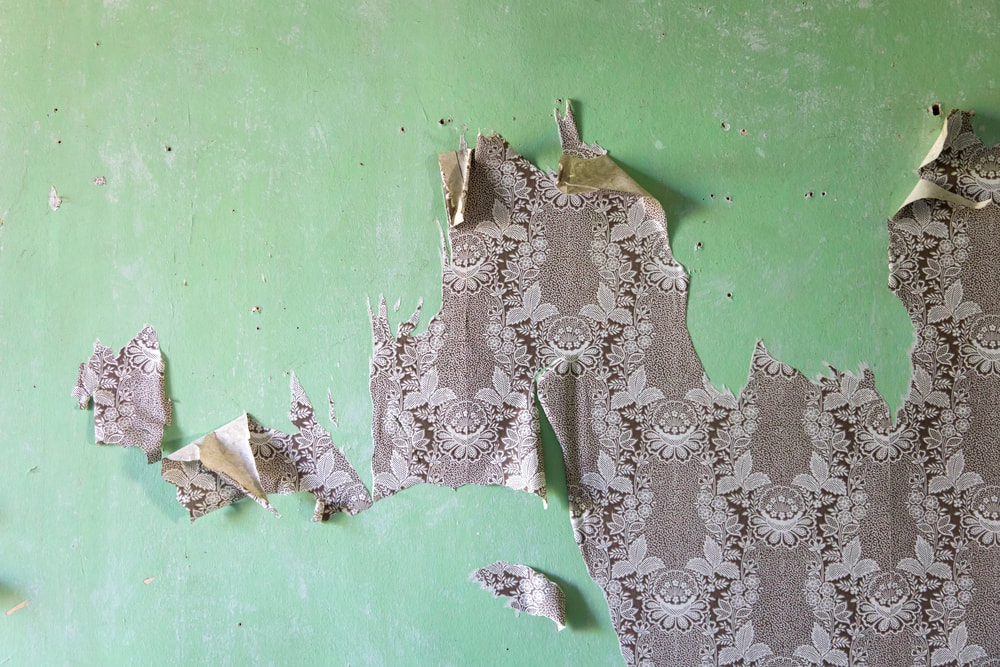
"'It was first used’ says Hale, ‘for severe harassing cough,’ and such good results accrued that provings were made to ascertain its full value. 'It was found to cause severe coryza, with violent sneezing, intense headache, and conjunctivitis. 'These attacks were preceded or followed by rheumatic pains and swelling of the small joints.’ The catarrh of Stic. is for the most part obstructive, and if there is discharge it dries quickly, and forms crusts or scurf. Constant need to blow the nose, but no discharge comes on account of dryness." (Clarke 1902) Sticta is known for its “excessive and painful dryness of the mucous membrane is not due to any want of secretion; for secretions occur but they dry up very rapidly leaving thick crusts behind them.” If you have ever experienced the crusts in the nostril problem, it’s easy to envision that wet Lobelia plant above just instantly shriveling up to the dry Lobelia. This is what I refer to as “wallpaper.” Sticta may be useful when there is stuckness in the respiratory system and it also may be useful for stuckness in the joints. Bursitis is the inflammation of a bursa. Bursa is a small, fluid-filled sac that cushions bones and tendons and muscles near the joints. When there is overuse, for example, the bursa gets inflamed resulting in pain and tenderness. Many people with bursitis describe a “stuck” feeling in the affected joint due to the stiffness, swelling and pain rather than a true mechanical lock. The inflamed bursa swells, thickens and irritates surrounding tissues, resulting in a tight feeling. The hip may feel stiff or stuck when standing from sitting. There may be difficulty raising the arm overhead — it feels frozen or stuck halfway. The knee may feel like it’s kind of stuck - unable to bend or straighten all the way. Here is a quick look of grade 3 & 4 rubrics for Sticta:
"Feels as if she must talk, about everything and anything, whether listened to or not.… Confusion of ideas, patient must talk." — Murphy This little remedy has a surprising number of one remedy rubrics, like:
Feeling stuck? Try some Sticta to become unstuckta. Julia Coyte, CHom Classically Practical homeopath #wellnessawaits
0 Comments
 Back when I first thought about writing this article (in 2023), decongestants were front and center in the news, just like one’s nose is front and center when it’s all stuffed up. The Consumer Healthcare Products Association suddenly announced that currently available decongestants don’t work. I didn’t dig into all the details because that was another lifetime when I cared about such things.
Back in the day, I was a big fan of Sudafed. I used it very frequently and it really never occurred to me to think there was any reason why I shouldn’t use it. Until one day after years of regular Sudafed use, I had what seemed like, (in hindsight, anyway), a panic attack. At that time, I lived at sea level and I was visiting a high altitude. I took my little red Sudafed, because that’s what I did pretty much every day, and I ended up breathing into a paper bag to calm my system. I have never checked out the side effects of Sudafed until literally right now and, lo' and behold: "fast, pounding or uneven heartbeat" and "severe dizziness or anxiety." It appears (according to Drugs.com) I should have sought medical attention but I didn’t know that at the time. I don’t think I ever had another Sudafed after that miserable experience. Since finding homeopathy, the thought has honestly never again occurred to me to take any of the allopathic over the counter decongestants. In the homeopathic literature, the word congestion refers to hyperemia or "an excessive amount of blood in a given part of the body." To look up congestion, as in, “a head filled with snot,” those words would be catarrh and coryza. Old words for colds, basically. From the Oxford Dictionary of English, 2nd edition:
For simplicity’s sake, let’s say catarrh is stuffed up (congestion) and coryza is running out. Both problems are associated with colds and allergies which are both causes of congestion. (It's getting circular again!) I suppose one could say it’s better to have it running out rather than being stuck in there, “better out than in!” — but that has its own set of problems. In an ideal homeopathic world, we would investigate catarrh as it exists in the individual. Where is the congestion located? The eyes, ears, sinus, larynx, trachea, etc. Were I to begin treating some acute generic catarrh of the cold or allergic derivation (remember, catarrh could be in any part of the body and therefor other remedies may be more appropriate), I would start with either Kali bich or Calc carb. How would I choose? Well, if it is thick, I’d start with Kali bich. (Did you catch that rhyme there? Very useful to remember.) If the ears are involved to a high degree, I would start with Calc carb. (If we’re talking about a child, I would start with Calc carb because it’s just a good remedy for children, in general.) For the following symptoms which I gathered from Robin Murphy’s Repertory, both remedies are indicated, but one or the other is generally more indicated.
Let’s sum that list up… Calcarea Carbonica (Calc carb)
Kali Bichromicum (Kali bich)
It’s important to remember that BOTH Calc carb and Kali bich are indicated in all of these symptoms. What I have highlighted here is when one remedy was MORE indicated in each of these symptoms. (It's also important to remember there are many more remedies indicated in every one of these symptoms. I just chose to focus on the two most highly indicated remedies for catarrh, in general.) As a rule of thumb for an acute situation, choose one remedy and try a few doses. For example, take a dose of your chosen remedy in a 30c, approximately every 15-20 minutes for one hour. If there is ANY improvement, stick with that remedy. If there is NO improvement (I mean none!) then try a few doses in the same manner of the other remedy. For further ideas on dealing with colds and congestion, see: “Cough cough!” ; “Tis the Season for the Crud”; “Her Ears were Yuck”; “Calming the Cold”; "Allergies are Back". Forget trying to figure out which over the counter decongestants may or may not work and try some homeopathy. Homeopathy has no side effects. Homeopathy doesn’t interfere with other medicines. Homeopathy is not addictive. Julia Coyte, CHom Classically Practical homeopath #wellnessawaits |
Julia Coyte, CHomI am passionate about homeopathy and I love sharing this passion. Having a working knowledge of homeopathy shouldn't be kept a secret. If people have the ability to help themselves, their children and their friends when they have minor ailments, life just gets better for everyone. That is the purpose behind Ruminating on Remedies. Archives
October 2026
Categories
All
|
 RSS Feed