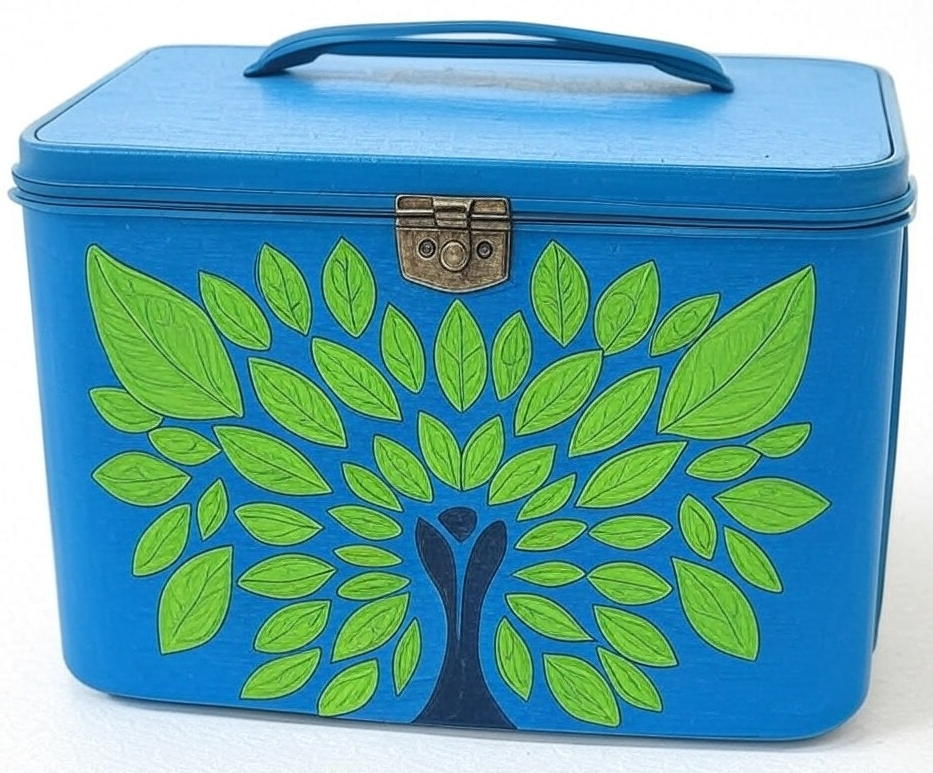
 “Wellness Box” image created by AI, with my help. Everything else was done by lil’ old me. Do you have a homeopathy kit yet?
If not, why not? It doesn’t take anything fancy. Any old box or bag will do. You could purchase a kit, ready to go. (See here and here for some ideas.) Or, you could make your own kit by purchasing remedies as you need them. Start with one. Add another couple and put a rubber band around them to keep them together. Add a few more and put them in a little ziplock bag. Add a few more and put them in a shoebox. Once you have them, you are then good to go. As long as you keep them safe and together, then you have your kit. I could give you a list of suggested remedies. Would that help? (Almost all of these Ruminating on Remedies articles are written with common, easily sourced remedies in mind. Read through and find a few remedies that might serve you and your family well. It’s actually one of the hardest things to do — narrowing down to just 10, but here goes! Top 10 — in no particular order: 1. Arnica
Two people have independently spoken to me about their homeopathic kits in the last two weeks. The first one purchased a Narayani kit and there is no other way to say it — she is over the moon with it. (She didn’t purchase the little one mentioned in the link above, she went for the whole kit and kaboodle!) The second person, just this morning told me how much she loved her little kit of 50 remedies. She said she wants to carry it around with her everywhere. The other day her son was feeling a little off — Nux took care of that. She slammed her finger tip in a drawer and Arnica and Hypericum took care of that. Done. Easy. Return the remedies to where they belong and your kit is once more ready to go for the next thing that comes along. What are you waiting for?!? Julia Coyte, CHom Classically Practical homeopath #wellnessawaits
0 Comments
 Hepar sulph has been touted as the homeopathic antibiotic. Taken literally, those two words don’t go together because hom (meaning “same”) is the opposite of anti (meaning “against”). (For more information, see Hom, not Home.) With that in mind, let’s talk a little bit about why homeopathic Hepar sulph has acquired this incongruous reputation. Hepar sulph is reputed to combat infections and reduce pain. If we take a look at the Banerji Protocols book (Banerji and Banerji 2013), we will find Hepar sulph listed 40 times. Beginning with acne vulgaris and venturing through such ailments as impetigo, pharyngitis (sore throat) and tonsillitis — all conditions which the internet tells me are generally, or at least often, treated with antibiotics*. Dr. Manuel Mateu Ratera, in his excellent book First Aid with Homeopathy, recommends Hepar for “serious and destructive situations: tendency to suppuration and an exaggerated sensitivity to pain.” Technically, the full name of this homeopathic remedy is Hepar sulphuris calcareum. When I ask my Brave search engine, it tells me that “in the past, ‘hepar’ referred to the liver or a preparation made from it. Although this term is no longer commonly used today, it is a direct borrowing from the Greek word ‘hepar’, meaning liver.” Interesting. Dr. Robin Murphy (2006) tells us that “Liver of Sulphur” is the name given “by the old alchemists to several sulphur compounds whose color was supposed to resemble that of liver.” SIDE NOTE: With all this talk of liver, I took a peek in the repertory to see how Hepar sizes up for liver symptoms and yes, there it is. The second part of the name comes from the “pure flowers of sulphur.” Nope, not that kind of flower. Webster’s Dictionary clears this up as: “sublimed sulfur in the form of a fine yellow powder used especially in agriculture and in medicine” (2024). Back to Murphy (this time accessed via Radar Opus 2.2.16) for the final installment of the understanding of how this remedy comes about: “an impure Sulphide of Calcium prepared by burning in a crucible the white interior of oyster shells with pure flowers of sulphur” bringing the calcareum into the picture. As you may know, our beloved homeopathic remedy Calc carb (aka Calcarea carbonica) is made from the extract from the middle layer of the oyster shell, so all that goodness is part of the Hepar sulph calc picture, too. In fact, Samuel Hahnemann prepared this mineral compound because he was trying to combine the effects of two of homeopathy’s biggest remedies (AKA polycrests) Sulphur and Calc carb. Ok, after a brief side journey to learn how we get this remedy, let’s get back to understanding how Hepar sulph can be applied. Hepar is known physically for exquisite pain and sensitivity: think of ingrown toenails, hang nails, those tender zits that can pop up which cause unbearable pain at the slightest touch. Mentally: anger; being contrary; irritable; extremely sensitive in general as well as to pain; sensitive to air and cold … Put the physical and mental pain and sensitivity together and that pretty much describes a Hepar sulph moment. What general conditions may be helped by Hepar? In no particular order:
Cold may worsen any condition which may be helped by Hepar. For instance, think of the cough or discomfort that may come on after breathing in cold air when unwell or the throat pain that is worse after swallowing a cold drink or a toothache that really zings when you breathe in cold air or swallow a cold drink. And, on top of that, the person may be chilly in general. What unusual symptoms might Hepar sulph tackle?
Cheese? Yes, cheese. Stools which smell like cheese. Cheesy discharges from any part of the body. Conditions which smell like cheese. Breath which smells cheesy. Experiencing the odors of cheese (or old cheese) — be they imaginary odors or real odors. Cheesy smelling sweat. Coughing up “cheesy lumps.” Homeopathy is so effective in so many conditions and Hepar sulph is an excellent remedy to have in your kit, especially if you are adventuring where modern medicine is limited. A well-timed early dose of Hepar sulph could help to avoid bigger problems down the road. Julia Coyte, CHom Classically Practical homeopath #wellnessawaits * Given the fact that many of these conditions are treated via antibiotics in conventional medicine, please make sure to work with a physician alongside a certified homeopath. RESOURCES
Banerji, P. and Banerji, P., 2013. The Banerji protocols : a new method of treatment with homeopathic medicines. India: Pratip Banerji. Merriam-Webster, 2024. Merriam-Webster Dictionary [online]. Merriam-webster.com. Morrison, R., 1993. Desktop guide to keynotes and confirmatory symptoms. Nevada City, Calif.: Hahnemann Clinic Pub. Murphy, R., n.d. Homeopathic Remedy Guide. accessed through Radar Opus 2.2.16. Murphy, R., 2006. Nature’s materia medica : 1,400 homeopathic and herbal remedies. Blackburg, Va.: Lotus Health Institute, November. Ratera, Dr. M. M., 2016. First Aid with Homeopathy. Germany: Narayana Verlag.  “So putrescent, so feculent, so foul.” These words, borrowed from Colleen Paeff’s The Great Stink: How Joseph Bazalgette Solved London’s Poop Solution Problem (2021) really get to the heart of the matter. What’s the first thing you think of when you think of poop? The smell, of course! Poop and stink go hand in hand. (See Rooty Toot Toots for remedies which may help for stinky gas.) Why are poops stinky? Referring back to the first article in this series, dead bacteria, which makes up 30% of poop, is the cause of the smell. Mental Floss, citing Val Curtis from the London School of Hygiene and Tropical Medicine says, “that we think poop stinks for our good. Our disgust towards certain sights and smells is a ‘behavioral immune system’… that evolved to keep us from coming into contact with infection and disease (Soniak 2013). So, how does homeopathy fit into stinky stools? Well, if you are a regular reader of Ruminating on Remedies, I’m hoping you are now catching on to the idea that after the 220+ years that homeopathy has been around, homeopathy pretty much has a remedy to address pretty much everything… even stinky stools. Most stools stink and that’s normal. However, sometimes there may be a particular odor that is new to a person. In these instances, that new poop smell may help guide one to a helpful remedy. There are a few homeopathic remedies which keep popping up for specifically stinky stools. In particular, Dioscorea, Colocynthis and Sulphur. Generally speaking, I try to keep the remedies mentioned in this blog to those that are readily available. Dioscorea and Colocynthis aren’t unusual remedies, but unlike Sulphur, they are definitely not found in my local stores which sell homeopathic remedies, nor are they always included in remedy kits, but they are well worth seeking out to have in your homeopathic remedy stash. Interestingly, in terms of gastrointestinal disorders, Dioscorea and Colocynthis are opposite each other in regard to colicky pains. Dioscorea has a tendency to stretch backwards to relieve abdominal pains whereas Colocynthis would bend forward to relieve those pains. As for smelly stools, Colocynthis, according to Schroyens, has stools which smell like:
Dioscorea, on the other hand, is mentioned in Murphy’s Repertory in 86 rubrics relating to stools but it is the only remedy listed in the only rubric for those acutely sensitive to the odor of stools to the point of fainting. (Dioscorea is also mentioned in a number of other repertories for offensive stools in general.) Sulphur is another remedy to consider for those oversensitive to stool odors. A Synoptic Key (Boger 2015) is an excellent get-to-the-point materia medica (the book also includes “a brief repertory” which also gets right to the point). Dr. Boger lists Stool, bad odor, including 3 really good stool remedies: Arsenicum album, Carbo-veg and Podophyllum. (That’s a heck of a lot easier than parsing through the 297 remedies listed in Schroyens under offensive stools. See what I mean -- he gets right to the point, kind of like a "start here" sort of repertory.) However, if the stools are offensive only in the morning, consider Graphites. If the stools smell like rotten cheese, try Bryonia or Hepar sulph. If the stools have a penetrating odor: Sulphur or Podophyllum. If the odor cannot be removed, even with washing: Sulphur. Putrid (meaning decaying or rotting smell) stools: there are lots of well indicated remedies here, but start with Podophyllum or Arsenicum album. If these putrid stools are found in the elderly, try Baptisia. If they smell putrid only at night, try Sulphur. Back to Boger for stools that smell like carrion (decaying flesh of dead animals): Carbo veg. Like rotten eggs? Chamomilla. Like sour milk? Tabacum. Sour, in general? Calc carb, Hepar sulph, Mercurius or Sulphur. For an odorless stool, look to Veratrum album. If you would like to keep your bathroom smelling decent for those visitors who have not yet discovered the wonders of homeopathy, try some Poo-Pourri.* They make products to spray into the toilet “before-you-go” and claim it “trap[s] bathroom odor under the water’s surface, so it never enters the air.” It works and it also makes for a funny present with names like: “Trap-a-Crap” and “Royal Flush” and “Heavy Doody” and they even come in seasonal scents. Now, I must admit that I am pooped. I have crapped out on the Doo-Doo Documents for now but there is more to be said on this topic and perhaps one day we shall revisit this extraordinarily important topic. Julia Coyte, CHom Classically Practical homeopath #wellnessawaits * I have no affiliation with this company, I just like their products. RESOURCES
Boger, C. M., 2015. Synoptic key of the materia medica : a treatise for homeopathic students. New Delhi: B. Jain. Murphy, R., n.d. Homeopathic Remedy Guide. accessed through Radar Opus software. Paeff, C., Carpenter, N. and Mcelderry, M. K., 2021. The great stink : how Joseph Bazalgette solved London’s poop pollution problem. New York: Margaret K. Mcelderry Books. Schroyens, F., 2012. Synthesis : repertorium homeopathicum syntheticum. Accessed through Radar Opus software. London: Homeopathic Book Publishers. Soniak, M., 2013. Why Does Poop Stink? [online]. www.mentalfloss.com. Available from: https://www.mentalfloss.com/article/49033/why-does-poop-stink.  You can't see them in the photo, but trust me… they're there! So there I was, basking in the purity of the White Sands. The day before was unbearably hot… all… day… long. I mean seriously hot. In fact, we were supposed to visit White Sands yesterday afternoon but the thought of said dunes in that heat was too much. We opted for an early morning visit the next day instead. Excellent choice! The sand, (well, the gypsum,) felt amazingly cool as we climbed the first dune. I left the rest of the hiking of the dunes to the more intrepid among us and I wallowed in the marvel that is this amazing place. I was lying on my back, hat over my face, loving every second of this and contemplating making a sand angel cuz it felt like the appropriate thing to do. My arms were stretched out to either side, just about ready to go and, “Ow!” I frantically brushed at my arm and as I looked to see what got me, a little red head was still attached to my bicep. How could something so awful be hanging out in such a pure and marvelous landscape? To be fair, shortly after arriving on the top of the dune, I looked down and saw a red ant. Then I saw many more red ants. I knew they were there and I should have paid heed. Alas. Live and learn. Back to the red menace… I leapt up and got down the dune incredibly quickly. (Bounding down the dune was so much fun — if you go, forget the sled! They sell you a sled at the ranger station and then they buy it back from you for less than you paid. Sometimes you can find a perfectly good sled in the garbage, FYI.) I dug out my kit of 100 miniature vials of homeopathic remedies that always travels with me and immediately went for the Apis. I did a couple doses of Apis but the thing was still incredibly painful. I then switched to Ledum. Still really not any improvement. Then, I looked at the bite and saw a large welt developing, coupled with the intensely painful itching… Staphysagria. That one brought some relief, both to my arm and to my mood. I then alternated between Staphysagria and Apis every few hours for the rest of the day. This was on a Sunday. By Tuesday, it felt like it was getting worse. It was hot. It was itchy. It hurt. It felt like it was getting much bigger. Infection setting in? I moved to Hyper/Ars: Hypericum mixed with Arsenicum album. This, too, was helpful. It contained the spread and it shrunk in size just a little bit, but then it began to spread again. I tried a little Plantain ointment. That certainly didn’t hurt, but it wasn’t the answer. By Wednesday morning, I had decided to try a completely different route and I dug out my little canister of PRID Drawing Salve*. PRID Drawing Salve has been around for over 50 years, and, as the package says, it is a “pain relief & irritant drawing salve” for splinters, thorns, ingrown hairs, insect bites, boils, minor cuts and scrapes. My one little bite was pretty big by now so I dabbed the sticky brown stuff on my arm and had to use 2 bandages to keep it from getting on everything. What’s in it? As I mentioned above, this stuff is sticky. Among its ingredients: beeswax and wood rosin (the internet tells me this is a natural resin from the sap of pine trees.) Homeopathically speaking, PRID contains low X potencies of Arnica, Calendula, Echinacea, Hepar sulph, Ichthammol, Silicea and Sulphur -- all excellent choices for infection. I have written previously about Arnica, Calendula, Echinacea, Hepar sulph, Silicea and Sulphur. (You can search for articles on these remedies on Ruminating on Remedies.) While digging a little deeper into Echinacea, I have learned some interesting things from herbalist Matthew Wood (I highly recommend picking up Wood's Earthwise Herbal books). (Note: I accessed this through Radar Opus software and I don't see which of his many books correlates to this title.) The Indians of the Great Plains used the western purple coneflower, Echinacea, "to treat snake bites, insect bites, septicemia and various kinds of poisonings" (Wood). Dr. Robin Murphy notes that homeopathic Echinacea is a great remedy "when boils progress to the stage where they appear about to point then stop and do not suppurate. Echinacea helps in carbuncles with similar symptoms, a bluish-red color and intense pain" (Murphy n.d.). (I have to say, this sounds a little like where it felt my ant bite was going.) Ichthammol (or, Ichthyolum), however, is a new remedy for me. Dr. Robin Murphy tells us this is an “unproved” remedy**, (made from shale oil), which comes to us from old-school therapeutics as an external application which has been used for psoriasis, eczematous dermatitis, leg ulcers, seborrheic dermatitis and furuncles (Boyd 2010). Like Echinacea, Ichthammol is said to be a powerful anti-septic. When I removed those first 2 bandages a couple hours later, the swelling and redness had shrunk considerably. I did feel the need to apply the PRID two more times and then that was the end of that. I am now a day shy of 2 weeks from the day of this bite and I have no pain, but I do have a residual reddish mark. The other day I could see and feel 4 little white bumps so I think I suffered more than 1 nibble. The downside of using a combination remedy is that it is impossible to know which remedy worked. Having said that, who cares? I am interested in positive results -- it really doesn't matter to me how I get there. Might it be more elegant to take a single dose of the appropriate homeopathic remedy. Sure! In this case, might the drawing part of this salve have played a role? Could be. Julia Coyte, CHom Classically Practical homeopath #wellnessawaits * I have no affiliation with this company or this person (or, any other, actually). ** Ichthammol is listed in Bradford’s Index of Homeopathic Provings (1898), so 🤷♀️. References:
Boyd, A. S., 2010. Ichthammol revisited. International Journal of Dermatology [online], 49 (7), 757–760. Murphy, R., n.d. Homeopathic Remedy Guide. accessed through Radar Opus software. National Park Service, 2022. White Sands National Park (U.S. National Park Service) [online]. www.nps.gov.  Photo by Julia Coyte The first time I saw an eclipse, I was in 4th grade. We had our pinhole cameras that we made at school, and we were warned of the dangers*, but I looked directly at the sun anyway. I’ve been paranoid for the 40+ years following that I did true damage to myself that day but fortunately the eye doctor has never found any problem. (Be sure to see an ophthalmologist if you have any concerns about your eye health.) Well, there was another eclipse today. The news keeps telling us that these eclipses are a once in a lifetime thing, and maybe I have just been lucky and have been in the right place at the right time, but I have now seen 3 big solar eclipses. This year we weren’t on the ball enough to get the special little glasses and we weren’t crafty enough to make the pinhole camera in time. But, what I saw this time that I didn’t see the other times were these crazy, crazy shadows. When I first noticed them I thought I was seeing things and then I thought I was having a dizzy spell.  My first glimpse of the shadows thinking something was wrong with my eyes. Photo by Julia Coyte Turns out I wasn’t seeing things. The trees made a pinhole camera for us. (I didn’t look very hard for an explanation of this, but I did find this article from a Singapore newspaper from 2019.)
What do these trippy shadows have to do with homeopathy? Well, I’ve never looked into it until now, but there is one homeopathic remedy listed in most repertories for ailments from looking at an eclipse and that is Hepar sulph. While Dr. Murphy lists 26 remedies which may be indicated for ailments following sun exposure to the eyes, his rubric for affects from looking at an eclipse lists just Hepar and Sol. What other eye complaints might Hepar help? Turns out there are quite a few possibilities, but these are the most likely indications, according to Robin Murphy:
Calvin Knerr’s repertory lists a few more well indicated eye symptoms for Hepar sulph:
I see some of those paper eclipse glasses on sale on the internet — maybe I’ll buy a couple to leave in the drawer for the next time an eclipse rolls through town. Then again, if I had them, I may never have noticed these cool shadows. Julia Coyte, CHom Classically Practical homeopath #wellnessawaits As summer winds down, the cicadas seem to be winding up. Boy, they have been noisy this year! When they take a break, the silence makes me realize that living with something like tinnitus must be very trying, indeed! Tinnitus (National Institute on Deafness and Other Communication Disorders 2018), the perception of outside noise when no actual external stimulus is causing the sound, affects 15-20% of people of all ages but it is especially common in older adults. Sometimes there is an underlying cause that can be addressed to fix the tinnitus, but usually, treatments to make the tinnitus less noticeable are used (things like hearing aids, sound generators). Common causes are hearing loss, ear infection or ear canal blockage, head or neck injuries and medications (Mayo Clinic 2018). Like so many chronic conditions, we are told there is no cure. Half the people who experience tinnitus do not have measurable hearing loss. A small percentage of people suffering from tinnitus experience serious debility in their daily lives (Prutsman 2023). Homeopathically speaking, there are some remedies that can help though it’s not usually a quick fix, so be prepared to be patient. There are a lot of rubrics and remedies associated with hearing noises in the ears — some of them quite specific as to the sound (for example, hearing bagpipes in the distance — Nat carb) or, specific circumstances or specific times of day when the noises occur. A few remedies pop up more often than others: Petroleum, Lycopodium, and China officinalis, in particular. There is a theme amongst these remedies of sensitive hearing, hyperacusis, which is a common complaint of tinnitus sufferers (Hebert et al. 2013). It never ceases to amaze me how homeopathy figured this stuff out a hundred plus years before the research was done! Petroleum is associated with chronic eustachian catarrh, (mucus or gunk in laymen’s terms). Conversely, there may be a dryness or a disagreeable feeling of dryness in the ears. There may be itching deep inside the ear or, diminished hearing in general. There could be an over-sensitiveness of not only hearing, but also of touch and smell, too. Impaired hearing with noises in the ears; impaired hearing in old people or, progressive hearing impairment. The sounds which may be heard for which Petroleum may be of benefit: bells; humming; constant roaring or rushing water; cracking; whizzing or the sound of wind. Lycopodium may help when there is a swelling of the ear with discharge. Perhaps, a sensation as if hot blood has rushed into the ears. Impaired hearing with discharge from the ear. Sensitive to noises and sounds, particularly music. The noises which may be helped with Lycopodium are: roaring, humming, whizzing and rushing. China officinalis is for a great over-sensitiveness of the nervous system — all sights, smells, hearing and taste are too strong. The external ear may be sensitive to touch. Impaired hearing with constant noises in the ears, possibly with a headache. The noises which may be helped by China officinalis are humming; ringing, especially with an accompanying headache; roaring; ticking as of a distant watch; buzzing; noises as if hearing singing. Back to the bagpipes of Natrum carbonicum… this remedy isn’t as prominent as the remedies listed above, but there are some interesting things associated with it. There may be a stopped sensation with diminished hearing. Sensitive hearing, particularly to music - they can’t bear it or, the rumpling of paper. Bubbling noises or as if a bubble is bursting; sounds seem to come from the left side when they really come from the right; and, the illusion of hearing singing. And, though they can’t stand hearing music, they have the delusion they are hearing music — that must be frustratingly awful! A list of a few noise rubrics and some corresponding remedies:
Book a focused consultation and see if we can take the focus off those noises for you. Julia Coyte, CHom Classically Practical homeopath #wellnessawaits Reference list
Cleveland Clinic, n.d. Tinnitus: Causes, Treatment & Prevention [online]. Cleveland Clinic. Hebert, S., Fournier, P. and Norena, A., 2013. The Auditory Sensitivity is Increased in Tinnitus Ears. Journal of Neuroscience [online], 33 (6), 2356–2364. Mayo Clinic, 2018. Tinnitus - Symptoms and causes [online]. Mayo Clinic. National Institute on Deafness and Other Communication Disorders, 2018. Tinnitus [online]. NIDCD. Prutsman, Dr. J., 2023. Tinnitus [online]. Sound Relief Tinnitus & Hearing Center.  Waking up in the middle of the night to your little one “barking” and struggling to breathe is a frightening thing. Croup, according to Taber’s Medical Dictionary “is an acute viral disease, usually occurring in children from 6 months to 5 years and marked by a resonant barking cough, (sounding like a seal), and varying degrees of respiratory distress" (Venes and Clarence Wilbur Taber 2013). Croup isn’t a separate disease unto itself — it’s something that can develop from a common cold or flu. “If there’s enough swelling, irritation and coughing, a child can develop:
Mayo says to seek medical attention if your child:
Despite how scary it sounds, croup isn’t usually serious and it mostly can be treated at home. Why the barking? The cough forces air through the swollen and irritated passageway and results in a seal-like bark. My oldest was prone to this and it is indeed an unnerving experience. I didn’t know about homeopathy then, but we were able to treat him at home each time by sitting in the steamy bathroom until it all calmed down. Conversely, taking the child outside into the cold night air or having them stand in front of an open freezer can also do the trick (Cleveland Clinic 2021). How can homeopathy help? The first remedy to consider for croup is Aconitum napellus, or Aconite, for short. (Remember! Aconite rhymes with fright!) It’s a pretty sure bet that both the child and the parent* will be frightened! Use Aconite at the first sign. Repeat, if needed. Aconite is the “go-to” remedy for any illness with rapid onset. * Don’t forget Ignatia for the worried parent! Other homeopathic options for croup: Spongia tosta is the next remedy to consider if the Aconite did not take care of it quickly. Spongia is known to have a cough which sounds like a saw going through wood — a very dry cough and warm drinks are probably helpful. Hepar sulph might be useful in the morning or in the following days when the cough can sound basically the same, but it changes to a wetter cough — loose and possibly rattling. There may be some choking fits that accompany the cough. Repeat the chosen remedy every 15-20 minutes, if needed. If the child falls asleep, that’s good! If they wake again, repeat the remedy. (Click for an instructive video of cough sounds and their corresponding homeopathic remedies.) If your child is prone to croup, consider working with a professional homeopath to help prevent recurrences. Julia Coyte, CHom Classically Practical homeopath #wellnessawaits Allen College of Homoeopathy, n.d. Listen the Cough Sounds & Diagnose the Remedy (Part 1) [online]. www.youtube.com. Cleveland Clinic, 2021. How to Care for Your Child’s Croupy Cough [online]. Cleveland Clinic. . Kessels, L., n.d. Home Remedies for Colds and Croup: Do They Work? [online]. www.stlouischildrens.org. Mayo Clinic, 2019. Croup - Symptoms and causes [online]. Mayo Clinic. Venes, D. and Clarence Wilbur Taber, 2013. Taber’s cyclopedic medical dictionary. [22nd ed., ISBN: 9780803629776]. Philadelphia, Pa.: F.A. Davis.
 Tis the season for… Sore Throats. Sore throat complaints are keeping me busy this month! Some have the dreaded Covid, some have the flu, some may have strep throat and some people just have a sore throat. What to do about this pharyngitis? (Pharynx is the part of the throat behind the mouth and nasal cavity and “itis” for inflammation.) Well, at the first sign of feeling unwell, I like the Banerji protocol of Aconite 200c mixed with Bryonia 30c. Taking this right away can often nip things in the bud and send the yucks away before they can settle in. Another option for those who are quick on the draw is Ferrum phos 6x. This, too, can often turn things around in short order. Once the yucks have made themselves at home and one is definitively feeling unwell, let’s look at a few homeopathic remedies which may help. (Note: There are many remedies which can be helpful for sore throats, these are just a few of my favorites.) See also: Calming the Cold; Some Flu Remedies to Consider and Tis the season for the crud. Baptisia Extremely painful, dark red throat, where swallowing liquids is the only option and even that is very difficult, despite being thirsty; tiny bites of food gags them. They may have swollen glands and/or bad breath. Belladonna The sore throat appears suddenly and generally hurts more on the right side with burning or throbbing pain. The throat and the tip of the tongue may be red. Pain is worse from turning the head, touching the throat and swallowing, especially liquids. Face will often be red and hot but the hands and feet tend to be cold. Gelsemium Burning and rough sore throat with pain that extends from the throat to the ear. May feel like there’s a painful lump in the throat that cannot be swallowed. Pain in the sternocleidomastoid — the long muscles on either side of your neck. Paralysis of the vocal cords. Swallowing solid foods is difficult. Hepar sulph Homeopathic Hepar is known for a sticking sensation in the throat, like a splinter or a bone. Pain extends to the ear on yawning and swallowing. May hawk up thick, yellow, sticky mucus. Wrapping up the external throat feels good. Cold drinks or becoming cold makes them feel worse but warmth in general and warm drinks can help. There may be a pulsation felt in the throat and they may feel worse in the evening and at night. Very sensitive to the pain and sensitive to everything else, too, actually and they may be irritable and impatient. Lachesis A purple throat, often on the left side (or starts on the left and moves to the right) and feels worse when swallowing liquids — even saliva is difficult — empty swallowing makes the throat hurt even worse (though they may have a constant desire to swallow). Swallowing solids may be easier. May have a disturbing constricting sensation, causing them to loosen clothes around the throat. Ear pain with sore throat. There may be a sensation of breadcrumbs or a painful sensation of a lump or plug which is not relieved by swallowing. They may choke easily, especially on falling to sleep and may have a suffocative feeling. Often feel worse on waking. Lycopodium Often on the right side with a dryness in the throat and they may not be very thirsty. A stitching pain on swallowing which is better with warm drinks and worse with cold drinks. Choking on swallowing. They may feel like there is a lump or a plug in the throat. They are chilly but they also want fresh air but are worse becoming cold or eating/drinking cold things. May have digestive issues at the same time as the sore throat. Mercurius sol Lots of saliva and a raw, rough and burning feeling in the throat. Lots of slime gets stuck in the throat and there may be drooling while sleeping. Swollen glands. A bad or metallic taste in the mouth and may have bad breath. The throat may be copper colored. Throat pain on coughing. The throat may be worse at night and they may also experience night sweats. Finding the right temperature is often difficult. Rhus tox Body aches and restlessness may accompany the sore throat. The tip of the tongue may be red. The throat becomes irritated and the voice becomes hoarse and is often worse from talking. The pain is worse from swallowing at first, but improves with more swallowing. Warmth is helpful and moving around may help, too — feeling worse when they are resting. Like the swallowing, they may feel worse when first moving around but better as they keep moving. When to see a doctor? According to the Mayo Clinic, see a doctor if:
TONSILLITIS A few quick notes relating to tonsillitis. (Note on type: Most highly indicated, highly indicated and indicated.) Again, there are many homeopathic remedies for tonsillitis and I am just focusing on the throat remedies already mentioned. Tonsillitis, in general — in order of importance: Belladonna, Ferrum phos and Mercurius. Hepar & Lachesis. Baptisia and Lycopodium. Tonsillitis with pus: Hepar, Mercurius. Belladonna, Lycopodium, Lachesis Hardness of hearing with tonsillitis: Hepar, Lycopodium and Mercurius Chronic, recurring tonsillitis: Hepar, Lachesis and Lycopodium Painless tonsillitis: Baptisia Burning pain in tonsils: Belladonna and Mercurius Purple tonsils: Hepar and Lachesis Bright red tonsils: Belladonna and Ferrum phos Dark red tonsils: Baptisia and Lachesis Tonsillitis in children: Ferr-phos, Lachesis, Lycopodium and Mercury Sharp pain in tonsils: Belladonna, Lachesis, Lycopodium and Mercury Tearing pain in tonsils: Belladonna Throbbing pain in tonsils: Belladonna STREP THROAT Strep throat is another possibility and can lead to long term problems in rare cases. Unlike most sore throats, strep is caused by bacteria. Strep A is big in the news this year, especially in the UK, but there are other strains of strep which can cause throat problems, too (A, C & G are the primary throat culprits). I never messed around with strep throats when my kids were little because I know two people who suffered terribly as a result of untreated strep. “Untreated strep throat can cause an autoimmune reaction in which the body attacks its own tissues and may lead to rheumatic fever, chorea and kidney damage” (Berkow et al. 1995). How can you tell the difference between a sore throat and Strep throat? Ultimately, for a full diagnosis of strep throat, you need to see a doctor and get a throat culture. According the the Merck Manual and the Mayo Clinic, strep throat symptoms typically appear suddenly and include:
In very young children (under 4), the only symptom may be a runny nose. (When my kids were little, I learned that strep infections in littles may present with only stomach problems, so keep that in mind.) “People with strep throat generally get better in 2 weeks, even without treatment. … antibiotics can shorten the duration of symptoms in young children and prevent serious complications such as rheumatic fever” (Berkow et al. 1995). (Note: There are homeopathic remedies which can be helpful in strep throat, but that is beyond the scope of this article.) If you are suffering from a sore throat, try one of these homeopathic remedies so you can get back to some painless Fa La La-ing before the festive season is behind us. Julia Coyte, CHom Classically Practical homeopath #wellnessawaits Reference list
Berkow, R., Beers, M. and Fletcher, A., 1995. The Merck Manual Home Edition. Merck Research Laboratories. Mayo Clinic, 2018. Strep throat - symptoms and causes [online]. Mayo Clinic.   Whether a river, an ocean or a pool -- nothing is as inviting as a body of water on a hot, summer’s day. It’s cool and refreshing, but, after a shallow dive into the subject … I hate to be the bearer of bad news, but it can be dangerous! Let’s start with a dip in the pool, which is most likely chlorinated. Some people are particularly sensitive to the chlorine and can develop what is known as SWIMMER'S EYE or, chlorine conjunctivitis. It is essentially eye irritation but it stings and it can be pretty miserable. Goggles can help, but that's not a sure thing to keep it at bay. Homeopathic Euphrasia or “Eyebright” for burning eyes and watery eyes. Pain as if something were in the eye. Puffy eyes. Red eyes. When “eye” is in the name of the remedy, you know it’s a good place to start. Arsenicum album for profuse, watery, burning discharge. There is often a level of restlessness. Or, Similisan’s Redness & Itchy Eye Relief* would be a good thing to keep in the cupboard if you or your child is prone to this. --------------------------------------------- Moving from the pool to a natural body of water can bring it’s own set of problems, namely, SWIMMER'S ITCH or Cercarial Dermatitis. Caused by a parasite that gets under the skin (Kolářová et al. 2012) and triggers an allergic reaction, swimmer’s itch is as the name suggests, an itchy rash. If the rash is blistery and oozy, look to Graphites. If the rash burns, stings and itches, try Sulphur. If the rash stings and is raised and fluid filled, try Apis. ------------------------------------------- SWIMMER’S EAR Regardless of what kind of water you’re swimming in, swimmer’s ear is basically an outer ear infection caused by trapped water in your ear that can lead to the growth of bacteria (Mayo Clinic). For sharp ear pain with a sudden onset, Belladonna. There may be redness and throbbing pain. An aching ear pain that feels like the ear is stopped up, Chamomilla. If there is discharge and itching, try Hepar sulph. Or, Similason has a new formula: Swimmer's Ear Relief*. ------------------------------------------- If you are lucky enough to be near the ocean, beware of JELLYFISH! Potentially harmful jellyfish are found in most oceans and can cause both dermatological problems as well as systemic issues (Mebs 2014). The venom of the 51 species of box jellyfish can kill a human in less than 2 minutes (Baldwin 2022). The Wilderness Medical Society has published “Jellyfish Stings: A Practical Approach” (Lakkis et al. 2015). If you left your stinger suit hanging in the closet and manage to get stung, conventional medicine doesn’t have a lot to offer. “The literature published on the treatment of jellyfish stings is limited, conflicting, and lacks consensus.” In short, help the person out of the water, keep them from rubbing the stung area and reassure them. Some say to apply cold, others heat. If it’s a life-threatening species, call an ambulance immediately. (Be careful when helping someone with a jellyfish sting as stinging cells may be spread on contact.) Once again, this is a situation where homeopathy can come in very handy. Homeopathy doesn’t care if the sting is a result of a jellyfish or a bee. If the symptoms match the remedy, there is a good chance relief will follow. First Aid with Homeopathy (Mateu 2020) says applying vinegar can decrease the effect of the toxins. For all these homeopathic jellyfish remedy recommendations, repeat every five minutes until significantly better and then begin to lengthen the time between doses. For most “run of the mill” jellyfish stings, try Apis mellifica. For intense burning and stinging followed by redness and swelling. The person needing Apis will generally be worse from warm applications. If the affected area feels cold and also feels better from cold, try Ledum. Urtica urens can be applied topically as well as ingesting the homeopathic remedy. The person needing Urtica will be experiencing great itchiness and burning, similar to experiencing stinging nettles (from which the remedy is made). If the pains are more neuralgic in nature and radiating out, try Hypericum. ------------------------------------------- HYPOTHERMIA It’s a warm, beautiful day with a little breeze and you think, “what could possibly go wrong?” Well, Hypothermia is one thing that can ruin your day. “That only happens in the cold, right?” Um. Nope. The only requirement for hypothermia to set in is anything that causes a severe drop in body temperature. It can happen in perfect conditions (Florida Fish and Wildlife Commission 2022) and, actually, swimming doesn’t even need to be involved. It can happen from being in the water or from being caught in a rainstorm. When I was a kid, my brother went sailing on a too cold day and he returned way too cold. I remember being instructed to lie down on the kitchen floor next to him under a blanket to try and warm him up. I now know that is termed “external passive rewarming” and is the method of choice for mild hypothermia. A slow and gentle warming is what you’re after. For hypothermia to set in, the water doesn’t have to be cold, just cooler than your body temperature. Children, the elderly, injured or intoxicated people are more susceptible (Paal et al. 2022). Shivering, confusion, breathing issues, and muscle dysfunction are some of the symptoms which may be experienced with a significantly lowered body temperature. The Natural First Aid Handbook (Mars 2017) recommends hot water bottles to the groin and sides of the torso and warns against rubbing or massaging an individual with hypothermia. First Aid with Homeopathy (Ratera 2016) recommends hot liquids and moderate warmth to the abdomen via a hot water bottle and also talks about breath as a treatment for hypothermia. “The helper places his mouth against the spine, between the shoulder blades, and breathes out in long breaths, blowing directly against the clothing. Almost immediately, local heat is felt, and gradually this heat spreads through the body if the exercise is continued. This technique helps to warm, and also to calm the patient. It can therefore also be used in crises of asthma or panic, to calm the patient and restore natural breathing.” Fascinating! Other than warming the person, what can be done? Homeopathy, of course! If the person is conscious, give a dose of Aconite to help with the shock. Bellis perennis is useful in thermal shock (Ratera 2016). Thermal shock can happen from any sudden exposure to cold when the body is hot — even drinking cold drinks when the body is hot. Carbo vegetabilis can be useful for persons who are chilly, with cold perspiration and cold breath. Other symptoms may include coldness, numbness and weakness. Veratrum album is for internal coldness, as if ice-water is in the veins. Weakness and collapse with coldness. If the person is icy cold but wants to be uncovered, consider some homeopathic Camphor. Cramps, convulsions or shock may be present. ----------------------------------------- DROWNING Regardless of the size of the body of water, drowning is always something to watch out for and contrary to what we have seen in the movies, drowning is often completely silent (Redcross. CA 2013). See sidebar for "signs a swimmer is in trouble." According to Stop Drowning Now (2018), in the US, 10 people die every day from drowning. “Drowning is fast and silent and can happen in as little as 20-60 seconds.” When my son was little, I turned my back to get his floaties and the other mother with me (who I thought was watching all the kids!) said, “I didn’t know he could swim.” I turned around and I saw him standing on the bottom of the pool, completely underwater, eyes open, looking up at me. He couldn’t swim! He definitely did not belong there! That could have been a disaster. It was absolutely instantaneous — shockingly fast! Thankfully, he was completely fine. I will never be able to get that vision out of my mind. It was terrible. CPR or the Heimlich maneuver, followed by mouth-to-mouth is the standard recommendation. Venema (et al. 2010) claim that 30% of rescued drowning victims require CPR. Get medical help immediately. If the person is unconscious, administer homeopathic Carbo vegetabilis while waiting for help to arrive. Carbo veg is known as “the corpse reviver” and should be administered frequently. To avoid inhaling the remedy, place the pellet between the lips and the teeth and let it dissolve there. If the person is better when sitting up but is experiencing a rattling in the chest, try Antimonium tart. Lachesis is indicated when the person is suffering asphyxia and the pulse is very weak. If there is a “near miss” like I described with my son, it may not be over and done with when you have them out of the water and breathing on their own again. Jama Pediatrics (Stern and Thompson 2022) notes that “symptoms of drowning such as gasping or difficulty breathing most commonly occur immediately. In rare cases, symptoms may develop after a nonfatal drowning. If a child develops worsening cough, fast breathing rate, vomiting or change in mental status after nonfatal drowning, take them to the nearest emergency department for evaluation.” It may seem like it’s better (and safer!) to just dip your toes in the water to cool off, but no! Life is too short to sit out the swim! Julia Coyte, CHom Classically Practical homeopath #wellnessawaits * I have no affiliation with this company, I just like their products.  REFERENCES AND FURTHER READING:
Baird, J. K. and Wear, D. J., 1987. 12 Cercarial dermatitis: The swimmer’s itch. Clinics in Dermatology, 5 (3), 88–91. Baldwin, E., 2022. Box Jellyfish: The Dangerous Jellyfish | Ocean Info [online]. oceaninfo.com. Florida Fish and Wildlife Commission, 2022. Hypothermia [online]. Florida Fish And Wildlife Conservation Commission. Gordy, M. A., Cobb, T. P. and Hanington, P. C., 2018. Swimmer’s itch in Canada: a look at the past and a survey of the present to plan for the future. Environmental Health, 17 (1). Hoeffler, D. F., 1977. ‘Swimmers’ itch’ (cercarial dermatitis). Cutis [online], 19 (4), 461–465, 467. Kolářová, L., Horák, P., Skírnisson, K., Marečková, H. and Doenhoff, M., 2012. Cercarial Dermatitis, a Neglected Allergic Disease. Clinical Reviews in Allergy & Immunology [online], 45 (1), 63–74. Lakkis, N. A., Maalouf, G. J. and Mahmassani, D. M., 2015. Jellyfish Stings: A Practical Approach. Wilderness & Environmental Medicine [online], 26 (3), 422–429. Lessell, C. B., 1999. The world travellers’ manual of homoeopathy. Saffron Walden: C.W. Daniel. Mateu, M., 2020. First aid with homeopathy. Kandern, Germany Narayana Verlag. Mayo Clinic, n.d. Swimmer’s ear - Symptoms and causes [online]. Mayo Clinic. Mayo Clinic, n.d. Swimmer’s itch - Symptoms and causes [online]. Mayo Clinic. Mebs, D., 2014. Durch Quallen verursachte Verletzungen. Jelly Fish Sting Injuries Der Hautarzt [online], 65 (10), 873–878. Paal, P., Pasquier, M., Darocha, T., Lechner, R., Kosinski, S., Wallner, B., Zafren, K. and Brugger, H., 2022. Accidental Hypothermia: 2021 Update. International Journal of Environmental Research and Public Health [online], 19 (1), 501. Ratera, Dr. M. M., 2016. First Aid with Homeopathy. Kander, Germany: Narayana Verlag. Redcross. CA, 2013. Drowning: A silent killer - Canadian Red Cross [online]. Red Cross Canada. Schmukler, A. V., 2006. Homeopathy : an A to Z home handbook. Woodbury, Minn.: Llewellyn Publications. Smith, S., 2007. Medical homoeopathy. West Wickham England: Winter Press. Stern, A. M. and Thompson, L. A., 2022. What Parents Should Know About Drowning and Dry Drowning. JAMA Pediatrics [online]. Stop Drowning Now, 2018. Facts & Stats About Drowning - Stop Drowning Now [online]. www.stopdrowningnow.org. Szpilman, D., Bierens, J. J. L. M., Handley, A. J. and Orlowski, J. P., 2012. Drowning. New England Journal of Medicine [online], 366 (22), 2102–2110. Venema, A. M., Groothoff, J. W. and Bierens, J. J. L. M., 2010. The role of bystanders during rescue and resuscitation of drowning victims. Resuscitation [online], 81 (4), 434–439. |
Julia Coyte, CHomI am passionate about homeopathy and I love sharing this passion. Having a working knowledge of homeopathy shouldn't be kept a secret. If people have the ability to help themselves, their children and their friends when they have minor ailments, life just gets better for everyone. That is the purpose behind Ruminating on Remedies. Archives
October 2026
Categories
All
|

 RSS Feed