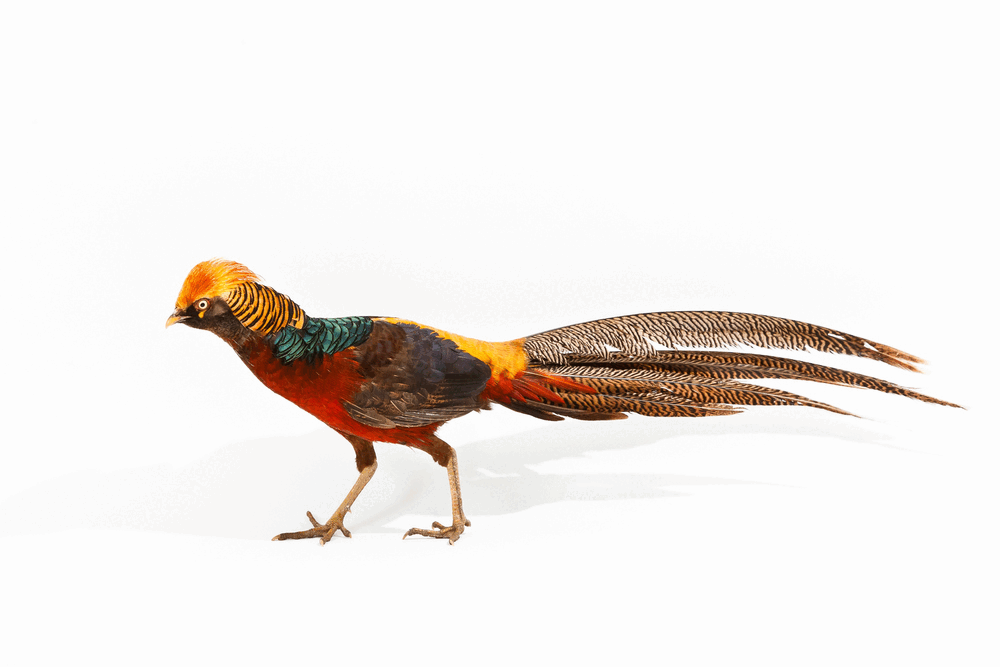
 Not a photo of the bird that adopted us, but this one looks almost as good as he did.😂 The flu is for the birds and the bird flu, well… I was asked about homeopathic remedies the other for backyard chickens. We used to have chickens (and a peacock and a Chinese pheasant adopted us for a while, too) and I can tell you that homeopathic remedies work beautifully for birds. (See Homeopathy to the Rescue.) Let’s start with giving remedies to the birds. Some say to put the remedies directly in their water. If you have a large flock, this might be the only way to do it. But, if you have a small backyard flock and it’s easy to see if only 1 or 2 birds are sickening, I like to put the pellets in a little water (or bone broth) and add some rice to the small bowl because I knew they would always go for the rice, even if they weren’t going to go for the water. (See also Making a Water Dose.) This way, you can isolate the sick chickens and make sure those who are most in need are actually getting the remedy. Another reason I like to give the remedies in a small bowl of water is that when you put the remedies directly in the birds’ waterer, it’s important to remember that every sip is a dose. However, if you have a large flock and you already have some sick birds, “dosing” the entire flock is probably the best way to approach this problem. As for the bird flu that is going around, the first thought that comes to mind is Oscillococcinum. (“Oscillococcinum 200 actually a patent property of Boiron Laboratory, France” (Julian 1980)). Well, that’s a bit simplistic, isn’t it… just to suggest using a major homeopathic flu remedy for the bird flu? Well, no, actually. The main ingredient in Oscillococcinum* is Anas barbariae which is made from the heart and liver of wild duck. Pierre Schmidt (Schmidt 2025), a homeopath of the 20th century (1894-1987), says “Oscillococcinum is for ‘influenza at the beginning as a preventative, as well as during convalescence.’” “This is the remedy at the beginning of influenza, of rhinitis and otitis. Given early it is very efficacious. To obtain good results in a case which begins and to cut short the manifestations of influenza, it is necessary to use one dose of Oscillococcinum 200c every 2 to 3 hours or repeat only if necessary” (Murphy). See here and here and here and here and here for some studies and here* for a review of Oscillococcinum trials. (Note: I think it is fair to say that at this point in history, there are not many fans of homeopathy in the mainstream medical system, and that includes researchers. Finding positive research on homeopathy is tough going for a couple of reasons: The main one, in my opinion, is that mainstream medicine has not been educated about homeopathy and therefore dismiss it as quackery. The other important reason why it is hard to find good research on the efficacy of homeopathy is that at its core, homeopathy is individualized medicine — a remedy that works for one person’s symptoms may not necessarily work for the next person’s symptoms. (See also: What to Expect.) Could Oscillococcinum work for birds and bird flu? I would certainly be willing to try it if I still had my backyard flock and if I was worried about bird flu. Apparently, bird flu is in my area (said my chicken-keeping neighbor), so I looked up what to look for in the flock. According to the Australian Government (2023):
So, what I’m seeing in these government documents, other than the combs and wattles and egg laying, are signs of the flu, but in chickens. With that in mind, symptoms are symptoms and remedies are remedies… meaning… it doesn’t matter if it’s a bird or a dog or a human, the symptoms will be noticeable and those symptoms can be addressed through the same homeopathic remedies regardless of showing up in a bird or a dog or a human. Sneezing is sneezing. Watery eyes are watery eyes. Fevers are fevers. Weakness is weakness. The only difference here, though, the chicken can’t tell us if the watery eyes or the diarrhea are acrid or bland. They can’t tell us if they they ache. Chickens run hot compared to humans (106 F) (Hobby Farms 2019), so telling if they have a fever could be a little tricky to begin with. My last article, When you have to get up… has a nice, long list of flu symptoms and possible remedies. I would say any chicken symptoms you could match with that list would work fine and dandy. The trick is translating what you’re seeing in your birds into human language. A more severe form of this disease which “presents suddenly, often with very high mortality, with affected birds developing swollen heads [emphasis mine], a blue coloration of the comb and wattles, dullness, lack of appetite, respiratory distress, diarrhea and significant drop in egg production” (2025) is another matter. Looking back in time a bit, The Poultry Doctor (Chambers 2018) originally published in 1891, mentions a swelled head: “From some cause not clear, the heads of hens will often swell greatly and be very hot. Exposure to draughts of air, however, is a fruitful cause of both swelled heads and swollen eyes. Spongia has given relief in many cases but Belladonna is the indicated remedy for this trouble; Bryonia also will relieve.” All three of these remedies are excellent flu remedies, in general. What else may help ward off the bird flu in your flock? This article has a short list of possible flu preventatives which may be applicable:
Prior to any symptoms showing up, Hyland’s Bioplasma* (or any other source of the combined cell salts — this is just the easiest to come by in most natural food stores in the US) is another good option. A couple of pellets of this combination of the twelve cell salts could easily be dropped in the flocks’ waterer for a while to help shore up their immune systems. We birds of a homeopathic feather need to flock together to keep sharing information on homeopathic remedies for humans and fowl alike! — if you would like to schedule a consult with me, drop me a line at [email protected]. Julia Coyte, CHom Classically Practical homeopath #wellnessawaits * I have no affiliation with this company, I just like their products. ** This review is not really in favor Oscillococcinum, however, I think it’s very important to note that in the “Authors’ conclusions” that it “could have a clinically useful treatment effect but, given the low quality of the eligible studies, the evidence is not compelling. There was no evidence of clinically important harms due to Oscillococcinum.” [emphasis mine] Reference list
Australian Government, 2023. Bird flu (Avian influenza) - DAFF [online]. Agriculture.gov.au. Beghi, G. M. and Morselli-Labate, A. M., 2016. Does homeopathic medicine have a preventive effect on respiratory tract infections? A real life observational study. Multidisciplinary Respiratory Medicine, 11 (1). Boericke and Tafel, 2018. The Poultry Doctor: The homeopathic treatment and care of chickens, turkeys, gees, ducks and singing birds. 2018 ed. Colombo, G. L., Di Matteo, S., Martinotti, C., Oselin, M., Bruno, G. and Beghi, G. M., 2018. The preventive effect on respiratory tract infections of Oscillococcinum®. A cost-effectiveness analysis. ClinicoEconomics and Outcomes Research [online], Volume 10, 75–82. Dutta, A., Manna, A., Ghosh, S., Mundle, M., Saha, M., Kumar Gourav, Sukhdeb Maiti and Chattopadhyay, B., 2024. Prespecified Homeopathic Medicines in the Prevention of Confirmed and Suspected Cases of COVID-19: A Community-Based, Double-Blind, Randomized, Placebo-Controlled Prophylaxis Trial. Complementary Medicine Research, 31 (2), 140–148. Hobby Farms, 2019. Chickens & Body Temperature: What You Need to Know [online]. Hobby Farms. Homeopathy Plus, 2024. Bird Flu: Are We at Risk [online]. Homeopathyplus.com. Julian, O. A., 1980. Treatise on Dynamised Micro-Immunotherapy. First Indian Edition, 1980. New Delhi - 110055 (India): B. Jain Publishers (P.) Ltd. Mathie, R. T., Frye, J. and Fisher, P., 2015. Homeopathic Oscillococcinum® for preventing and treating influenza and influenza-like illness. Cochrane Database of Systematic Reviews. Murphy, R., 2006. Nature’s materia medica : 1,400 homeopathic and herbal remedies. Blackburg, Va.: Lotus Health Institute, November. Schmidt, P., 2025. Pierre Schmidt [online]. Remedia-homeopathy.com. Scottish Government, 2025. Avian influenza (bird flu): how to spot and report the disease - gov.scot [online]. www.gov.scot. UCHealth, 2024. The bird flu has spread to dairy cows. Do you need to worry about another pandemic? [online]. UCHealth Today. Vickers, A. J. and Smith, C., 2004. Homoeopathic Oscillococcinum for preventing and treating influenza and influenza-like syndromes. Cochrane Database System Review.
0 Comments
 Flu season has returned. Well, colds, flu, Covid, influenza, whatever you want to call it — it’s back.
I’ve said it before and I’ll say it again - homeopathy doesn’t give a hoot what you call it. Homeopathy only cares about the symptoms you are experiencing. Here is a short and sweet list of remedies to keep handy - to take at the first sign of feeling unwell; whether that be cold symptoms or fatigue setting in or aches or sneezing.
Not homeopathic but pretty impressive… Last December while traveling in England, everyone around me was coming down with whatever it was everybody was coming down with. I was in Helios pharmacy picking up some remedies and I saw A. Vogel Echinaforce tablets on the shelf. I took these, as well as Ferrum phos 6x and never had so much as a sniffle. I would use that combination again in a heartbeat. If you don’t get there in time with the above remedies and the yucks have made themselves at home, see Flu Remedies to Consider. With all of these remedy suggestions (unless otherwise noted), take a dose at the first sign of feeling unwell. Repeat every 3-12 hours. When feeling better, stop the remedy. If the symptoms return, start the remedy again. Now, go out there, make merry and celebrate the joyous season like you used to! Julia Coyte, CHom Classically Practical homeopath #wellnessawaits  I’ve been thinking a lot about convalescence. I’ve been thinking about it partly because I’ve been doing it (Covid, round 2 for our house) and I’ve been thinking about it because I attended a webinar recently given by a naturopathic doctor. She said that when her patients tell her they are feeling better, that then begins their 3 day convalescence. She doesn’t clear them for returning to work or school until they have been 3 days past when they started to feel better. What a concept! I get it! It makes so much sense! Get back up to speed before returning to life at full speed! It’s a luxurious thought, though, I think. It shouldn’t be a luxury to recuperate, but I think in today’s day and age, it is. Bills need to be paid, houses need to be cleaned, school work needs to be completed… who has time to take 3 days to get back up to speed? Maybe it’s time we return to this seemingly outdated idea. What does it mean to “convalesce,” exactly? Dictionary.com tells us “convalescence” means, “the gradual recovery of health and strength after an illness.” Victoria State Government recommends setting “recovery goals,” such as:
Homeopathy has some lovely remedies to assist with convalescence. For this article, we’ll look at some remedies for recovering from influenza, in particular. For recuperation, we’re not looking at symptoms of the disease so much as we’re looking at the weakness, lethargy, loss of appetite and even wonky sleep. Homeopathic Gelsemium is the first to consider. Interestingly, Gelsemium is one of the first remedies to consider on the front side of the flu, too. The 4 Ds: droopy, drowsy, dull, dizzy. (Well, the dizzy part is hopefully behind you at this point….) The fatigue following influenza can be pronounced and Gelsemium is a fantastic remedy for fatigue, in general and chronic fatigue in particular. Phosphoric acid is indicated when mental weakness is a bigger deal than the physical weakness following an acute disease, particularly when recovering from fevers. People who may benefit from Phos-ac may find they are worse from conversation, sensitive to light and sound and smells; worse from cold drafts, worse from sitting and worse from standing. Sulphur is known to help “clean up” following respiratory illnesses. I liken it to mopping up the gunk — it just kind of clears stuff out. (How’s that for getting technical?!) Another remedy to consider here is Sulphuric iodatum. Sulph-iod has a connection to exertion: weakness from exertion as well as a fear of exertion. If sleeplessness sets in, try some Avena sativa tincture. It is also excellent for nervous exhaustion and debility. Calc phos 6x and Ferr phos 6x are two excellent cell salts to help build up what was broken down during the illness. Calc phos can help when there is a lack of energy as well as mental or physical weakness. It can also help with absorption and assimilation of nutrients. Ferrum phos is said to assist in oxygenating the blood and can help with inflammation and sore muscles. Take this cell salt combination 3-4 times a day. And, don’t forget my favorite non-homeopathic recommendation of bone broth! So many nutrients! Now, go forth and rest! A few extra days to get back to full strength has to outweigh jumping back in with both feet when you’re still half in the bag! Julia Coyte, CHom Classically Practical homeopath #wellnessawaits Victoria State Government, n.d. Convalescence - Better Health Channel [online]. www.betterhealth.vic.gov.au.
 I first learned about the homeopathic remedy Ammonium carbonicum when I was just beginning my adventure into the world of homeopathy. It was taught to me as part of a Banerji Protocol for menopausal symptoms: Brainfog, moodiness & irritability and abnormal menstrual bleeding. I next stumbled upon Ammonium carbonicum when I had flu-like symptoms. I remember the headache very well. It was like I had eaten ice cream too fast except time was not helping the pain to go away. I was thumbing through a book that had been sitting on the shelf, waiting for this very moment to prove its usefulness. The Homeopathic Treatment of Influenza: Surviving Influenza Pandemics Past, Present and Future with Homeopathy by Sandra J. Perko. This book has since earned a prized location on my bookshelf. Headache Symptoms: Am-c (Ammonium carbonicum): Headache with fever. Headache centered in the forehead at the root of the nose. Headache with nausea. Better with pressure and in a warm room (Perko, 2005, p. 211). This description was by far the closest listed for my headache that day, though the words alone didn’t fully describe the pain I was experiencing. When I learned that Ammonium carbonicum is a homeopathic remedy made from smelling salts, that’s when the penny really dropped. If you have ever had a good whiff of ammonia, you know where that odor concentrates — right at the root of the nose — right where an ice cream headache settles in. I took one dose of homeopathic Ammonium carbonicum 200c and I was on my way back to engaging with the world. Perko’s book is formatted in such a way that even if it is you who is trying to figure out the best remedy for yourself when you’re feeling rotten, it is totally do-able. Following interesting information about influenzas throughout history (which you can marvel at later, when you’re feeling better), page 138 jumps right in with Predominating Symptoms: “Fever Predominates: High Temperature - Severe Sweating” and lists 54 short descriptions of homeopathic remedies and the types of fever symptoms they address. There are not chapters, per se, but headings: Fever, Perspiration, Chill, Respiratory symptoms, Catarrhal (mucus) symptoms, Cough, Throat, Larynx, Tongue & Mouth symptoms, Nasal, Sneezing, Eyes, Musculoskeletal, Headache & Face symptoms, and Vertigo. Each subheading is followed by dozens of 2-4 line entries of clear symptomatic descriptions of each homeopathic remedy. Following the Predominating Symptoms is the “Influenza Differential Reference” listing the previously mentioned remedies and how they each relate to the flu. Unlike most Materia Medicas, this one first lists “Influenza Keynotes” and then provides a paragraph from noted homeopaths (current and historic) and their thoughts on the homeopathic remedy in regard to its connection to influenza. The end of the book closes out with a section on “Complications of Influenza” and homeopathic remedies which may help and a special Bird Flu section. You may now be wondering how menopausal symptoms relate to a remedy for an ice cream headache. Good question. Most homeopathic remedies relate to all/most parts of the body in their individual ways.* Let’s look at Ammonium carbonicum on a very surface level and think back to the old movies and novels where we would see women of a certain age taking a little whiff of their smelling salts. We learn in Tasca’s article, (2012) Women and Hysteria in the History of Mental Health that “During the Victorian Age (1837-1901) most women carried a bottle of smelling salts in their handbag: they were inclined to swoon when their emotions were aroused, and it was believed, that, as postulated by Hipocrates [sic], the wandering womb disliked the pungent odor and would return to its place, allowing the woman to recover her consciousness.” I posit that it wasn’t the “wandering womb” that was causing the problems and nor were her problems to be considered "hysteria," but various menopausal symptoms were in play and that the smelling salts were helping to address. Menopausal Syndrome, Banerji Protocol: Menopausal symptoms, in general, including brain fog, moodiness & irritability as well as heavy menstrual bleeding: Ammonium carbonicum 200, once every 10 days. Note: this is one part of the protocol and other remedies would be employed to address further menopausal symptoms. If you are experiencing a difficult time as a result of peri-menopause, menopause or post-menopause, book an acute appointment now * Keep an eye out for an upcoming article on homeopathic “provings” which will bring a little clarity on how we know how homeopathic remedies affect individuals. You can sign up to have the latest articles delivered to your email here. Banerji, P. and Banerji, P. (2013). The Banerji protocols : a new method of treatment with homeopathic medicines. India: Pratip Banerji. Tasca, C. (2012). Women And Hysteria In The History Of Mental Health. Clinical Practice & Epidemiology in Mental Health, [online] 8(1), pp.110–119.  Perko, S.J. (2005).
The homeopathic treatment of influenza : surviving influenza epidemics and pandemics past, present and future with homeopathy. San Antonio, Tx: Benchmark Homeopathic Publications. |
Julia Coyte, CHomI am passionate about homeopathy and I love sharing this passion. Having a working knowledge of homeopathy shouldn't be kept a secret. If people have the ability to help themselves, their children and their friends when they have minor ailments, life just gets better for everyone. That is the purpose behind Ruminating on Remedies. Archives
October 2026
Categories
All
|
 RSS Feed