 Where has the summer gone? I spoke with someone yesterday who told me their son started kindergarten that morning. I really don’t know how it happens, but once again, school is here! I thought summer vacation seemed short as a kid, but I think it seems even shorter as an adult.
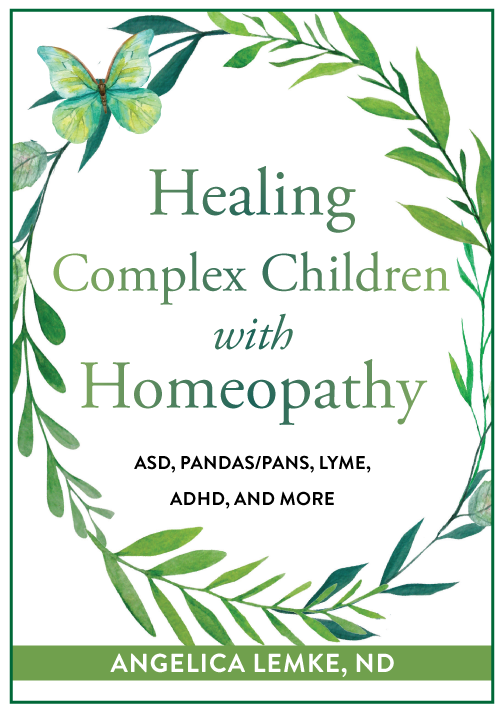
I no longer have school-aged youngsters but there is no escaping all the “back to school” stuff everywhere right now. To read some previous articles about some homeopathic remedies which may help with all the emotions that come along with heading back to the classroom, check these out: Today, though, I’m going to take a little different angle. School is school for most kids — but not all kids. “Among children 8 years in 2022, ASD (Autism Spectrum Disorder) prevalence was 32.2 per 1,000 children (one in 31)” (Shaw 2025). Almost 1 in 6 US children have a developmental disability (Zablotsky et al. 2019). That translates to an awful lot of kids who may need a little extra help in school. Angelica Lemke, ND has written a really amazing book and this little review is not going to do the book justice. Healing Complex Children with Homeopathy: ASD, PANDAS/PANS, LYME, ADHD, and more is a packed (400+ pages), but straightforward and clear book written by “a homeopath and naturopath who specializes in the complex cases of children through an empathic, heart-centered approach. She has empowered many of the parents she works with to ‘find the healer within’, using homeopathy to support their family and the health of their communities.” “Invit[ing] parents to be active participants in the healing of their children” (Lemke 2021*). Before you cast this book aside because the children in your life are not “complex” and don’t suffer from any of the above listed conditions, just know that this book is pretty much a good overview of homeopathic remedies and how to use them in general. I have read a gazillion books on homeopathy and this one provided me with more than a few “aha” nuggets. Here is a link for the table of contents and introduction so you can get an overview of what’s in it. “I wrote this book to empower parents, homeopaths, and healers to use their intuition, along with homeopathic remedies, to heal the growing number of today’s children who suffer from a wide range of complex conditions.” The keyword here for how Angelica works is “intuition.” She teaches parents how to tune into their intuition and their “inner knowing” to connect their child with an appropriate homeopathic remedy. Healing Complex Children begins with chapters on the history and practice of homeopathy and then dives right into miasms (see also: Miasms, a very brief introduction). Unlike most homeopathic books written for the general public, she doesn’t just touch on the explanation of miasms, she shows us how to see them in our children and includes information on some nosodes and what physical and mental symptoms to look for which may indicate the use of these remedies. Her conclusion to this chapter is a nice list of the miasms with key remedies for each. Chapter 4: Animal Remedies: what they are made from, why they would be prescribed and how to recognize the symptoms which may lead to an animal remedy. This chapter looks at lacs (milks), spiders, insects, birds, mollusks, fish, reptiles and amphibians. Within each sub-section is a list of “notable features” which can be found in complex children. Before describing those remedies, though, Lemke provides us with a short and sweet differential list of how these remedies may show up on the physical plane, followed by a few questions which may help find an animal remedy. Each sub-section has a generalized overview of the remedy family, followed by a succinct paragraph or two with a basic introduction to each remedy — as is the case for all her remedy write-ups, they are just enough to whet the appetite and send one digging further into the materia medica. Chapter 5: Plant Remedies: includes another nice little list of a few physicals/organs and some commonly associated remedies. She writes, “While there are thousands of plant remedies that could be included here, this chapter focuses on those that I have found to be most useful in complex children. In particular, plant remedies can be critical to help address pain sensations in the body. When a child is in pain and their life revolves around it, this is the main symptom that should be addressed and plants become prime candidates.” At this point, she has a sidebar/box with a little information about Gemmos and Bach flowers. I love Gemmos and Bach flowers and am always happy to see that info being shared!! Next are questions to help find a plant remedy, followed by each plant family with a short overview and then the paragraph or two of each remedy. Chapter 6: Mineral and Periodic Table Remedies: "Mineral remedies assist with issues of structure, function, and deficiency in the body… For children who are building up their bodies, their sense of self, and their ability to process information, mineral remedies are key to helping them develop in a solid, stable way.” Lemke touches on Jan Scholten’s Element Theory and proceeds essentially through the periodic table in her listing of remedies. Within the many sub-sections are tables listing the various remedies within certain elements, e.g. carbon-based remedies; the multiple Natrum remedies, Magnesia remedies, Kali remedies, etc. We are just over halfway through this book and the huge number of remedies already covered is impressive! Chapters 7 & 8: Nosodes & Sarcodes. As mentioned above, not many homeopathy books aimed at the general population (as opposed to being written for homeopaths) include much information on Nosodes and Sarcodes. Lemke lists core sensations, physical symptoms, and gastrointestinal symptoms which may lead to the use of a nosode, followed by how to use them. In my estimation, this chapter on nosodes alone is worth the price of admission. There is so much amazingly useful information here! There is also a really nice, long section on Lyme disease and concurrent co-infections. The Sarcodes section is divided into matridonal remedies and hormones, glands and neurotransmitters — again with a paragraph on each remedy. Sarcodes are another area where there is a dearth of useful information and Healing Complex Children helps to shed some light on these important remedies… what they are, how to use them, why to use them. She explains that, “the purpose of the treatment with a sarcode is to heal the tissue so it can go back to its normal job, not to replace the energy of the tissue, such as with thyroid medication.” Chapter 9: Tautopathy. Another topic for which good information is hard to find. This book is chock-a-block full of useful stuff! Chapter 10, the final chapter in the book, is “Remedies by Categories of Complex Kids.” Sub-sections include, among others: Children with Acute Rage and Panic; Highly Anxious Children; Sad, Serious Children; Angelic Children; Hyperactive Children and ends with Common Remedies for Parents, noting: “It is of utmost importance for parents to heal themselves along with their children.” There are plenty of “woo woo” ideas in this book, which I have heard some homeopaths object to, e.g. if they “flit” from one thing to the next, they may need a Butterfly remedy. Let’s be honest here — all homeopathy is a little “woo woo.” If you have a complex child for which nothing has been able to help, maybe finding a remedy based on the fact the child “flits” is exactly what that child needs! Going beyond her book, back in 2015, based on Angelica Lemke’s practice of focusing on special needs children, she began the School of Intuitive Homeopathy: “Integrating an intuitive approach with a traditional homeopathy foundation, creating a new paradigm for the future of medicine.” Courses include:
Healing Complex Children with Homeopathy is available in the usual places, but it’s also available on her own website. And, I’m really excited about this… I just learned this book is now available on Kindle. I have a well-loved, well-thumbed, dog-eared, underlined copy and I have been hoping for an electronic version because this is a book that I return to over and over again and now I can search it electronically. Yay!! If you are interested in learning homeopathy, don’t discard this book because “children” is in the title. Know that this book is an incredibly helpful overview of this amazingly powerful modality called homeopathy; touching on all the important topics and introducing us to many remedy families as well as a large range of individual remedies. Happy reading! Julia Coyte, CHom Classically Practical homeopath #wellnessawaits * All further quotes in this article are coming from Angelica Lemke’s Healing Complex Children with Homeopathy.
0 Comments
Your comment will be posted after it is approved.
Leave a Reply. |
Julia Coyte, CHomI am passionate about homeopathy and I love sharing this passion. Having a working knowledge of homeopathy shouldn't be kept a secret. If people have the ability to help themselves, their children and their friends when they have minor ailments, life just gets better for everyone. That is the purpose behind Ruminating on Remedies. Archives
October 2026
Categories
All
|
 RSS Feed